
AUGUST 2025:

Protest, Power, and the Faces of Dissent…
Aaron Sorkin has always been a dramatist of institutions. From The West Wing to The Social Network, his stories unfold in courtrooms, conference rooms, and committee hearings — places where words carry as much weight as action. With The Trial of the Chicago 7 (2020), Sorkin turns his rapid-fire dialogue and structural polish toward one of the most notorious legal spectacles of the 20th century: the prosecution of seven (and at times eight) antiwar activists following the 1968 Democratic National Convention in Chicago. The result is a courtroom drama that doubles as a meditation on dissent in a fractured democracy.


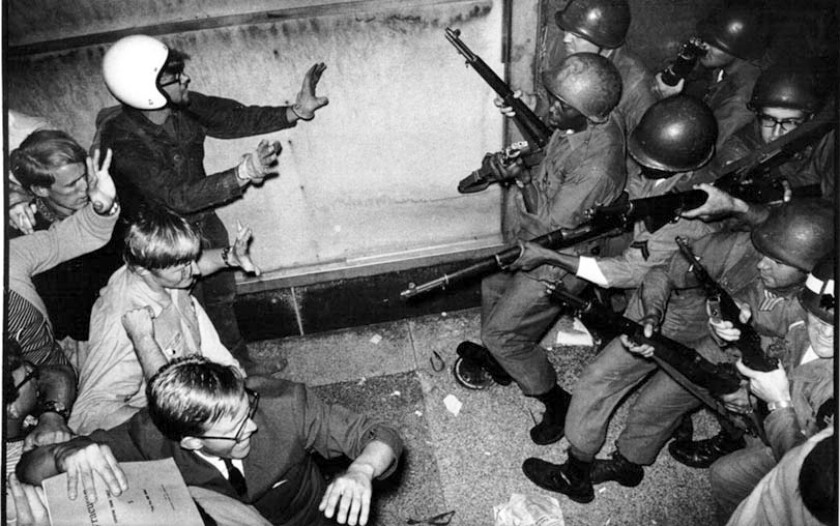
The film, with its ensemble of accomplished actors, dramatizes the trial with Sorkin’s characteristic flair for verbal combat, but three characters stand out above the rest: Tom Hayden, the buttoned-up reformer; Abbie Hoffman, the irreverent trickster; and Bobby Seale, the silenced outsider. Together, they embody the spectrum of protest in the late 1960s, from pragmatic liberalism to anarchic street theater to radical Black resistance. By focusing on their portrayals, we see how Sorkin shapes the legacy of dissent — and what it means to resist power in America.


A Trial Born of Crisis
Before diving into the characters, it’s important to situate the story. The protests at the 1968 Democratic Convention erupted at a moment of national crisis. The Vietnam War raged on, with body counts rising and public trust in government evaporating. Martin Luther King Jr. and Robert F. Kennedy had been assassinated earlier that year. Chicago’s Mayor Richard Daley responded to the prospect of demonstrations with overwhelming police force. The “police riot,” as it was later described, resulted in chaos, bloodied protesters, and a crisis broadcast on live television.


When Richard Nixon took office in 1969, his Justice Department wanted to make an example of the protest leaders. Eight men — Tom Hayden, Abbie Hoffman, Jerry Rubin, Rennie Davis, David Dellinger, John Froines, Lee Weiner, and Bobby Seale — were charged with conspiracy and crossing state lines to incite a riot. The trial that followed, presided over by the notoriously biased Judge Julius Hoffman, became a national spectacle. It wasn’t merely a question of guilt or innocence; it was a referendum on dissent, the Vietnam War, and the limits of democracy itself.


Sorkin condenses this sprawling history into a two-hour courtroom drama. While historical liberties are taken, the film frames the trial as a clash not just between government and protest, but between different visions of what protest should look like. And that is where Hayden, Hoffman, and Seale become central.

Tom Hayden: The Respectable Revolutionary

Eddie Redmayne’s portrayal of Tom Hayden offers one of the film’s most intriguing character studies. Hayden, a co-founder of Students for a Democratic Society (SDS) and the principal author of the 1962 Port Huron Statement, had long been committed to reshaping American democracy from within. Unlike the flamboyant Yippies or the militant Panthers, Hayden sought systemic reform through politics, policy, and persuasion.

In the film, Redmayne emphasizes Hayden’s cautious pragmatism. He is almost obsessively concerned with optics — whether the jury sees the defendants as patriots or provocateurs, whether the public perceives the movement as serious or chaotic. His clashes with Abbie Hoffman dramatize this tension. Where Hoffman sees theater as truth, Hayden sees it as sabotage. Their rivalry provides the film’s dialectic: should dissent work within the system, or mock and dismantle it?


Historically, Hayden did represent this respectable face of radicalism. After the 1960s, he transitioned into mainstream politics, serving for years in the California State Assembly and Senate. But Sorkin arguably sanitizes Hayden’s radical edge. The real Hayden was deeply critical of American institutions, not simply a reformist in waiting. By framing him as the moral compass of the Seven, Sorkin risks suggesting that Hayden’s path — earnest, restrained, institutionally oriented — is the “correct” model of dissent. Still, Redmayne’s performance captures the tension of a man caught between rebellion and responsibility, torn between youthful fire and political maturity.


Abbie Hoffman: Comedy as Revolution

If Hayden is the system’s reluctant interlocutor, Abbie Hoffman is its gleeful saboteur. Sacha Baron Cohen’s performance as the co-founder of the Youth International Party (the Yippies) is the film’s most colorful. Hoffman treats the courtroom as a stage, turning testimony into stand-up routines, mocking Judge Hoffman (no relation), and reveling in absurdity.

At first glance, Hoffman appears unserious, even clownish. But as the film develops, his humor emerges as strategy. In one memorable exchange, he insists that comedy is not frivolous, but a weapon — a way to expose power as ridiculous and illegitimate. Baron Cohen, known for his own brand of political satire, is perfectly cast. He captures Hoffman’s Boston accent, his irreverence, but also the sharp intelligence beneath the antics.


Historically, Hoffman was a master of media manipulation. He and Jerry Rubin staged protests that blurred the line between activism and performance art — from attempting to levitate the Pentagon to showering Wall Street with dollar bills. He believed revolution had to be both serious and surreal, capable of breaking through the monotony of politics-as-usual. Yet Hoffman’s life was also marked by tragedy. By the 1980s, he faced drug charges, depression, and eventual suicide.


Sorkin’s script, of course, “Sorkin-izes” Hoffman — giving him eloquent, polished monologues that sometimes sound more like Sorkin than Hoffman. But Baron Cohen grounds the role with enough wit and bite that it works. Hoffman, as portrayed here, is not merely comic relief but a prophet of absurdity, exposing the trial as farce by making it farcical.

Bobby Seale: The Silenced Outsider

If Hayden and Hoffman represent two poles of white radicalism, Bobby Seale represents something else entirely: the racial injustice embedded in the system itself. Played by Yahya Abdul-Mateen II in one of the film’s most devastating performances, Seale is portrayed as an outsider from the start. He was the national chairman of the Black Panther Party, but had no substantive role in organizing the Chicago protests. His inclusion in the indictment was nakedly political — an effort to link the antiwar movement to Black radicalism and to frighten the jury.

The film’s most harrowing moment comes when Seale, denied his right to counsel and repeatedly insisting he is not part of the conspiracy, is ordered by Judge Hoffman to be bound and gagged in the courtroom. Sorkin stages this sequence with unflinching brutality. The image of a Black man literally silenced in the supposed temple of justice is shocking, enraging, and unforgettable. Abdul-Mateen imbues Seale with dignity, fury, and anguish, capturing the horror of being erased not just politically but physically.


Historically, this event did happen, and it remains one of the darkest episodes in modern American judicial history. Eventually, Seale’s case was severed from the others, reducing the Chicago Eight to the Chicago Seven. But Sorkin truncates Seale’s story; after this climactic scene, he largely disappears from the narrative. Some critics argue this mirrors the very erasure the scene condemns — that the film sidelines Seale in favor of the white defendants. It’s a valid critique. Still, Abdul-Mateen’s performance ensures that Seale’s presence lingers, a haunting reminder that the struggle against systemic racism could not be reduced to the generational quarrels of white radicals.

Clash of Styles, Clash of Visions
By centering Hayden, Hoffman, and Seale, the film dramatizes the fault lines within the American left. Hayden represents reformist respectability; Hoffman, anarchic disruption; Seale, the Black revolutionary demand for justice. The three rarely intersect directly, but their juxtapositions are telling. Hayden worries about alienating Middle America; Hoffman insists Middle America must be jolted awake; Seale reminds us that Black Americans don’t even get the privilege of being heard in the first place.


The courtroom becomes a stage for these arguments, with Judge Julius Hoffman (Frank Langella) serving as the embodiment of institutional corruption and bias. His dismissive, sometimes openly hostile treatment of the defendants underscores the absurdity of the trial itself. In one sense, the defendants are on trial for conspiracy; in another, the very idea of dissent is on trial.

Courtroom Theater and Historical Resonance
Sorkin leans heavily on the metaphor of the courtroom as theater. This is fitting, since the real trial often played like performance art. Witnesses paraded in and out, protests erupted outside, and the defendants themselves turned the proceedings into a circus. Sorkin compresses and heightens these moments, giving us a trial that feels brisk, dramatic, and packed with rhetorical fireworks.

Mark Rylance as defense attorney William Kunstler serves as the audience’s guide through this chaos, weary but sharp, reminding us that even in the midst of farce, lives and futures were at stake. Joseph Gordon-Levitt, as prosecutor Richard Schultz, plays the rare Sorkin Republican — sympathetic but bound by duty. These side performances round out the drama, but it is the trio of Hayden, Hoffman, and Seale that give the film its heart and urgency.


The timing of the film’s release in 2020, amid the Black Lives Matter protests and political polarization of the Trump era, sharpened its resonance. Viewers could not miss the parallels between 1968 and the present: protesters clashing with police, generational divides over tactics, and the state’s attempt to criminalize dissent.


The Limits of Sorkin’s Approach
For all its power, The Trial of the Chicago 7 has its limitations. Sorkin’s style favors eloquence over messiness, clarity over complexity. The real trial stretched over months, filled with procedural chaos, ideological squabbles, and grueling testimony. Sorkin condenses this into sharp dialogue exchanges and polished climaxes. The result is compelling cinema but simplified history.

Most significantly, the film sidelines Bobby Seale after his binding-and-gagging scene, echoing the broader tendency in American culture to treat racial injustice as a moment of spectacle rather than a sustained narrative. Critics also note that Sorkin frames Hayden as the moral victor, implicitly privileging respectability over radicalism. This softens the more unsettling lessons of the trial — that dissent often looks unruly, uncomfortable, and divisive.

Yet these flaws do not erase the film’s achievement. Sorkin succeeds in making history accessible without stripping it of urgency. He turns transcripts into drama, ideology into dialogue, and history into something alive.

The Many Faces of Dissent
In the end, The Trial of the Chicago 7 is not simply about whether a group of activists conspired to incite a riot. It is about the struggle over how dissent is defined, who gets to speak, and how power responds when it is challenged. Tom Hayden’s measured pragmatism, Abbie Hoffman’s anarchic humor, and Bobby Seale’s anguished exclusion create a portrait of protest that is fractured, contradictory, and deeply human.

The film does not resolve these tensions — nor should it. Democracy itself is built on the clash of voices, the friction between reform and revolution, the persistence of those silenced. By dramatizing these conflicts, Sorkin reminds us that dissent is never neat, never unified, and never safe.

Hayden, Hoffman, and Seale each remind us of a different truth: that change can come through institutions, through spectacle, or through the raw demand for recognition. Taken together, they show us that dissent is not one face, but many — and that in 1968, as in 2020, the real trial was not just in the courtroom but in the court of public conscience.

The Trial of the Chicago 7 is available now with a subscription to Netflix…