Skip to content
CONNECT WITH US
https://moviestohistory.com/wp-content/uploads/2022/03/cropped-d3d0f4de5c874cf7a06b2f50e0bc7820-2-10.png

Movies To History.com

  • Home
  • About
  • Featured Film Blog
    • Film Critiques
    • Film Reviews
    • FIlm Recommendations
    • Video
  • Featured Television Blog
    • Television Critiques:
    • Television Reviews:
    • Television Recommendations:
    • Image
    • Video
  • Blog Posts
  • Contact Us
  • Subscribe
  • Oscar History
  • Top Ten List
Close Button

Television Recommendations:

Welcome to my Television Recommendations Page! This is where you will find all of the Recommendations from the Featured Television Blog of the month! It is organized in a television poster Table of Contents, so you can scroll down for the Television Recommendation your looking for easily!

AUGUST 2022:

Poster for the limited television series "1883" from Paramount + Network, starring Tim McGraw, Sam Elliott, Faith Hill and Isabel May, created, directed at times and written by Taylor Sheridan. Photo Cr: Paramount+ © 2022 MTV Entertainment Studios. All Rights Reserved. (2021-2022)
1883 (2020-21)

THE REAL WEST IN THE 1880’s…

While 1883 is not historically accurate of the West, it was not intended to be. It’s a dramatization of year within the Western History. Regardless of the pigeonhole, the series still touches on many elements of such a vast history through its drama. There was no way that Taylor Sheridan could cover the settlement of the West in a ten episode series focusing on one year. The entire expansion of the Western settlement occurred between 1860 – 1900, Sheridan simply took one group of pioneers and immigrants who possibly could have made the journey and dramatized that idea for television. But the series does include important elements of the history weaved into the Dutton family journey West to eventually become Montana ranchers. Congress does not admit Montana as a state until 1889, until then it remained an open plain territory.

Series poster from the Paramount+ original series 1883, Created and written by Taylor Sheridan. Photo Cr: Paramount+ © 2022 MTV Entertainment Studios. All Rights Reserved.
A photograph of the American Frontier West as it was being settled in the 1860's to 1900's. Photo Credit: Getty Images
Taylor Sheridan attends the world premiere of "1883" at Encore Beach Club at Wynn Las Vegas on December 11, 2021 in Las Vegas, Nevada. (Photo by Ethan Miller/Getty Images)
A drawing depicting of Settling The West. Photo Credit: Mr. Vanduyne.net
In this interactive map, explore several ways in which the United States experienced substantial growth between the years 1860–1890. Population centers, railroad networks, and improved agricultural lands are pictured in decade increments against base maps, reflecting natural barriers to growth and the presence of Native tribal populations. Photo Credit: cptv.pbslearningmedia.org
The European Wagon Train Expedition to Oregon as depicted on the Paramount+ limited series 1883. Created and written by Taylor Sheridan. Photo Credit: Paramount+
The wagon train expedition crosses The Red River to reach Doan's Crossing in a scene from the Paramount+ original series 1883, Created and written by Taylor Sheridan. Photo Cr: Paramount+ © 2022 MTV Entertainment Studios. All Rights
Gratiela Brancusi as Noemi and LaMonica Garrett as Thomas in a scene from the Paramount+ original series 1883, Created and written by Taylor Sheridan. Photo Cr: Paramount+ © 2022 MTV Entertainment Studio
Faith Hill as Margaret Dutton in a scene from the Paramount Network original series Yellowstone, Created and written by Taylor Sheridan. Photo Cr: Paramount Network © 2022 MTV Entertainment Studios. All Rights Reserved.
The Dutton Family on 1883: (L-R) James Dutton (Tim McGraw), Margaret Dutton (Faith Hill), Elsa Dutton (Isabel May), Claire Dutton (Dawn Olivieri) and Mary Abel Dutton (Emma Malouff) on the Paramount+ original series 1883. Photo Cr: Paramount+ © 2022 MTV Entertainment Studios. All Rights Reserved.
The Dutton Family: (L-R) Kelly Reilly as Beth Dutton, Kevin Costner as John Dutton III, Kelsey Asbillie as Monica Dutton, Wes Bentley as Jamie Dutton, Luke Grimes as Kayce Dutton, and Cole Hauser as Rip Wheeler from the Paramount Network original series Yellowstone, created and written by Taylor Sheridan. Photo Credit: Paramount Network. (2020) All Rights Reserved.
Kevin Costner as John Dutton III on Yellowstone Dutton Ranch, established in 1886 with the land settled by James Dutton in 1883, from the Paramount Network original series Yellowstone, Created and written by Taylor Sheridan. Photo Cr: Paramount Network © 2022 MTV Entertainment Studios. All Rights Reserved.
Map of the territory of Montana with portions of the adjoining territories Drawn by W. W. de Lacy for the use of the first legislature of Montana, 1865.
An early printing of the second attempt at a state constitution for Montana. The first constitution was drafted at the 1866 Constitutional Convention, but the document was lost en route to the printer and was never subject to a vote. The 1884 constitution printed in the present document was ratified, but Congress did not admit Montana to the Union. It was not until 1889 that Montana achieved statehood, with a third constitution.

CARRYING THE WEIGHT WEST…

Miners, farmers and ranchers led the way of the expansion into the western territories. Homesteading allowed settlers to claim acres of the land to then cultivate and build lives for themselves. This was a result of The Homestead Act of 1862, signed by Abraham Lincoln on May 20, 1862, and during the American Civil War, provided that any adult or intended citizen, who had never taken up arms against the U.S. Government could claim 160 acres of surveyed government land. The only thing required of the claimants was that they are required to live on and “improve” their plot by cultivating the land. Business in the West was able to prosper, due to the building of the first transcontinental railroad that connected the East to those western states. The railroad also made a quicker turnaround time on cattle to market, with trains as a new mode of quicker transport, better known as the Long Drive.

Miners during the Klondike Gold Rush, Yukon Territory, circa 1897. Photo Credit: Getty Images
Farmers in approximately 1852, with their land made made possible by The Homestead Act of 1852. Photo Credit: History.com
A rancher in approximately 1852, with land made possible through The Homestead Act of 1852. Photo Credit: familysearch.org
The Homestead Act of 1852, Page 1, Act of May 20, 1862 (Homestead Act), Public Law 37-64 (12 STAT 392); 5/20/1862; Enrolled Acts and Resolutions of Congress, 1789 - 2011; General Records of the United States Government, Record Group 11; National Archives Building, Washington, DC. [Online Version, https://www.docsteach.org/documents/document/homestead-act, August 2, 2022]
The Homestead Act of 1852, Page 2, Act of May 20, 1862 (Homestead Act), Public Law 37-64 (12 STAT 392); 5/20/1862; Enrolled Acts and Resolutions of Congress, 1789 - 2011; General Records of the United States Government, Record Group 11; National Archives Building, Washington, DC. [Online Version, https://www.docsteach.org/documents/document/homestead-act, August 2, 2022]
The Homestead Act of 1852, Page 3, Act of May 20, 1862 (Homestead Act), Public Law 37-64 (12 STAT 392); 5/20/1862; Enrolled Acts and Resolutions of Congress, 1789 - 2011; General Records of the United States Government, Record Group 11; National Archives Building, Washington, DC. [Online Version, https://www.docsteach.org/documents/document/homestead-act, August 2, 2022]
The Homestead Act of 1852, Page 4, Act of May 20, 1862 (Homestead Act), Public Law 37-64 (12 STAT 392); 5/20/1862; Enrolled Acts and Resolutions of Congress, 1789 - 2011; General Records of the United States Government, Record Group 11; National Archives Building, Washington, DC. [Online Version, https://www.docsteach.org/documents/document/homestead-act, August 2, 2022]
Scholars and enthusiasts alike believe this portrait of Abraham Lincoln, taken on November 8, 1863, eleven days before his famed Gettysburg Address, to be the best photograph of him ever taken. Lincoln’s character was notoriously difficult to capture in pictures, but Alexander Gardner’s close-up portrait, quite innovative in contrast to the typical full-length portrait style, comes closest to preserving the expressive contours of Lincoln’s face and his penetrating gaze. Photo Credit: Alexander Gardner
The Battle of Gettysburg (1863), lithograph by Currier & Ives. Photo Credit: Library of Congress, Washington, D.C. (LC-USZC4-2088)
Building of the Transcontinental Railroad, circa 1869. Photo Credit: Fotosearch/Getty Images
Prior to the arrival of railroads, logging was restricted to areas near a body of water. Animals were used to drag the cut trees to the river or lake. Oxen were the most popular but did not have nearly the pulling power of a locomotive. Logging with oxen, Snoqualmie Mill Company slough 1891. Photo Credit: Snoqualmie Valley Museum PO-40-264

THE FORGOTTEN SUFFRAGE….

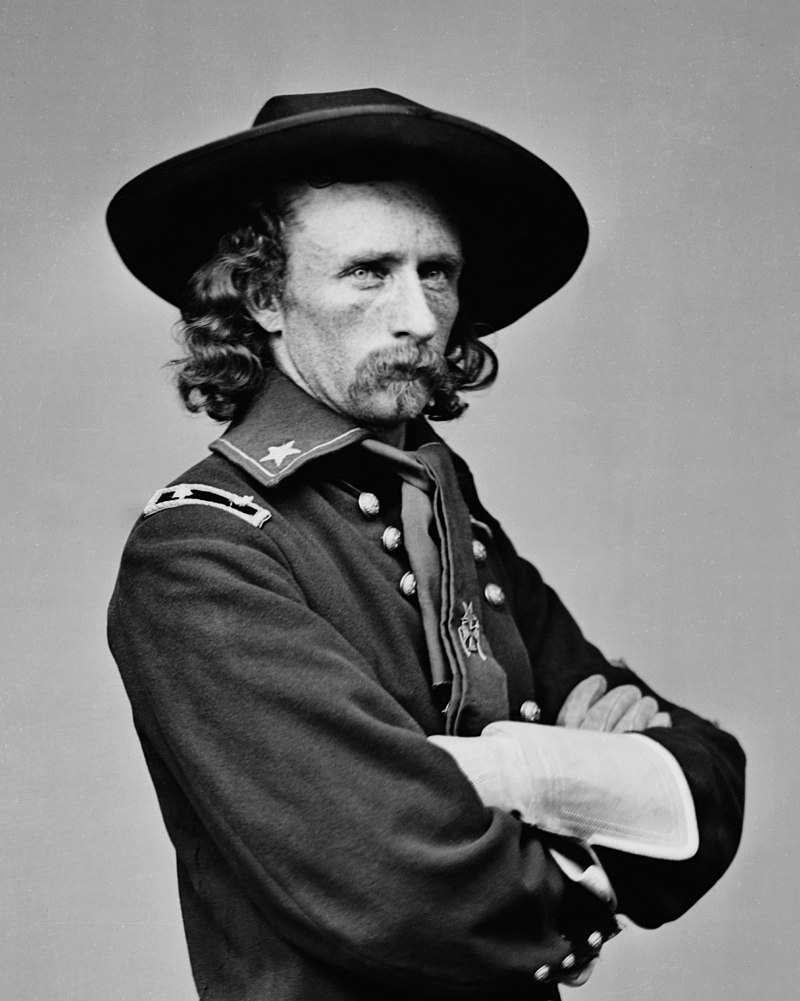
Yellowstone and 1883, also do a fair job of telling the Native American suffering as a result of the white settlers in the West. For centuries this land belonged to many groups of Native Americans, their lives were altered forever by the settlement of the West. The most famous of conflicts between the Native Americans and the U.S. Government is The Battle of Little Bighorn in 1876, involving Sitting Bull, Chief Gall along with Crazy Horse, and Lieutenant Colonel George Armstrong Custer. When prospectors overran the Lakota Sioux Reservation in the Dakota Territory to mine gold in the Black Hills, the Lakota saw no reason to abide by the treaty that settlers were breaking, so many of the Lakota left to hunt near the Bighorn Mountains in Montana. The U.S. Government responded by sending an expedition that was accompanied by Lieutenant Colonel George A. Custer and the Seventh Calvary. Custer underestimated the fighting ability of the Lakota and Cheyenne, and the rest is well, history.

Series Season 4 poster for the Paramount Network original series Yellowstone featuring Kevin Costner as John Dutton III, created and written by Taylor Sheridan. Photo Cr: Paramount Network © 2022 MTV Entertainment Studios. All Rights Reserved.
Series poster featuring Faith Hill, Tim McGraw, Sam Elliott and Isabel May for the Paramount+ original series 1883, created by Taylor Sheridan for Paramount+ and MTV Entertainment Group. (2021-2022)
An artist's drawing of Native American life before the settlement of the West. Photo Credit: BY Jan Mackell Collins
As explorers sought to colonize their land, Native Americans responded in various stages, from cooperation to indignation to revolt. Photo Credit: History.com
Pioneers looking ti settle in the West and the Native American they would cross paths with. Photo Credit: Qiuzlet
A Native American man looking at the Central Pacific Railroad, about 1869. Photo Credit: Courtesy of Library of Congress.
Important bullet points to remember when discussing the Native Americans and the settlement of the West. Photo Credit: Qizlet
First Report of the Battle of the Little Bighorn, From Gen. Alfred H. Terry, Montana, to Assistant Adjutant General R.C. Drum, Page 1, Chicago; 6/27/1876; Special Files of Letters Received, 1863 - 1885; Records of U.S. Army Continental Commands, Record Group 392; National Archives Building, Washington, DC. [Online Version, https://www.docsteach.org/documents/document/report-battle-little-bighorn, August 2, 2022]
First Report of the Battle of the Little Bighorn, From Gen. Alfred H. Terry, Montana, to Assistant Adjutant General R.C. Drum, Page 2, Chicago; 6/27/1876; Special Files of Letters Received, 1863 - 1885; Records of U.S. Army Continental Commands, Record Group 392; National Archives Building, Washington, DC. [Online Version, https://www.docsteach.org/documents/document/report-battle-little-bighorn, August 2, 2022]
The Native American Men responsible for The Battle of Little Bighorn in 1876, Crazy Horse, Chief Gall, and Sitting Bull. Photo Credit: MotArt
Brevet Major General George Armstrong Custer in field uniform. Photo Credit: Getty Images
Map showing the Great Sioux Reservation and current reservations. Photo Credit: Kmussler
The Dakota Territory in 1861. Photo Credit: Wikipedia.com
Charles T. Brown, a gold miner in San Gabriel Canyon, displays about $55 in gold in a pan. Photo Credit: (Los Angeles Times Archive / UCLA)
Needles Highway in the Black Hills of South Dakota. Photo Credit: Wikipedia.com
Big Horn range in Northern Wyoming
The Lakota people or the people of Standing Rock are one of the first original Native American tribes who inhabited the North Americas before the arrival of Europeans. Photo Credit: Lakotamall.com
Cheyenne-Men-1909

WE CALLED IT THE GREAT PLAINS, THEY CALLED IT HOME…

The Great Plains were home to many groups of Native Americans, some living in farming and hunting communities. But many were referred to as nomads who roamed the land following their source of food, the Buffalo. The plains Indians were divided into bands, they ranged anywhere from a few dozen to several hundred people. These bands of Native Americans lived in extended family groups and respected nature. The settlers who migrated to the plains to settle, deprived the Native Americans of their hunting grounds, and often forced the Native Americans off their land to relocate elsewhere. These relocations were often the result of broken treaties that guaranteed them land, agreed upon by the Native Americans and the U.S. Government. Native Americans resisted the settlement of the West by attacking the pioneers, their property and occasionally went to war with the settlers.

The Natives of the Great Plains are those Native American tribes living between the Mississippi River and the Rock Mountains. Their history is often divided between before the horse and after the horse. Horses first arrived in the 1600’s an became common by the 1700’s. Before the arrival of the horse, the Plains were sparsely populated, and the tribes were initially hunter-gathers. The only animal that was domesticated was the dog. Slowly in the 12th and 13th centuries man of the Plain Indians started to live together in larger villages and became at least part-time farmers. They grew corn, beans, and squash. The woman were primarily responsible for the farming while the men did much of the hunting. The area was full of large animals such as bison, deer, and elk. Photo Credit: Historycentral.com
Teepees as seen above were a typical dwelling of many Native Americans living on the Great Plains. They were usually made by arranging poles into a cone-shape frame, with an opening at the top to release smoke from fires that burned within the teepee, and then wrapping animal skins over the frame for insulation. Teepees were especially good for nomadic tribes or hunting parties because they were easily transported from one location to another, and provided protection from the weather. Fun Fact: Because of the adaptability of the teepee to prairie life, Gen. Henry Sibley used it as a model for the tent that bears his name. Photo source: Library of Congress
Horses were first introduced to Native American tribes via European explorers. For the buffalo-hunting Plains Indians, the swift, strong animals quickly became prized. Photo Credit: History.com
Distribution of North American Plains Indians. Photo Credit: Britainnica.com
Fort Laramie Treaty; 4/29/1868; Indian Treaties, 1722 - 1869; Page 1, General Records of the United States Government, Record Group 11; National Archives Building, Washington, DC. [Online Version, https://www.docsteach.org/documents/document/fort-laramie-treaty, August 2, 2022]
Fort Laramie Treaty; 4/29/1868; Indian Treaties, 1722 - 1869; Page 2, General Records of the United States Government, Record Group 11; National Archives Building, Washington, DC. [Online Version, https://www.docsteach.org/documents/document/fort-laramie-treaty, August 2, 2022]
Fort Laramie Treaty; 4/29/1868; Indian Treaties, 1722 - 1869; Page 3, General Records of the United States Government, Record Group 11; National Archives Building, Washington, DC. [Online Version, https://www.docsteach.org/documents/document/fort-laramie-treaty, August 2, 2022]
Fort Laramie Treaty; 4/29/1868; Indian Treaties, 1722 - 1869; Page 4, General Records of the United States Government, Record Group 11; National Archives Building, Washington, DC. [Online Version, https://www.docsteach.org/documents/document/fort-laramie-treaty, August 2, 2022]
Battles, army posts, and the general location of tribes in the American West, Photo Credit: Wikipedia.com
Westward expansion brought about numerous wars between Native Americans and colonists during the 18th and 19th centuries. As had occurred before elsewhere on the American continents, the Native Americans rebelled against invasion and occupation. Some of the most bellicose tribes were the Sioux and the Apaches, whose battles and skirmishes against the United States Army have been portrayed in innumerable Westerns. In this post, we’ll tell you about some episodes of the most famous Indian wars of the 19th century. Photo Credit: Oasysparquetmatico.com
Between 1622 and the late 19th century, a series of wars and skirmishes known as the Indian Wars took place between American-Indians and European settlers, mainly over land control. Photo Credit: History.com
Council of Sioux chiefs and leaders that settled the Indian wars, Pine Ridge, South Dakota; 1891; Records of the Office of the Chief Signal Officer, Record Group 111. [Online Version, https://www.docsteach.org/documents/document/council-of-sioux-chiefs-and-leaders-that-settled-the-indian-wars-pine-ridge-south-dakota, August 2, 2022]
Nez Perce Indian Wars, graves of soldiers and civilian scouts killed.; ca. 1881 - ca. 1885; Records of the War Department General and Special Staffs, Record Group 165. [Online Version, https://www.docsteach.org/documents/document/nez-perce-indian-wars-graves-of-soldiers-and-civilian-scouts-killed, August 2, 2022]

FROM A FRONTIER TO A UNITED STATES OF AMERICA…

The United States was still a massive frontier, with only 38 states in 1880. Immigrants helped increase the American population from 31 million in 1860 to more than 50 million in 1880, as pioneers pushed westward into that massive frontier. While the United States remained a largely rural nation with many settlers in villages and working on farms as ranchers. This did allow the rural population to continue to grow in the late 1800’s, but with it, the urban population that grew more rapidly. But as America entered 1900, a majority of American’s still lived in rural areas.

North America in 1880. Photo Credit: Reddit
Pioneers on the frontier in 1880 settling West. Photo Credit: PBS.com
Chester A. Arthur was officially chosen as Garfield's vice presidential running mate in 1880. Selected to appease the Stalwart faction of the Republican Party, Chester Arthur had never run for elected office prior to his nomination. Photo Credit: Library of Congress
1880 Census Schedule for 97 Orchard Street, Lower East Side of Manhattan; ca. 1880; Page 1, Tenth Census of the United States, 1880; Records of the Bureau of the Census, Record Group 29; National Archives Building, Washington, DC. [Online Version, https://www.docsteach.org/documents/document/1880-census-schedule-for-97-orchard-street, August 3, 2022]
1880 Census Schedule for 97 Orchard Street, Lower East Side of Manhattan; ca. 1880; Page 2, Tenth Census of the United States, 1880; Records of the Bureau of the Census, Record Group 29; National Archives Building, Washington, DC. [Online Version, https://www.docsteach.org/documents/document/1880-census-schedule-for-97-orchard-street, August 3, 2022]
1880 Census Schedule for 97 Orchard Street, Lower East Side of Manhattan; ca. 1880; Page 3, Tenth Census of the United States, 1880; Records of the Bureau of the Census, Record Group 29; National Archives Building, Washington, DC. [Online Version, https://www.docsteach.org/documents/document/1880-census-schedule-for-97-orchard-street, August 3, 2022]
America Circa 1880. Photo Credit: AmericasBestHistory.com
Urban Life in America in 1880. Photo Credit: Americainclass.org
Photograph 90-G-125-9; Photograph of Immigrants Outside a Building on Ellis Island; ca. 1900; Public Health Service Historical Photograph File, 1880 - 1943; Records of the Public Health Service, Record Group 90; National Archives at College Park, College Park, MD. [Online Version, https://www.docsteach.org/documents/document/immigrants-outside-ellis-island, August 3, 2022]

A CONNECTION IS MADE…

Between 1865 and 1900, the American West saw the completion of the railroads to the West following the end of the Civil War. It opened up vast areas of the massive frontier to settlement and economic development. Eastern White settlers came through the Mississippi River to mine, farm and ranch. African American settlers had also come West from the Deep South, on the notion that prosperity could be found in all-black Western towns. The diversity of the population in America was increased by the number of Chinese railroad workers that settled in the region.

After the Civil War, the United States was convulsed with change. A technological revolution was taking place, and miles of new railroad tracks connected the nation as never before. As historian Kenneth Ackerman observed: "the energy of war was now channeled into building railroads, factories, and mines. Photo Credit: PBS.com/Library of Congress
East and West Shaking Hands at Laying Last Rail." Ceremony for the driving of the golden spike at Promontory Summit, Utah on May 10, 1869. Photograph by Andrew J. Russell. Public Domain.
Artwork 30-N-38-1364; Pony Express Station; 1880; Roads and Trails - Pony Express; Historical Photograph Files, 1896 - 1963; Records of the Bureau of Public Roads, Record Group 30; National Archives at College Park, College Park, MD. [Online Version, https://www.docsteach.org/documents/document/pony-express-station, August 3, 2022]
More than 750,000 men died in the Civil War. Americans felt the profound loss deeply, and James Garfield was no different. He would later recall that when he came upon a group of men that looked as if they were sleeping, something went out of him that never came back – "the sense of the sacredness of life and the impossibility of destroying it. Photo Credit: PBS.com/Library of Congress
Bird's-eye view of New Orleans with the Mississippi River in the foreground; prominent building and place names are listed below the image. Contributor Names  Currier & Ives. Created / Published  New York : Published by Currier & Ives, c1885.
Colorado Miners. Photo Credit: University of Colorado
S. Timmons farm, Walla Walla County, ca. 1892 Photo by F. Fortin, Courtesy UW Special Collections (WAS0304)
The cowboy, the quintessential symbol of the American frontier. Photo by John C. H. Grabill, c. 1887
These four people moved from Tennessee to Nicodemus, Kansas as part of the Exodusters movement. Library of Congress, Prints & Photographs Division, HABS KANS,33-NICO,1–6
Construction of the roadway on the Brooklyn Bridge in 1880. Photo Credit: Getty Images
Act of February 4, 1887 (Interstate Commerce Act), Page 1, Public Law 49-41, 49 STAT 379.; 2/4/1887; Enrolled Acts and Resolutions of Congress, 1789 - 2011; General Records of the United States Government, Record Group 11; National Archives Building, Washington, DC. [Online Version, https://www.docsteach.org/documents/document/interstate-commerce-act, August 3, 2022]
Act of February 4, 1887 (Interstate Commerce Act), Page 2, Public Law 49-41, 49 STAT 379.; 2/4/1887; Enrolled Acts and Resolutions of Congress, 1789 - 2011; General Records of the United States Government, Record Group 11; National Archives Building, Washington, DC. [Online Version, https://www.docsteach.org/documents/document/interstate-commerce-act, August 3, 2022]
Chinese workers on the Central Pacific Railroad. Credit...Amon Carter Museum of American Art Archives, Fort Worth, Texas. Photo Credit: New York Times

THE GREAT PLAINS BECOMES WESTWORLD…

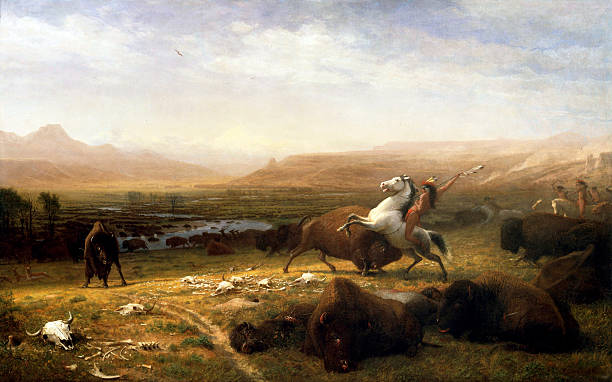
The Great Plains was transformed by settlement from the East. The American Bison that moved in large herds and roamed the plains were almost wiped out, and so the farmers of the region plowed the natural grasses to be able to plant wheat and other crops. The cattle industry saw a rise in importance as the railroad now provided a practical means for getting the cattle to market. Cattle ranching will become an important business for the Great Plains. This would also allow the government to create an open range for cattle drives, where vast areas of grassland that the federal government owned could be used by ranchers to graze their herds free of charge and be unrestricted by private property.

Custer County, Nebraska: Food And The Consumer. When colonists landed on the shores of the "new world" America, they found an abundance of natural resources, fertile soil and a good climate for growing food. Even the "sod house" settlers of the Great Plains were able, with determination, to develop substantial diets, including the luxury of a watermelon to be split on a summer afternoon. Similar to this family living on the farm of Omer Kern in Bow, Custer County, Nebraska. Today, with the constant development in agriculture, people living in the U. S. are among the best fed in the world.
The Moses Speese family sits for a portrait outside their sod house on the prairie, Westerville, Nebraska, 1888. (Photo by Solomon Butcher/Underwood Archives/Getty Images)
circa 1885: A family outside their sod home out on the Great Plains. (Photo by MPI/Getty Images)
Frederic Remington (American, 1861–1909), The Buffalo Hunt, 1890, oil on canvas , 86.4 × 124.5 cm (34 × 49 in), Buffalo Bill Historical Center, Cody, Wyoming. (Photo by VCG Wilson/Corbis via Getty Images)
Albert Bierstadt (American, 1830–1902), The Last of the Buffalo, c. 1888, oil on canvas, 153 × 245.1 cm (60.2 × 96.5 in), Buffalo Bill Historical Center, Cody, Wyoming. (Photo by VCG Wilson/Corbis via Getty Images)
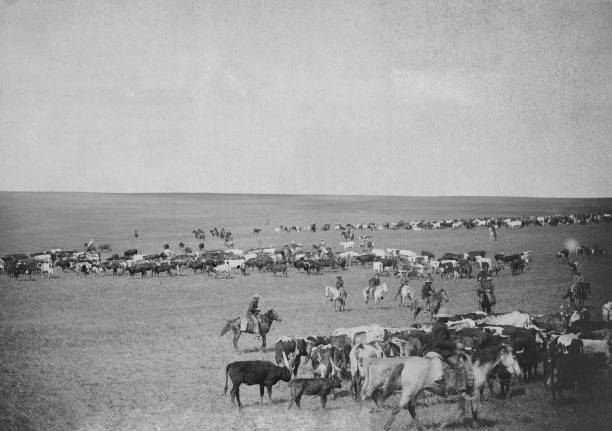
American West Cattle Drive. Photo Credit: Public Domain
The Cattle Industry in the 1880's. Photo Credit: AGDaily.com
Roundup on the Sherman Ranch, Genesee, Kans. Cowboy with lasso readied looks beyond the herd on the open range to his fellow cowpunchers waiting on the horizon; ca. 1902; Records of the War Department General and Special Staffs, Record Group 165. [Online Version, https://www.docsteach.org/documents/document/roundup-on-the-sherman-ranch-genesee-kans-cowboy-with-lasso-readied-looks-beyond-the-herd-on-the-open-range-to-his-fellow-cowpunchers-waiting-on-the-horizon, September 3, 2022]

RESERVED CONFINEMENT…

The growth of white settlement and the loss of bison affected the lives of the Native Americans that lived in the western plains. Native Americans would have occasional victories in the conflicts that resulted but seemed doomed to defeat the greater number of settlers in the region and the military force of the United States government. By the 1880’s, most Native Americans had been confined to reservations, and often in areas of the West that white settlers found to be less desirable.

A Blackfoot Indian family, father, mother, two children, and a pet dog, sit outside their teepee tent house on the Great Plains, Blackfeet Indian Reservation, Montana, 1887. (Photo by George Eastman Museum/Getty Images)
A group of horses graze in the foreground as a Blackfoot Indian encampment spreads into the background behind them, Blackfeet Indian Reservation, Montana, 1887. Text reads 'Indian Camp, Blackfoot Reserve' and 'Wm. Notman & Sons, Photo., Montreal.' (Photo by William McFarlane Notman/George Eastman Museum/Getty Images)
A group of horses graze in the foreground as a Blackfoot Indian encampment spreads into the background behind them, Blackfeet Indian Reservation, Montana, 1887. Text reads ‘Indian Camp, Blackfoot Reserve’ and ‘Wm. Notman & Sons, Photo., Montreal.’ (Photo by William McFarlane Notman/George Eastman Museum/Getty Images)

COWBOY UP…

In the late 19th century, cowboys became the representation of the West, and were often depicted in pop culture with glamour and heroism. This myth, however, is inaccurate to the history. The first cowboys to exist were called Spanish vaqueros and had introduced cattle to Mexico centuries earlier. Black cowboys also roamed the Western frontier in the late 1800’s. The truth to the life of a cowboy was that it was far from glamorous and involved long, hard hours of labor with usually poor living conditions and an economic hardship to go with their glamour.

19th century American West pair of men driving stagecoach drawn by team of six horses through rugged landscape (Photo by H. Armstrong Roberts/ClassicStock/Getty Images)
'Cowboy on Horseback' by Detroit Publishing Co. Between 1898 and 1905. Photo Credit: Library of Congress via Wikimedia Commons / Public Domain
Fashion, clothing in North America, end of the 18th - end of the 19th century, cowboy in various clothes, with cotton shirt, over-leg gowns, jerkin, hat, boots, digital improved reproduction from an original from the year 1900. (Photo by: Bildagentur-online/Universal Images Group via Getty Images)
18th-century soldado de cuera in colonial Mexico, depicted similarly to the Spanish vaqueros. Photo Credit: Wikimedia Commons
Southwestern Cowboy Wearing Buffalo Chaps, And Armed With A Pearl Or Ivory-Gripped Colt Model 1878 Double Action 'Frontier' Revolver. 'Ed W. Ecker'. Semi-Arid Desert Landscape, Holding A Wide-Brim Hat By His Side. (Photo by Buyenlarge/Getty Images)
An African-American cowboy sits saddled on his horse in Pocatello, Idaho in 1903. Photo Credit: Corbis
This image appeared in cowboy Nat Love's privately published autobiography. Photo Credit: Corbis
Bob Lemmons, Carrizo Springs, Texas. Born a slave about 1850, south of San Antonio. Came to Carrizo Springs during the Civil War with white cattlemen seeking new range. In 1865, with his master was one of the first settlers. Knew Billy the Kid, King Fisher, and other noted bad men of the border. Artist Dorothea Lange. (Photo by Heritage Art/Heritage Images via Getty Images)
This trade card advertises cotton spools from the Clark Thread company and depicts a cowboy with a background of cows and a rising sun. Artist unknown, 1894 (Photo by Pierce Archive LLC/Buyenlarge via Getty Images)

HISTORY’S MYTH…

The myth of the cowboy is one of many in history that have shaped our views when it pertains to the West in the late 19th century. Historians have turned away from the once traditional view of the Western frontier, and instead choose to write that the West was a meeting point between civilization and savagery. Historians have begun to write about the Western frontier as a sort of crossroads of cultures, where many diverse groups of people struggled for property, profit and cultural dominance.

"Emigrants Crossing the Plains." Engraving 1869. Photo Credit: Getty Images
Horse-drawn stagecoach carrying by formally dressed women, children, and men circa 1890. (Photo by Buyenlarge/Getty Images)
Several ox teams and wagons in a valley in 1890. (Photo by Buyenlarge/Getty Images)
Small group of men and women and two deer in front of a tent. Some of the men are playing musical instruments, circa 1890. (Photo by Buyenlarge/Getty Images)
Line of oxen and wagons along main street, 1890.  (Photo by Buyenlarge/Getty Images)
Deadwood Street Parade in 1890. (Photo by Buyenlarge/Getty Images)
A group of prospectors poses with their equipment and a heavily laden horse as they prepare to go somewhere, Northwestern United States, 1867. (Photo by Hulton Archive/Getty Images)
Illustration depicting a messenger on horseback bringing news of a Native American uprising. Engraving by Naumanns. Photo Credit: Getty Images
Cowboys drink and play card games in a saloon circa 1890. (Photo by American Stock/Getty Images)

WHEN MYTH MEETS REALITY…

The cowboy will forever be an iconic symbol of the American West despite the reality being very different for cowboys in the 1880’s. The lonely life and grueling physicality that it took to cowboy is not as iconic as a symbol as one that sees them as heroic. But cowboys were some of the hardest working people in the Western frontier. Cowboys did everything from working cattle drives and herding cattle to caring for horses while also repairing fences and buildings in the frontier towns they would often live in. They were not always welcome in these frontier towns, as they traveled for work, due to the reputation of a cowboy being seen as drunk, disorderly and even violent. But the work of cowboys in the states west of the Mississippi River would greatly impact the beef industry in America in 1880’s.
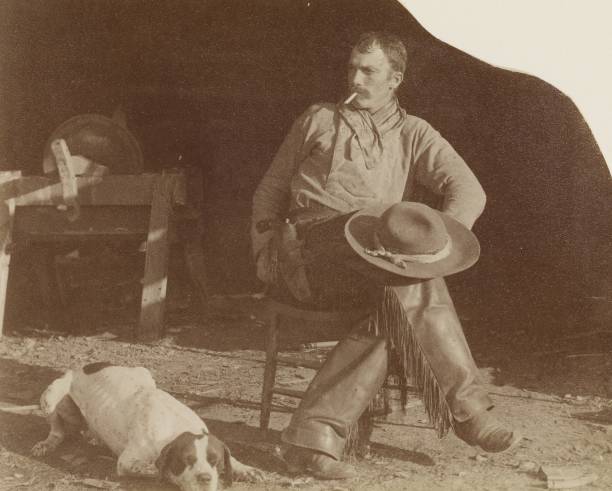
Cowboy at the B-T Ranch, Missouri Territory, Thomas Eakins (American, 1844 - 1916), 1887, Albumen silver print, 8.7 x 11.3 cm (3 7/16 x 4 7/16 in.) (Photo by: Sepia Times/Universal Images Group via Getty Images)
Cowboy Camp And Chuck Wagon- Cowboys Are Not Back In From The Range, But Supper Will Be Ready For Them When They Arrive. 'Cowboy Life On The Plains', From Denver, Colorado North To Cheyenne, Wyoming. Cowboy Camp And Chuck Wagon. (Photo by C.D. Kirkland/Buyenlarge/Getty Images)
Inspecting a Brand on the Prairies', circa 1897. From "A Tour Through the New World America", by Prof. Geo. R. Cromwell. [C. N. Greig & Co., London, circa 1897]. Artist Unknown. (Photo by The Print Collector/Getty Images)
Round-up scenes on Belle Fouche in 1887. (Photo by: HUM Images/Universal Images Group via Getty Images)
The Spring Round-Up' Ca 1880S-90S - Roping Can't Kick. Title; Roping A Texas Steer - Caught, Thrown, Heeled And Stretched. The Spring Round-Up' -Roping A Texas Steer. (Photo by L.A. Huffman/Buyenlarge/Getty Images)
19th century American West two men driving stagecoach drawn by team of six horses arriving in frontier town (Photo by H. Armstrong Roberts/ClassicStock/Getty Images)
Briggs Hotel/ Stage Stop, Carson, Nevada, Ca. 1890S. Briggs House In Carson, Nevada Was Also A Stage Stop According To Posted Sign, 'Briggs House Meal 25C Stage Office To Lake Tahoe And All Points South' Chinese Cooks, One Black Man, And Miscellaneous Town Folks. (Photo by Buyenlarge/Getty Images)
The Day The Circus Came To Town. A Parade Of Circus Wagons Makes Its Way Down The Dusty Main Street To The Delight Of Scattered Onlookers. El Paso - The Day The Circus Came To Town. (Photo by F. Parker/Buyenlarge/Getty Images)
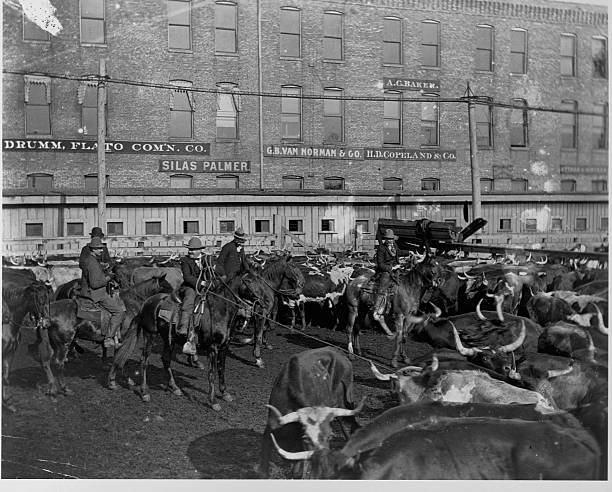
Cowboys in Chicago Stockyards. (Photo by Ray Stannard Baker/Library of Congress/Corbis/VCG via Getty Images)
Midwest frontier town. Typical street scene after an eye witness sketch by R. F. Zogbaum, 1887.
Buffalo Bill: Attack on Stagecoach in 1885. (Photo by Buyenlarge/Getty Images)
William Frederick " Buffalo Bill" Cody (1846-1917), American Plainsman, Scout & Showman, unidentified artist, 1887. (Photo by: Universal History Archive/Universal Images Group via Getty Images)
Buffalo Bill and the Red Indian Chiefs from his wild west show. (Photo by: Universal History Archive/Universal Images Group via Getty Images)
Portrait of American cowboy, scout, professional gambler and gunfighter Wild Bill Hickok (1837 - 1876) (right), here acting as Marshal, shoots and kills saloon owner Phil Coe and fellow law man Mike Williams in response to a noise complaint, Abilene, Kansas, Ocotber 5, 1871. (Photo by American Stock/Getty Images)

HISTORIC BEEF…

The Spanish vaqueros mentioned before, were ranching in what is now Texas before American settlers even arrived. They were responsible for building ranches for cattle and other livestock when they introduced the cattle to Mexico, long before the American cowboy decided it was a good idea. By 1519, indigenous cowboys were being hired by the Spanish vaqueros to tend to the cattle. American cowboys adopted the skills in the 19th century that they were known for, roping, riding and herding.

Vaquero, c. 1830. Photo Credit: Wikipedia Commons
Mexican vaqueros would inspire American cowboys with every aspect of their work. Photo Credit: History.com
Miller Brothers 101 ranch circa 1800's on Kay County, Oklahoma. Photo Credit: Wikipedia Commons
Vaqueros in Western Town circa 1800's. Photo Credit: thestoryoftexas.com

A COWBOY RISES…

After the American Civil War came the rise of the American cowboy. Due to many Texas ranchers going off to fight in the name of the Confederacy, they left their ranches unattended. Texas ranchers arrived back to their land and found their cows had bred excessively and there were now an estimated 5 million cattle in Texas. But with supply, comes demand. There was a high demand for beef increasing in the north, which had effectively used up its beef supply during the war. Ranchers decided to hire cowboys to help maintain the excessive herds of cattle and bring them north for market. American cowboys didn’t just adopt the skills of the Spanish vaqueros, they adopted their dress and lifestyle as well. They would also use their methods of cattle driving when moving north.

On April 9, 1865, General Robert E. Lee surrendered his Confederate troops to the Union’s Ulysses S. Grant at Appomattox Court House, Virginia, marking the beginning of the end of the grinding four-year-long American Civil War. But it would be more than 16 months before President Andrew Johnson would declare a formal end to the conflict in August 1866. Photo Credit: History.com
Heading a stamped: A cowboy's life, 1888, United States, Washington. Library of congress, . (Photo by: Photo12/Universal Images Group via Getty Images)
Farm House 1890's -  Typical Large Family In Front Of Farm House On The Plains. (Photo by Buyenlarge/Getty Images)
Rancher And Son, Circa 1890's. - Rancher Poses With His Horses And His Toddler Son, With Cattle Pens In The Background. (Photo by Buyenlarge/Getty Images)
Cowpoke On The Ranch, Circa 1890S.- Posed Near The Front Porch Of A Ranch House. His Heavy Leather Chaps Sport Silver Conches Down The Side, And He Holds His Pistol At The Ready. (Photo by Buyenlarge/Getty Images)
Cowboy, 1898. Photographed In 1898 Atop His Horse, A Young Man In Suit Jacket And Knee-High Leather Boots Poses With Several Wood-Frame Buildings In The Background. (Photo by Buyenlarge/Getty Images)
The Cowboys Of Colorado--Lassoing And Branding Calves circa 1890's. Photo Credit: Getty Images
Cowboy going after a steer that has left the herd during a cattle drive: Montana. Engraving, 1885. (Photo by: Photo 12/Universal Images Group via Getty Images)
Great Image Of Cowboys At Round-Up On The 3-C Ranch Four Cowboys On Horseback Watching Over A Group Of Nearby Ponies. Two Men Work The Chuck Wagon As Another Cowboy Reclines Amid Bed Rolls And Bagged Supplies. (Photo by Buyenlarge/Getty Images)
Five Cowboys Tending A Large Herd Of Cattle Near Colorado Springs. 1896 Colorado Springs Scenic View. (Photo by W.E. Hook/Buyenlarge/Getty Images)
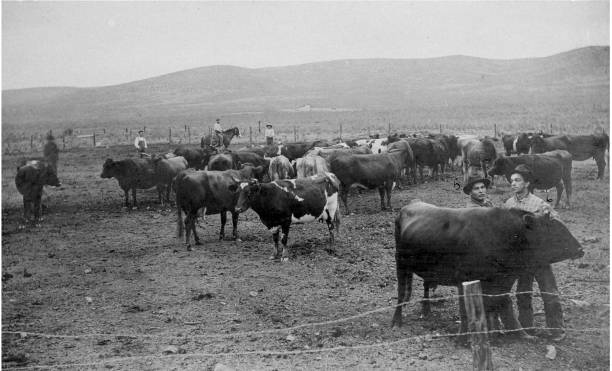
Cattle With Cowboys In Fenced Area Weiser, Idaho 1890S - This Large Photograph Of Cowboys On Horseback Tending To Cattle. Fenced In Cattlemen. (Photo by D. Marsh/Buyenlarge/Getty Images)

WITH ACCESS, COMES INDUSTRY…

Meanwhile, with more railroads being built throughout the 19th century in the United States, there was more accessibility to the West, which meant an increase of areas for settlement, agriculture and economic development. America saw diversity to ranching, farming and mining through African Americans and Chinese railroad workers traveling to the new states. With Bison basically being hunted to extinction by the 1870’s, cattle became the primary industry in Texas and throughout the United States. And with trains being able to send the herds north for market the industry only grew larger for southern farmers.

Stereoscopic image showing unspecified engineers employed by consulting engineer William Lafayette Darling, two using theodolites mounted on tripods, during construction of the Northern Pacific Railway, location unspecified, United States, circa 1880. On completion, the railroad ran for approximately 6,800 miles, serving the states of Idaho, Minnesota, Montana, North Dakota, Oregon, Washington, and Wisconsin. (Photo by F. Jay Haynes/Graphic House/Archive Photos/Getty Images)
This photo depicts a Northern Pacific Railway (USA) section crew. The unidentified crew members and, what appears to be family, 1880's. (Photo by: Ann Ronan Picture Library/Photo12/Universal Images Group via Getty Images)
Black Diamond Express, Lehigh Valley Railroad, Pennsylvania, Jackson, William Henry, 1843-1942, Railroads, Rivers, United States, Pennsylvania, Lehigh River, 1898 (Photo by: Sepia Times/Universal Images Group via Getty Images)
Lloyds Map of the Southern States showing all the Railroads, their Stations & Distances, Published by James T Lloyd, New York, 1862. (Photo by: GHI Vintage/Universal History Archive/Universal Images Group via Getty Images)
1890: Ranchers at the Buena Vista farm. (Photo by MPI/Getty Images)
An farm in the California prairie, United States of America, drawing by Theodor Alexander Weber (1838-1907) from a photograph, from The White Conquest, 1875, by William Hepworth Dixon (1821-1879), from Il Giro del mondo (World Tour), Journal of geography, travel and costumes, Volume IV, Issue 6, July 6, 1876.
Unspecified coal miners stand around the entrance to a mine, around the tracks of a mine railway, a donkey pulling a cart emerging from the darkness of the tunnel, in Fargo, North Dakota, circa 1885. The image is one half of a stereoscopic image. (Photo by Graphic House/Archive Photos/Getty Images)
Breaker boys, coal-mining workers, anthracite mine, Wyoming valley, Pennsylvania, United States of America, illustration from the magazine The Graphic, volume XIV, no 359, October 14, 1876.
Chinese labourers engaged to work on the American Transcontinental Railroad system, 1880. (Photo by: Pictures from History/Universal Images Group via Getty Images)
Chinese workers greet a train on a snowy day on the Central Pacific Railroad in the Sierra Nevada Mountains. From a sketch by Joesph Becker, 6 February 1870. (Photo by: Pictures from History/Universal Images Group via Getty Images)
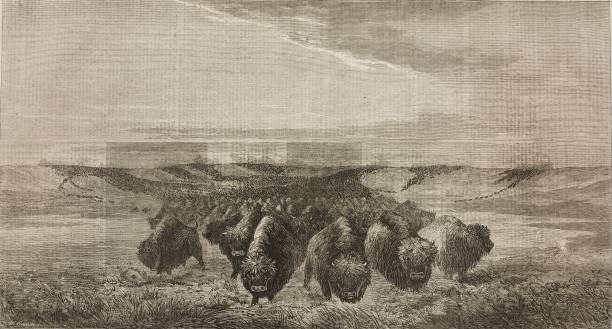
A herd of bisons crossing a river bottom on the upper Missouri, engraving from the painting by Hays, illustration from the magazine The Illustrated London News, volume XLI, December 6, 1862.
Engraving depicting men hunting bison. Dated 19th century. (Photo by: Universal History Archive/Universal Images Group via Getty Images)
This tradecard for Arbuckle Bros. is part of a set of cards presenting a pictorial history of the United States and territories. This card shows a colored map of the state of Texas. There is an image of ranchers with a large herd of cattle in a vast field. Two ranchers in the foreground lasso two bulls who strayed away from the herd. Artist unknown, 1889 (Photo by Pierce Archive LLC/Buyenlarge via Getty Images)
St. Louis Beef Canning Co. uses a cowboy scene to sell its beef on this trade card published circa 1880 in New York City. (Photo by Transcendental Graphics/Getty Images)
1878: Texas Long Horn cattle being driven to a cattle rendevous in Dodge City. Original Artwork: Engraving from a drawing by Edward Rapier in Frank Leslie's Illustrated Newspaper. (Photo by MPI/Getty Images)
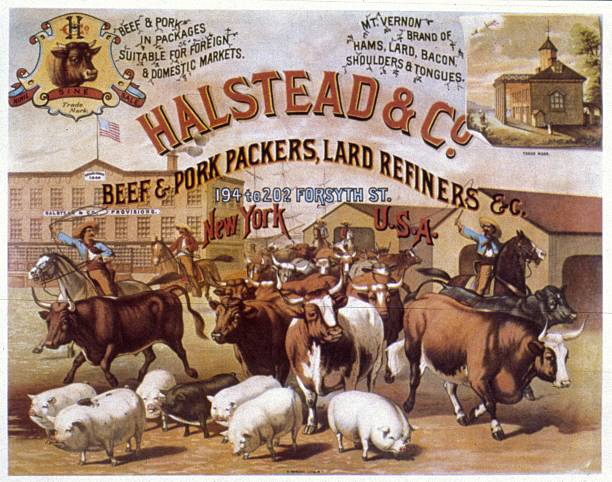
An advertisement for the Halstead Company Beef and Pork packers, New York, which features cowboys rounding up cattle and other livestock. (Photo by MPI/Getty Images)
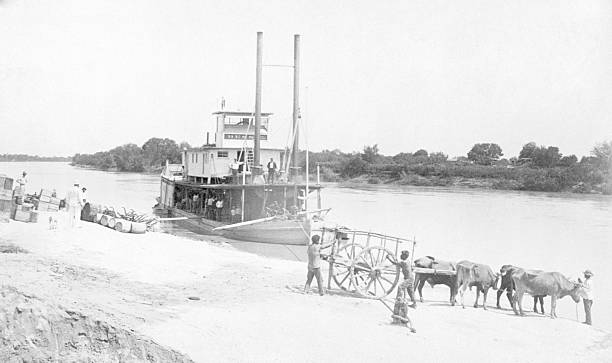
The steamer Bessie, on the Rio Grande River, loading up at Fort Ringgold, Texas en route to Brownsville, circa 1890. | Location: Rio Grande River, Texas, USA. (Photo by © CORBIS/Corbis via Getty Images)
Photograph of Shipping Point for Texas Cattle in Kansas, circa 1867.  (Photo by Fotosearch/Getty Images)
Sugar cane field in South Carolina, United States of America, drawing by Edouard Riou (1833-1900) from a photograph, from The White Conquest, 1875, by William Hepworth Dixon (1821-1879), from Il Giro del mondo (World Tour), Journal of geography, travel and costumes, Volume V, Issue 14, March 8, 1877.

SENSIBLE STYLE AND TEN GALLON HATS…

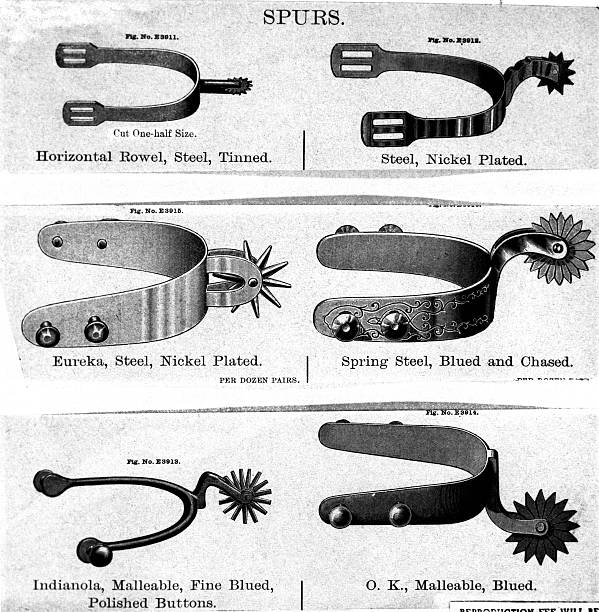
The dress attire adopted by American cowboys from the Spanish vaqueros helped them manage harsh working conditions. Cowboy boots were most famous for having a pointed toe to easily slip in and out of stirrups. A critical style of dress since it was common to fall off a horse, which could be life-threatening if you could not get out of the stirrups fast enough and lead to cowboys being dragged by the horse. The cowboy hat even had a functioning capability and wasn’t just a style choice. Not only did the brim of a cowboy hat protect he rider from the sun, but the high crown of the cowboy hat also allowed for it be a cup for water, and when folded it served as a pillow on the plains in which they would often call a bed. Cowboys also wore bandanas to protect them from the dust that would kick up from the cattle. And the famous chaps that cowboys wore were for realistic means of protecting them from sharp bushes and cacti in the region they would encounter on the plains during cattle drives.

An advertising mural painted on the side of a 19th century brick warehouse in downtown Nashville, Tennessee, advertises a western clothing store. (Photo by Robert Alexander/Getty Images)
Cowboys decked out in the famous attire circa 1880's. Photo Credit: Public Domain
Pegoraro(?) vaquero wearing wooly chaps; Spanish; about 1870; Hand-colored albumen silver print. (Photo by: Sepia Times/Universal Images Group via Getty Images)
Cowboy boot in a stir-up. Photo Credit: Public Domain
A collection of illustrations of spurs from catalogs. Photo Credit: Getty Images
Wild West Frontier Days Cheyenne, Wyoming Ca 1890's-1900's. (Photo by Buyenlarge/Getty Images)
Cowboy Scout 'Wild Burt,' Ca. 1880S. A cowboy Scout With His Leather Chaps, Huge Large Brim Hat, Kerchief, And Long Gun. Cowboy Scout 'Wild Burt,' Ca. 1880S. (Photo by Smith of Cooperstown/Buyenlarge/Getty Images)
Stetson Hats, best known in the world. Company started in 1865 by John B Stetson. Poster images like this cowboy with his horse supported the Myth of the West, and reflected the values readers of Western novels and viewers of Western movies came to expect. (Photo by: Photo12/Universal Images Group via Getty Images)
Cowboys with bandanas circa 1880s. Photo Credit: Ranchlands.com
Young boy in leather chaps circa 1880's. Photo Credit: Public Domain
Tintype Of A Well-Armed Cowboy. This Dapper Range Rider, Circa The 1880S, Stands Armed To The Teeth With A Rear-Facing Revolver On His Waist And His Lever Action Rifle At His Side, Posed Against A Studio Backdrop Featuring Cacti And Rock Formations. (Photo by Buyenlarge/Getty Images)

A SHADED HISTORY…

Historians have often whitewashed the cowboy in the west, when in fact, there were African American and Native American cowboys. During the American Civil War when white settlers had left to fight the war, they left their enslaved peoples to maintain the lands and herds. This would allow the African American and Native American enslaved to learn invaluable skills that would help to aid them in transitioning to ranching as paid work after emancipation. 1 and 4 cowboys were estimated to be black, and history overlooked their contribution by whitewashing them and only focusing on the contributions of their white counterparts. Even with emancipation, black cowboys still faced discrimination and racism in the frontier towns they would pass through on cattle drives. Black cowboys found their respect and loyalty among their fellow cowboys. Though white cowboys make up the bulk of history and popular culture surrounding the Western frontier in the United States, Black, Mexican and Native American cowboys made for a diverse group for working cowboys.

Native American And African American Cowboys, circa 1865. Images Of Indian Cowboys Are Rare. (Photo by Buyenlarge/Getty Images)
Native American Indian Cowboys Two Native American Indian Cowboys That Features A Nice Pair Of Buffalo Chaps. The Sitting Native American Wears The Chaps Along With A Hat, Bandana, And Plain Moccasins. The Standing Man Has Buckle-Top Boots And Long Hair. (Photo by Buyenlarge/Getty Images)
Native American Cowboy. Photo Credit: TrueWestMagazine.com
Native American cowboy Jackson Sundown. Photo Credit: Courtesy of the National Cowboy Museum
Black Cowboys preparing for a horse race at the Negro State Fair. Image courtesy of the Erwin E. Smith Collection. Image available on the Internet and included in accordance with Title 17 U.S.C. Section 107.
Bill Pickett invented "bulldogging," a rodeo technique to wrestle a steer to the ground. Photo Credit: Corbis
Portrait of Bose Ikard. Image courtesy of PBS. Image available on the Internet and included in accordance with Title 17 U.S.C. Section 107.
Portrait of Daniel W. (80 John) Wallace. Image available on the Internet and included in accordance with Title 17 U.S.C. Section 107.
Bob Lemmons, Carrizo Springs, Texas. Born a slave about 1850, south of San Antonio, Texas. Came to Carrizo Springs during Civil War with white men seeking new range for their cattle. In 1865, with his master was one of the first settlers. He knew Billy the Kid, King Fisher, and other noted bad men of the border. Artist Dorothea Lange. (Photo by Heritage Art/Heritage Images via Getty Images)

THE ROUND UP…

In order for cowboys to keep track of the growing number of cattle on drives, each Spring and Fall, the cowboys would round up the cattle. They would bring the cattle from the open plains, where they roamed freely for most of the year, to be counted by the various ranches in the region. They would also brand each cow to keep track of the ranch it belonged to. After this process was done, the cowboys would return the cattle to open plains.
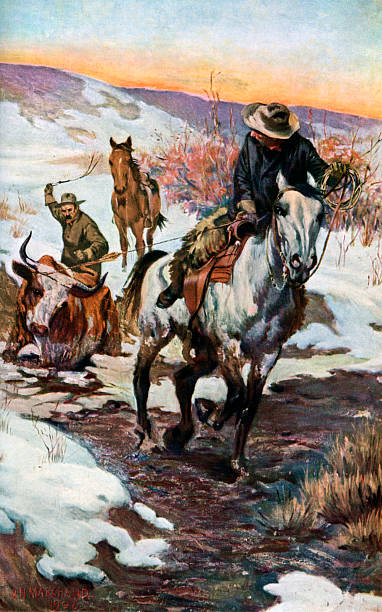
'Winter Work for the Cowboys', 1906 (1908-1909).From Penrose's Pictorial Annual 1908-1909, An Illustrated Review of the Graphic Arts, volume 14, edited by William Gamble and published by AW Penrose (London, 1908-1909). (Photo by The Print Collector/Print Collector/Getty Images)
A Montana cowboy watching the herd during a quiet moment in a cattle drive. Engraving 1885. (Photo by: Photo 12/Universal Images Group via Getty Images)
Cowboys Herding Cattle Ca 1880S - On The Open Range, On The Line Of The Denver And Rio Grande Railway. 'A Cattle Ranch' Three Ranchers On Horseback Tending Their Cattle With Men On Wagon With Supplies. Cowboys Herding Cattle. (Photo by R.M. Davis/Buyenlarge/Getty Images)
Round-up scenes on Belle Fouche in 1887. (Photo by: HUM Images/Universal Images Group via Getty Images)
The Spring Round-Up' Ca 1880S-90S - Roping Can't Kick. Title; Roping A Texas Steer - Caught, Thrown, Heeled And Stretched. The Spring Round-Up' -Roping A Texas Steer. (Photo by L.A. Huffman/Buyenlarge/Getty Images)
Roping and changing scene at --T Camp on round up of --T. 999 --S. & G., A.U.T. and others on Cheyenne River 1887-1892. (Photo by: HUM Images/Universal Images Group via Getty Images)
Cowboy's 'Dinner On Round-Up' Wyoming Cowboys Enjoying A Meal At The Chuck Wagon. Cowboy Dinner At The Roundup. (Photo by C.D. Kirkland/Buyenlarge/Getty Images)
Cowboys eating near chuck wagon; small groups of horses and cattle in campsite circa 1890. (Photo by Buyenlarge/Getty Images)
Engraving of cowboys branding a cattle, from the book 'Brief history of Texas from its earliest settlement to which is appended the constitution of the state' by De Witt Clinton Baker, 1873. Courtesy Internet Archive. (Photo by Smith Collection/Gado/Getty Images)
Montana Cowboys Branding On The Range.' This Image Has Eight Cowboys With Chaps, Cowboy Hats, Ropes, Etc. Lassoing A Calf To Brand. Montana Cowboys. (Photo by F.J.Haynes/Buyenlarge/Getty Images)
Cowboys Branding Calf - Cowboys Wearing Hats, Spurs, Boots,. Branding. (Photo by W.H. Jackson/Buyenlarge/Getty Images)
Branding At Texas Ranch, Ca 1880-1890. Cowboys, Ranch Hands, Even Children Pitch In To Get The Cattle Of The 7 Ranch In Texas Roped And Branded. Two Pairs Of Branders Hold Down The Cows Being Branded, While Other Horsemen Collect The Next One And Keep The Rest Of The Herd From Wandering Out Into The Flat Texas Prairie. Branding At Texas Ranch. (Photo by 7 RANCH/Buyenlarge/Getty Images)

A DRIVING INDUSTRY…

Cattle drives became the method of transporting large herds to market, running nearly 2,000 cattle by one trail boss and a dozen cowhands, and often along a long distance. By 1830, cattle driving had become a steady occupation after the war, there were more longhorns in the south and the demand for cattle drivers increased. Prior to the American Civil War, ranchers really had no incentive to round up the longhorns and move them to market. Texas originated most of the cattle drives that would reach as far as markets in Missouri or Kansas. The price of beef didn’t make it lucrative until after the war. With Longhorns requiring less water, they were often the hardiest of cattle on these drives. Jesse Chisholm is famous for establishing the Chisholm Trail in 1865, and would run cattle 600 miles from San Antonio, Texas all the way to Abilene, Kansas. The trail would prove hazardous, with rivers to cross and potential run-ins with farmers and Native Americans protecting their land in the area. But the high price to be fetched for beef was often worth the risk of the journey. More routes like the Chisholm Trail would be established in the decades to follow to meet the demand of the beef industry.

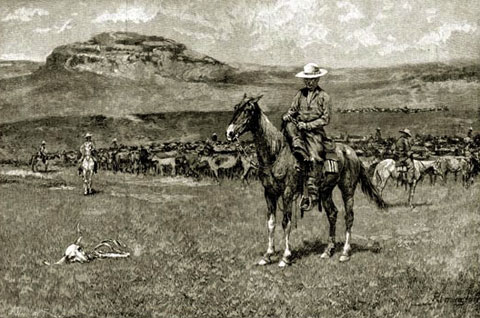
The cattle boom of the 1880s created Wyoming's indelible image as the Cowboy State. Photo Credit: WyoHistory.com
Painting, Texas Longhorn Cattle Drive. Image available on the Internet and included in accordance with Title 17 U.S.C. Section 107.
The era of the great cattle drives began right after the Civil War. Cowboys originated in Spanish, CA and Mexico then adapted to the Texas drives in the 1870s and 1880s Early cattle drives were initiated by Nelson Story and Charles Goodnight. Cattle were driven across the Chisholm and other trails to cow towns such as Abilene and Dodge City. Life on the open range changed forever with the invention of barbed wire. Fences, combined with the back to back killer winters of 1886 and 1887, changed the cattle industry forever. Photo Credit: geneologytrails.com
Jesse Chisholm. Photo Credit: Wikipedia Commons
Map of the Chisholm Trail. Image available on the Internet and included in accordance with Title 17 U.S.C. Section 107.
A Texas cattle drive making it across a river circa late 1880's. On the Chisholm Trail, cowboys and vaqueros had to bring herds across the Colorado River, Brushy Creek, the Brazos River, the Trinity Ford, and the Red River. Photo Credit: TSHA.com
This is a map of the major cattle trails used to move cattle from Texas to railheads in Kansas, Colorado and Missouri. Photo Credit: Map courtesy of Texas Historical Commission.

COWBOY DOWN…

But by the turn of the century, the cowboy era had effectively died out. As more people settled west of the Mississippi River, it would change the landscape of the frontier and technological advances would lessen the demand of cowboys in the west. Farmers started using barbed wire fencing to control their cattle and it made it harder for cattle drives with the open plains quickly becoming privatized. Though smaller cattle drives would continue in the 1900’s, many of the cowboys of the time began working for private ranch owners and gave up the open trial lifestyle they had become accustomed to. A brutal winter in 1886-1887 killed off many of the cattle and historians have often marked this as the timeline of the beginning of the end for the cowboy era.

Cowboys playing a craps game. Picture dated from after 1898. Photo Credit: Wikipedia Commons
Drawing for an Electric Lamp; 1/27/1880; Page 1, Patents Issued to Thomas A. Edison, 1868 - 1911; Records of the Patent and Trademark Office, Record Group 241; National Archives at College Park, College Park, MD. [Online Version, https://www.docsteach.org/documents/document/patent-application-incandescent-light-bulb, August 4, 2022]
Drawing for an Electric Lamp; 1/27/1880; Page 2, Patents Issued to Thomas A. Edison, 1868 - 1911; Records of the Patent and Trademark Office, Record Group 241; National Archives at College Park, College Park, MD. [Online Version, https://www.docsteach.org/documents/document/patent-application-incandescent-light-bulb, August 4, 2022]
Drawing for an Electric Lamp; 1/27/1880; Page 3, Patents Issued to Thomas A. Edison, 1868 - 1911; Records of the Patent and Trademark Office, Record Group 241; National Archives at College Park, College Park, MD. [Online Version, https://www.docsteach.org/documents/document/patent-application-incandescent-light-bulb, August 4, 2022]
Patent Drawing for T. A. Edison's Electric Meter ; 6/14/1881; Page 1, Records of the Patent and Trademark Office, 1836 - 1978, Record Group 241. [Online Version, https://www.docsteach.org/documents/document/patent-drawing-for-t-a-edisons-electric-meter, August 4, 2022]
Patent Drawing for T. A. Edison's Electric Meter ; 6/14/1881; Page 2, Records of the Patent and Trademark Office, 1836 - 1978, Record Group 241. [Online Version, https://www.docsteach.org/documents/document/patent-drawing-for-t-a-edisons-electric-meter, August 4, 2022]
“Waiting for a Chinnook” Also known as “Last of the 5000”, c. 1900. Photo Credit: Wikipedia Commons
Chisholm Trail contract drovers taking a break. Image available on the Internet and included in accordance with Title 17 U.S.C. Section 107.

THE END OF AN ERA BROUGHT TO LIGHT…

The end of the cowboy era was brought on by technological advances begun a decade before but had taken full flight by the late 19th century. From Thomas Edison and the invention of electricity to Alexander Graham Bell with the invention of the telephone, the methods of communication and transportation were rapidly increasing and changing how jobs were done in the Western frontier. A nation of people was beginning to see light and sound being transmitted East to West, North to South, and across state to state. With bridges being built, such as the Brooklyn Bridge that was completed in 1883, railroad lines were able to be extended and opened the plains even more. The era of cowboys wasn’t necessarily ending, it along with the era of outlaws and Native American massacres were simply moving in a different direction, toward the civility of a people and Reservations, unfortunately, for the Native Americans. The end of an era brought on the beginning of an emerging industrial giant. In the decades that followed the American Civil War, old industries were expanded, and new ones were being created. We saw the creation of petroleum refining, steel manufacturing and electrical power. With the railroad expansion making significant ground, remote parts of the country were able to enter the national market of economy.

1890s turn of the century portrait group of five men actors in various costumes against painted studio backdrop (Photo by H. Armstrong Roberts/ClassicStock/Getty Images)
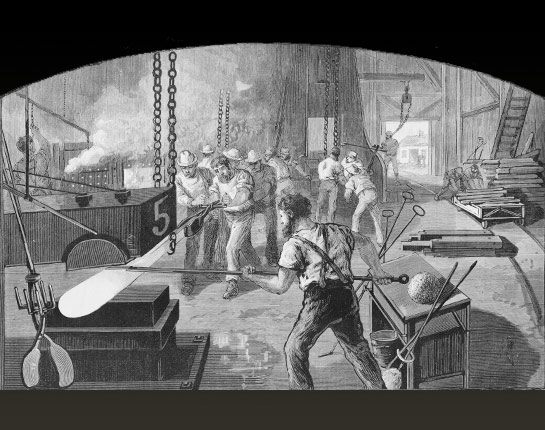
The burgeoning factory system boomed in the cities. For the first time, more Americans were living in cities than on farms. In the newly industrialized economy, millions of Americans worked in factories where fourteen-hour days, harrowing conditions, and starvation wages were common. Photo Credit: Corbis/PBS.com
Thomas Edison. Photo Credit: Wikipedia Commons
Thomas Edison at the lightbulb's golden jubilee anniversary banquet in his honor, Orange, New Jersey, October 16, 1929. Underwood Archives / Getty Images
Alexander Graham Bell. Photo Credit: Wikipedia Commons
Alexander Graham Bell's Telephone Patent Drawing and Oath; Page 1, 3/7/1876; Records of the Patent and Trademark Office, Record Group 241. [Online Version, https://www.docsteach.org/documents/document/alexander-graham-bells-telephone-patent-drawing-and-oath, August 4, 2022]
Alexander Graham Bell's Telephone Patent Drawing and Oath; Page 2, 3/7/1876; Records of the Patent and Trademark Office, Record Group 241. [Online Version, https://www.docsteach.org/documents/document/alexander-graham-bells-telephone-patent-drawing-and-oath, August 4, 2022]
Alexander Graham Bell's Telephone Patent Drawing and Oath; Page 3, 3/7/1876; Records of the Patent and Trademark Office, Record Group 241. [Online Version, https://www.docsteach.org/documents/document/alexander-graham-bells-telephone-patent-drawing-and-oath, August 4, 2022]
March 07, 1876: Alexander Graham Bell Patents the telephone. Photo Credit: History.com
Photograph of the Brooklyn Bridge whilst under construction. Dated 1883. (Photo by: Photo12/Universal Images Group via Getty Images)
Workers building the Brooklyn Bridge over the East River in New York City, 1883. (Photo by Frederic Lewis/Archive Photos/Getty Images)
bird's eye view of New York City with the Hudson River and the New Jersey waterfront on the left. New York Harbor and Governors Island in the right foreground. Battery Park. Manhattan. the East River. Brooklyn Bridge. and the borough of Brooklyn at center. 1880 ?. US. USA. America. (Photo by: Sepia Times/Universal Images Group via Getty Images)
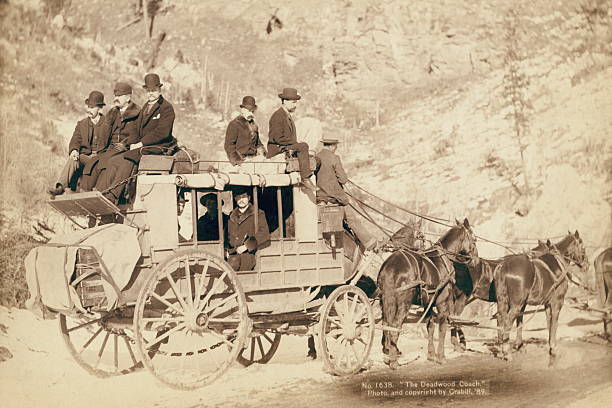
The Deadwood Coach circa 1890. (Photo by Buyenlarge/Getty Images)
Group Of Armed Men A Group Of Four Men Standing In Front Of Mud-Wagon, They All Have Rifles & Revolvers. One Of The Men Has A Fancy Hand Carved Steer Ivory Grip Pistol In Holster And Large Bowie Knife On His Cartridge Belt. All Of The Men Are Wearing Cartridge Belts, Some Are Full Of Bullets. Three Of The Guys Are Wearing Single Or Double Loop Holsters And The Man On Right Has Winchester, Stag Handle Bowie Knife, & A Colt Pistol. (Photo by Buyenlarge/Getty Images)
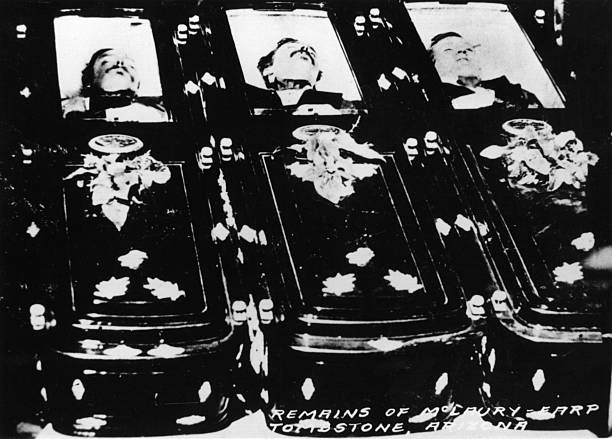
The bodies of, from left to right, Tom McLaury (or McLowry), Frank McLaury (or McLowry) and Billy Clanton. These three members of the 'Clanton Gang' were shot by Wyatt Earp, his brothers Virgil and Morgan and Doc Holiday during the 'Gunfight at OK Corral' on 26th October 1881, Tombstone, Arizona. Original Artwork: Arizona Historical Society Library (Photo by Hulton Archive/Getty Images)
Indian Territory, Department of the Interior, General Land Office, Illustration, 1887. (Photo by: Glasshouse Vintage/Universal History Archive/Universal Images Group via Getty Images)
Sitting Bull and Buffalo Bill, 1885 (Photo by: Universal History Archive/Universal Images Group via Getty Images)
Drying or tanning racks outside tepees in the camp of Sitting Bull on the Standing Rock Agency. | Location: Standing Rock Agency, the Dakotas, USA circa 1880's. Photo Credit: Getty Images
Chiricahua Apache Camp on Indian Reservation, Arizona Territory, 1886. (Photo by: Universal History Archive/Universal Images Group via Getty Images)

A REVOLUTION SO BIG IT NEEDED TWO…

A frontier nation was transformed into an industrial revolution through growth that changed American society. The class system in America shifted with the new class of wealthy that was produced by industrialists and a prosperous middle class. And we saw the development of a strong blue-collar working class. The rural areas of America were threatened by this changing landscape due to the labor force needed for the industrialization era compromising the jobs of newly arrived immigrants and migrants from the region. The industrial plants were then expanded on and allowed more output, and it became what the United States is best known for in the late 19th century. The mass production of goods by machines was at the heart of this increase in industrialization. The American process was adapted from British textile manufacturers. But with the rise of industrialization and the cowboy era dying out, the landscape of work was changing with a majority of positions being filled by fast producing machines.
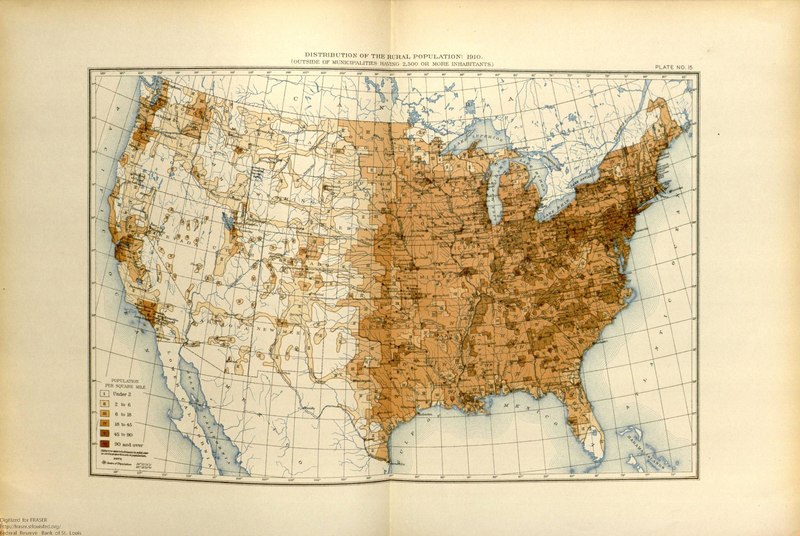
Map from 1910 U.S. Census showing the remaining extent of the American frontier. Photo Credit: Wikipedia Commons
New map of the Union Pacific Railway, the short, quick and safe line to all points West. County map of the United States showing relief by hachures, drainage, cities and towns, and the railroad network with emphasis on the main line. Scenic illustrations border the map. Photo Credit: Rand McNally and Company. Union Pacific Railway Company. Created / Published: [Chicago, 1883]
Illustration of well-muscled iron workers on a construction site, as an idealized allegory of the American 'Modern Industrial Age', 1930. Lithograph. (Photo by GraphicaArtis/Getty Images)
1878: The Great Union stockyards of Chicago, the largest livestock market in the world. (Photo by MPI/Getty Images)
[Construction Site], 1880s. Artist Louis Lafon. (Photo by Heritage Art/Heritage Images via Getty Images)
Eli Whitney, 1765 – 1825. American inventor best known for inventing the cotton gin. From The Century Magazine, published 1887. (Photo by: Universal History Archive/Universal Images Group via Getty Images)
Eli Whitney's Cotton Gin Patent Drawing; 3/14/1794; Restored Patent Drawings, 1837 - 1847; Records of the Patent and Trademark Office, Record Group 241; National Archives at College Park, College Park, MD. [Online Version, https://www.docsteach.org/documents/document/whitney-cotton-gin-patent, August 5, 2022]
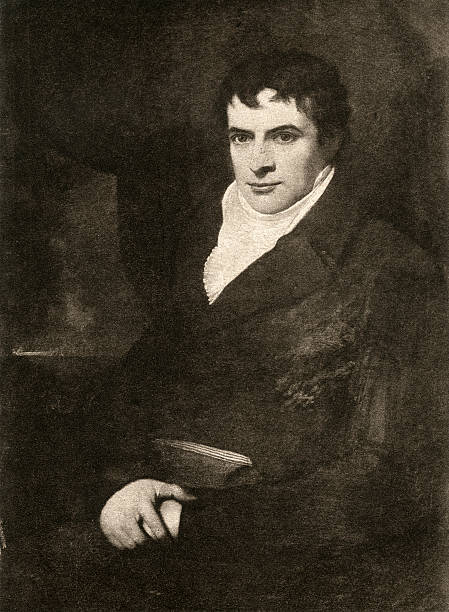
Robert Fulton (1765-1815), British-American Engineer and Inventor who is Widely Credited with the Development of the Steamboat, Portrait. (Photo by: Universal History Archive/Universal Images Group via Getty Images)
Robert Fulton's steamboat, Constructed by the North American engineer Robert FULTON (1765-1815), Colored engraving of the 19th century. (Photo by Prisma/UIG/Getty Images)
Henry Ford (1863 - 1947), American automobile manufacturer and organizer and president of the Ford Motor Company. (Photo by Stock Montage/Stock Montage/Getty Images)
1908: American inventor and manufacturer Henry Ford (1863 - 1947) drives an early tractor, which he called an 'automobile plow,' powered by a 1904 Model-B type engine on one of his farms near Dearborn, Michigan. (Photo by Hulton Archive/Getty Images)
American railroad entrepreneurs Cornelius Vanderbilt (1794 - 1877), Jay Gould (1836 - 1892), Russell Sage (1816 - 1906), and Cyrus W. Field (1819 - 1892) carve up the United States into a railroad monopoly as European royalty watch from across the Atlantic Ocean, 1882. Original color lithograph by the artist Frederick Burr Opper. (Photo by Stock Montage/Getty Images)
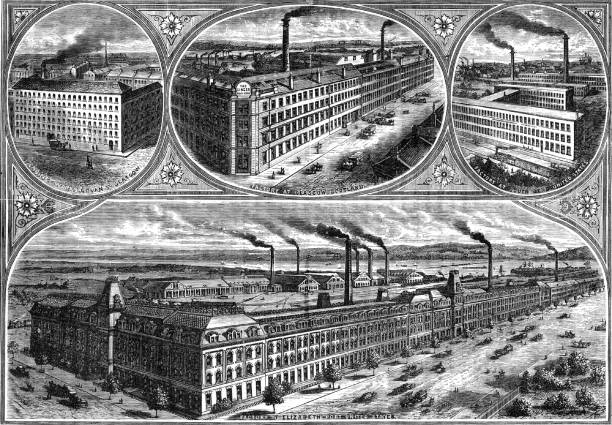
Factories of the Singer Sewing Machine company. Top left. Cabinet works at Govan, Glasgow, Scotland. Centre top. Factory at Glasgow, Scotland. Top right. Factory at South Bend, Indiana, usa. Bottom. Factory at Elizabethport, New Jersey, usa. From "Great Industries of Great Britain" (London, c1880). Engraving. (Photo by: Ann Ronan Picture Library/Photo12/Universal Images Group via Getty Images)

STEEL THE INDUSTRY…

Cowboys were replaced with Entrepreneurs and Industrialists, and cattle drives were replaced with skyscrapers built with steel. Andrew Carnegie founded Carnegie Steel; his business is one of few responsible for fueling the Industrial Revolution in the United States. He became a multimillionaire, he employed tens of thousands of workers through his company, and he built the steel for skyscrapers, bridges, and railroads that made the United States the world’s leading industrial nation. Carnegie along with the other business leaders of his time provided a leadership for a society built in industry. New technology enabled farmers to produce more crops, but they saw an increase in supply cause their prices to fall. Goods overseas became difficult to sell with high tariffs. And mortgages with large banks and the cost to ship by train continued to increase with demand, made the farmers’ difficulties worse. This brought about the movement called, populism, which was a movement to increase farmers’ political power and work for the legislation in their interests. The changing landscape and economic crisis after the American Civil War led to farmers joining the movement.

A full length portrait of Theodore Roosevelt at 25, wearing a cowboy outfit from his time working in the Dakotas, New York, New York, 1883. (Photo by Smith Collection/Gado/Getty Images).
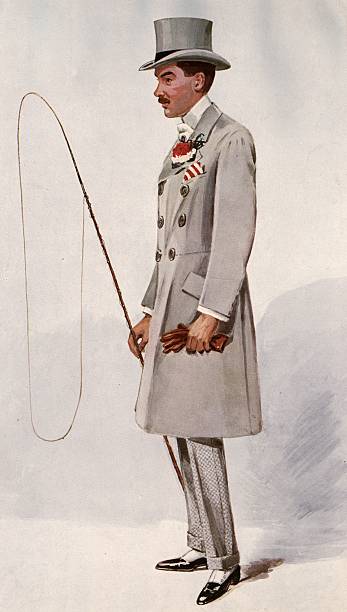
1907: Alfred Gwynne Vanderbilt Sr. (1877 - 1915), the son of the American industrialist Cornelius Vanderbilt. Original Artwork: Cartoon by Spy (Lesley Ward) from Vanity Fair. (Photo by Hulton Archive/Getty Images)
1892: New Yorks most powerful businessmen of the 1860's and the 1870's. Jay Gould (1836 - 1892) and Commodore William Vanderbilt (1821- 1885) sit opposite each other at the centre table. (Photo by MPI/Getty Images)
circa 1935: Cattle pens in Nebraska. (Photo by MPI/Getty Images)
1910: Labourers making steamboat and railroad forgings using steam hammers at the Paterson Iron Company works in Paterson, New Jersey. A lithograph by Endicott & Co. (Photo by MPI/Getty Images)
Scottish industrialist and philanthropist Andrew Carnegie (1835 - 1919). The son of a Dunfermline linen weaver, Carnegie emigrated to Pittsburgh in 1848. After the American Civil War (1861 - 1865) he moved into the production of iron and steel. Carnegie became one of the richest men of his day. A multi-millionaire, he retired to Skibo Castle in Sutherland and donated $350 million to many charities and over 1700 libraries in America and Britain. His name lives on in the Carnegie Institutes in Pittsburgh and Washington and in the famous Carnegie Hall in New York. (Photo by Keystone/Getty Images)
Carnegie Steel Company, "Lucy" Furnace, Pittsburgh, Pennsylvania, USA, circa 1910. (Photo by: Universal History Archive/Universal Images Group via Getty Images)
View of Carnegie steel furnaces from across a river. (Photo by © CORBIS/Corbis via Getty Images)
1901: The pay-car at the Carnegie Steel Works at Homestead, PA. Wash drawing, 1901.
Andrew Carnegie talking with men - Andrew Carnegie (1835-1919), a Scottish-American industrialist, made his fortune in the steel industry in the late 19th century. (Photo by: HUM Images/Universal Images Group via Getty Images)
Leaders who left giant footprints behind them. A labor conference in 1905, left to right, Andrew Carnegie, steel; William Jennings Bryan; James J. Hill, railroads; and John Mitchell, miner's union.
Farmers using a row potato planter on a farm in the San Luis Valley, Colorado, USA. (Photo by Ferdinand S. Hirsh/Fox Photos/Getty Images)
1791: Cartoon showing a ladder labelled 'federal revenue' ands 'federal credit' which leads from bankruptcy to financial stability. The cartoon is referring to the granting of the first charter to the Bank of the United States in1791 guaranteeing its existence for twenty years and the bank's subsequent growth and power. (Photo by MPI/Getty Images)

AMERICA SETTLES IN…

The government opened one of the last large territories for settlement on April 22, 1889. Within hours of the opening thousands of people raced to the stake to claim their piece of land in what is known as the Oklahoma Land Rush. By 1890, the United States Census Bureau, that reports on the American Population once every ten years, reported that there was no longer a true frontier left in America. There was still plenty land to be occupied though, and the Homestead Act would encourage new settlement into the 1900’s. But the official closing of the frontier by the Census Bureau marked the end of an era.

22nd April 1889:  White settlers rushing to claim Cherokee land in the Oklahoma Territory. The land rush resulted from the Dawes Act of 1887 which had robbed the Cherokee of their rights to the land known as The Cherokee Strip.  (Photo by MPI/Getty Images)
Poster Advertising "Indian Territory That Garden of the World, Open for Homestead and Pre-Emption" in Current Day Oklahoma ; ca. 1889; Letters Received, 11/1863 - 12/1904; Records of U.S. Army Continental Commands, Record Group 393; National Archives Building, Washington, DC. [Online Version, https://www.docsteach.org/documents/document/indian-territory-poster, August 5, 2022]
The start of the Oklahoma Land Run at high noon as settlers rush to claim the Unassigned Lands, Oklahoma, April 22, 1889. (Photo by Barney Hillerman/Underwood Archives/Getty Images)
The Rush for the Promised Land' - horsemen crossing the border into Oklahoma during the Gold Rush, USA, 1889. From the Graphi - 11th May 1889. (Photo by Hulton Archive/Getty Images)
Illustration shows a representation of settlers on horses and in wagons during the land rush into Oklahoma, 1889. (Photo by Interim Archives/Getty Images)
U.S. DEPARTMENT OF COMMERCE, BUREAU OF THE CENSUS
Oklahoma Land Rush image showing an active camp scene. Oklahoma Land Rush: Active Camp Scene. (Photo by P. Miller/Buyenlarge/Getty Images)
Holding Down A Lot In Guthrie.; ca. 1889; Records of the Office of the Secretary of the Interior, Record Group 48. [Online Version, https://www.docsteach.org/documents/document/holding-down-a-lot-in-guthrie, August 5, 2022]
Guthrie, Indian Territory' Land Rush 1889. Oklahoma Sooners Land Rush. (Photo by Walters & Evington/Buyenlarge/Getty Images)
United States, Purcell, Oklahoma, Main Street after the land rush, 1889, Engraving published in the newspaper 'Frank Leslie's' en 1889. (Photo by Prisma/UIG/Getty Images)

MY WESTERN RECOMMENDATION…

I would recommend watching 1883, if you’re a fan of Yellowstone, but I also recommend it for the historical relevance. This recommendation only covers a small portion of the history that took place when settling the West, the American Frontier was such a vast history and Taylor Sheridan decided to focus on aspects of that history with 1883. He looked at the journey West to settle through James Dutton and his family and touched on the elements of how the Native American peoples were affected by it. He looked at the importance of cattle driving and ranching in the West during that time, and he carried that importance into modern times with Yellowstone. John Dutton III, played by Kevin Costner, still carries the principal values of his ancestors that settled, he has spent almost every season defending the land that James Dutton settled in 1883. We now know why it means so much for John to hold on to the land, but we also know from this history that his job as a Montana cattle rancher, was and still remains a vital business in the West. Sheridan has also since the beginning of Yellowstone told a story of how the West being settled affected the Native Americans, thorough Chief Thomas Rainwater, played by Gil Birmingham, and his ongoing feud with the Dutton family over their land. With the intention of taking back the land that was stolen from his people. Sheridan has been true to his plan of telling the stories of the modern day frontiersman, like the Dutton’s on Yellowstone, and will continue that story with 1932. Don’t watch 1883, looking for it to be an entire history lesson, watch it for the elements of our American History that it touches on while also seeing where the Dutton family began. With the plans at Paramount+ for Sheridan, were likely to see the miles it took to get there, for the Dutton History is not done being written.

Sam Elliott as Shea Brennan, Tim McGraw and Faith Hill as James and Margaret Dutton, and Isabel May on a the DVD/Blu-ray/4k UHD poster for the Paramount+ original series 1883, Created and written by Taylor Sheridan. Photo Cr: Paramount+ © 2022 MTV Entertainment Studios. All Rights Reserved.
Paramount Network series poster for Season 1 of Yellowstone starring Dave Annable, Luke Grimes, Kevin Costner, Kelly Reilly, and Wes Bentley. (2018)
Sam Elliott and Taylor Sheridan filming at the 6666 Ranch, now owned by Taylor Sheridan. Sarah Coulter/ViacomCBS
Tim McGraw as James Dutton in a scene from the Paramount+ original series 1883, created and written by Taylor Sheridan. Photo Cr: Paramount+ © 2022 MTV Entertainment Studios. All Rights Reserved.
(L-R) Isabel May as Elsa Dutton, Faith Hill as Margaret Dutton, Tim McGraw as James Dutton and Audie Rick as John Dutton Sr. in a scene from Episode 1 in the Paramount+ original series 1883, Created and written by Taylor Sheridan. Photo Cr: Paramount+ © 2022 MTV Entertainment Studios. All Rights Reserved.
The European Wagon Train Expedition to Oregon as depicted on the Paramount+ limited series 1883. Created and written by Taylor Sheridan. Photo Credit: Paramount+
Faith Hill as Margaret Dutton and Sam Elliott as Shea Brennan in a scene from the Paramount+ original series 1883, Created and written by Taylor Sheridan. Photo Cr: Paramount+ © 2022 MTV Entertainment Studios. All Rights Reserved.
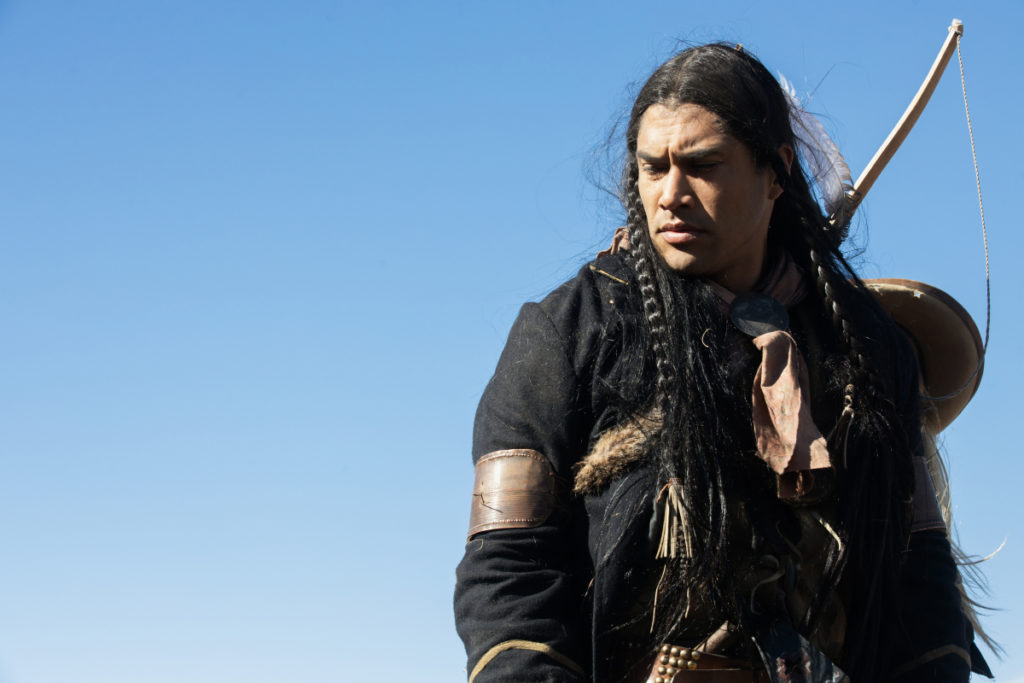
Martin Sensmeier as Sam in a scene from the Paramount+ original series 1883, Created and written by Taylor Sheridan. Photo Cr: Paramount+ © 2022 MTV Entertainment Studios. All Rights Reserved.
Isabel May as Elsa Dutton and Martin Sensmeier as Sam in a scene from the Paramount+ original series 1883, Created and written by Taylor Sheridan. Photo Cr: Paramount+ © 2022 MTV Entertainment Studios. All Rights Reserved.
Kevin Costner as John Dutton III in the Paramount Network original series Yellowstone, Created and written by Taylor Sheridan. Photo Cr: Paramount Network © 2022 MTV Entertainment Studios. All Rights Reserved.
Graham Greene, as the Indigenous Crow tribe elder and Tim McGraw as James Dutton in a scene from the Paramount+ original series 1883, Created and written by Taylor Sheridan. Photo Cr: Paramount+ © 2022 MTV Entertainment Studios. All Rights Reserved.
Tim McGraw as James Dutton in a scene from the Paramount Network original series Yellowstone, Created and written by Taylor Sheridan. Photo Cr: Paramount Network © 2022 MTV Entertainment Studios. All Rights Reserved.
Kevin Costner as John Dutton III on Yellowstone Dutton Ranch, established in 1886 with the land settled by James Dutton in 1883, from the Paramount Network original series Yellowstone, Created and written by Taylor Sheridan. Photo Cr: Paramount Network © 2022 MTV Entertainment Studios. All Rights Reserved.
Branding logo of Paramount+.
Actor Harrison Ford
Promotional announcement poster for the Paramount+ original series 1932, created by Taylor Sheridan for Paramount+ and MTV Entertainment Group.
Actress Helen Mirren

You can watch a clip of what’s coming soon from Taylor Sheridan and Paramount+ here:

All ten episodes of 1883 are streaming on Paramount+ now. It will be available on DVD, Blu-Ray, and 4K UHD on August 31, 2022.

Share this:

  • Share on X (Opens in new window) X
  • Share on Facebook (Opens in new window) Facebook
  • Share on LinkedIn (Opens in new window) LinkedIn

Like this:

Like Loading…
Pages: 1 2 3 4 5 6 7 8 9 10 11 12 13 14 15 16 17 18

Archives

  • May 2026
  • April 2026
  • March 2026
  • February 2026
  • January 2026
  • December 2025
  • November 2025
  • October 2025
  • September 2025
  • August 2025
  • July 2025
  • June 2025
  • May 2025
  • April 2025
  • March 2025
  • February 2025
  • January 2025
  • December 2024
  • November 2024
  • October 2024
  • September 2024
  • August 2024
  • July 2024
  • June 2024
  • May 2024
  • April 2024
  • March 2024
  • February 2024
  • January 2024
  • December 2023
  • November 2023
  • October 2023
  • September 2023
  • August 2023
  • July 2023
  • June 2023
  • May 2023
  • April 2023
  • March 2023
  • February 2023
  • January 2023
  • December 2022
  • November 2022
  • October 2022
  • September 2022
  • August 2022
  • July 2022
  • June 2022
  • May 2022
  • April 2022
  • March 2022

Categories

  • Blog Posts
  • Critics Choice Awards
  • Emmy Awards
  • Featured Blog
  • Golden Globe Awards
  • In Memoriam
  • Oscar History
  • SAG Awards
  • Screen Actors Guild Awards
  • Television
  • The Actor Awards
  • Top Ten List

ABOUT US

PRIVACY POLICY

TERMS & CONDITIONS

DISCLAIMER

All Rights Reserved © Copyright 2021, MoviestoHistory.com By Themespride

Manage Cookie Consent
To provide the best experiences, we use technologies like cookies to store and/or access device information. Consenting to these technologies will allow us to process data such as browsing behavior or unique IDs on this site. Not consenting or withdrawing consent, may adversely affect certain features and functions.
Functional Always active
The technical storage or access is strictly necessary for the legitimate purpose of enabling the use of a specific service explicitly requested by the subscriber or user, or for the sole purpose of carrying out the transmission of a communication over an electronic communications network.
Preferences
The technical storage or access is necessary for the legitimate purpose of storing preferences that are not requested by the subscriber or user.
Statistics
The technical storage or access that is used exclusively for statistical purposes. The technical storage or access that is used exclusively for anonymous statistical purposes. Without a subpoena, voluntary compliance on the part of your Internet Service Provider, or additional records from a third party, information stored or retrieved for this purpose alone cannot usually be used to identify you.
Marketing
The technical storage or access is required to create user profiles to send advertising, or to track the user on a website or across several websites for similar marketing purposes.
  • Manage options
  • Manage services
  • Manage {vendor_count} vendors
  • Read more about these purposes
View preferences
  • {title}
  • {title}
  • {title}

Loading Comments...

    %d