Skip to content
CONNECT WITH US
https://moviestohistory.com/wp-content/uploads/2022/03/cropped-d3d0f4de5c874cf7a06b2f50e0bc7820-2-10.png

Movies To History.com

  • Home
  • About
  • Featured Film Blog
    • Film Critiques
    • Film Reviews
    • FIlm Recommendations
    • Video
  • Featured Television Blog
    • Television Critiques:
    • Television Reviews:
    • Television Recommendations:
    • Image
    • Video
  • Blog Posts
  • Contact Us
  • Subscribe
  • Oscar History
  • Top Ten List
Close Button

Film Critiques:

AUGUST 2025:

Directed by Aaron Sorkin Written by Aaron Sorkin Produced by Stuart M. Besser Matt Jackson Marc Platt Tyler Thompson Starring Yahya Abdul-Mateen II Sacha Baron Cohen Daniel Flaherty Joseph Gordon-Levitt Michael Keaton Frank Langella John Carroll Lynch Eddie Redmayne Noah Robbins Mark Rylance Alex Sharp Jeremy Strong Cinematography Phedon Papamichael Edited by Alan Baumgarten Music by Daniel Pemberton Production companies Paramount Pictures Cross Creek Pictures DreamWorks Pictures Marc Platt Productions ShivHans Pictures Distributed by Netflix
The Trial of the Chicago 7 (2020)

Truth, Theater, and the Politics of Injustice…


Directed by Aaron Sorkin Written by Aaron Sorkin Produced by Stuart M. Besser Matt Jackson Marc Platt Tyler Thompson Starring Yahya Abdul-Mateen II Sacha Baron Cohen Daniel Flaherty Joseph Gordon-Levitt Michael Keaton Frank Langella John Carroll Lynch Eddie Redmayne Noah Robbins Mark Rylance Alex Sharp Jeremy Strong Cinematography Phedon Papamichael Edited by Alan Baumgarten Music by Daniel Pemberton Production companies Paramount Pictures Cross Creek Pictures DreamWorks Pictures Marc Platt Productions ShivHans Pictures Distributed by Netflix

Protest on Trial

Aaron Sorkin’s The Trial of the Chicago 7 (2020) is not just a legal drama — it’s a political memory exercise, asking viewers to revisit one of the most contentious court cases in American history. The film, based on the real trial of eight defendants (reduced to seven partway through), recounts how the federal government prosecuted anti–Vietnam War activists for conspiracy and inciting riots during the 1968 Democratic National Convention (DNC) in Chicago. At its heart, it is a story about power — the government’s determination to criminalize dissent — and the lengths to which the justice system can be bent into a political weapon.

Directed by Aaron Sorkin Written by Aaron Sorkin Produced by Stuart M. Besser Matt Jackson Marc Platt Tyler Thompson Starring Yahya Abdul-Mateen II Sacha Baron Cohen Daniel Flaherty Joseph Gordon-Levitt Michael Keaton Frank Langella John Carroll Lynch Eddie Redmayne Noah Robbins Mark Rylance Alex Sharp Jeremy Strong Cinematography Phedon Papamichael Edited by Alan Baumgarten Music by Daniel Pemberton Production companies Paramount Pictures Cross Creek Pictures DreamWorks Pictures Marc Platt Productions ShivHans Pictures Distributed by Netflix
Aaron Sorkin directing "The Trial of the Chicago 7" (2020) Photo Credit: Netflix
Mark Rylance, Ben Shenkman, Eddie Redmayne, Alex Sharp, and Yahya Abdul-Mateen II in "The Trial of the Chicago 7" (2020) Photo Credit: Netflix
Jeremy Strong as Jerry Rubin in "The Trial of the Chicago 7" (2020) Photo Credit: Netflix
New York delegates holding 'stop the war' banners in protest at the USA's continued involvement in the Vietnam War, on the third day of the 1968 Democratic National Convention, held at the International Amphitheatre in Chicago, Illinois, 28th August 1968. Photo by Pictorial Parade/Archive Photos/Getty Images
Aaron Sorkin directing Yahya Abdul-Mateen II, Mark Rylance, Ben Shenkman, and Eddie Redmayne in "The Trial of the Chicago 7" (2020) Photo Credit: Netflix

But Sorkin’s film, while rooted in fact, is also an act of dramatization. It compresses, streamlines, and — at times — reimagines events to make the narrative more digestible for audiences. The real trial lasted nearly five months. It involved thousands of pages of testimony, countless objections, and moments so absurd they felt scripted, even in reality. Sorkin’s challenge was distilling all this into two hours without losing its essence. The result is a fast-paced courtroom drama that captures the spirit of the trial, but not always its full radical edge.

The question is: does Sorkin’s version preserve the infamous injustices of the real case, or does it sand them down for broader appeal?

The Chicago Seven, Chicago Date: September 25, 1969 Artist: Richard Avedon American, 1923–2004 ABOUT THIS ARTWORK Pictured are Lee Weiner, John Froines, Abbie Hoffman, Rennie Davis, Jerry Rubin, Tom Hayden, and Dave Dellinger. Artist Richard Avedon Title The Chicago Seven, Chicago Place United States (Artist's nationality:) Date Made 1969 Medium Gelatin silver prints (triptych) Edition 18 of 50 Inscriptions Unmarked recto; verso, , center middle, artist certification information with signature Dimensions Each image: 24.4 × 19.4 cm (9 5/8 × 7 11/16 in.); Each paper: 25.1 × 20.2 cm (9 15/16 × 8 in.); Overall: 25.1 × 60.4 cm (9 15/16 × 23 13/16 in.) Credit Line Horace W. Goldsmith Foundation Fund Reference Number 2002.48 Copyright Copyright © The Richard Avedon Foundation. EXTENDED INFORMATION ABOUT THIS ARTWORK

The Real Trial: Context and Chaos


Portrait of the Chicago Seven and their lawyers as they raise their fists in unison outside the courthouse where they were on trial for conspiracy and inciting a riot during the 1968 Democratic National Convention, Chicago, Illinois, October 8, 1969. They are, from left, lawyer Leonard Weinglass, Rennie Davis, Abbie Hoffman (1936 - 1989), Lee Weiner, David Dellinger (1915 - 2004), John Froines, Jerry Rubin (1938 - 1998), Tom Hayden (1939 - 2016), and lawyer William Kunstler (1919 - 1995). Froines and Weiner were ultimately acquitted on all charges while the others were convicted of inciting to riot (though the convictions were overturned on appeal). Photo by David Fenton/Getty Images

The 1968 Democratic National Convention

The roots of the trial lie in the turbulent summer of 1968. The Vietnam War was escalating, public trust in government was plummeting, and the assassinations of Martin Luther King Jr. and Robert F. Kennedy had shocked the nation. In August, thousands of anti-war demonstrators descended on Chicago, intending to protest at the Democratic National Convention where Vice President Hubert Humphrey was set to receive the party’s nomination.

Protest outside the 1968 Democratic National Convention in "The Trial of the Chicago 7" (2020) Photo Credit: Netflix
American involvement in Vietnam can stretch back as far as the end of World War II, depending on how you define “involvement,” but one thing is for sure; when the U.S. committed its combat troops to defend South Vietnam, things got hot almost immediately. The most stunning example of the ferocity of Vietnam battlegrounds is the 1965 Battle of Ia Drang, the first time the U.S. Army fought a major battle against the People’s Army of Vietnam (PAVN), North Vietnam’s regular forces. Photo Credit: Uited States Army
Dr. Martin Luther King, Jr. spoke before a crowd of 25,000 Selma To Montgomery, Alabama civil rights marchers, in front of Montgomery, Alabama state capital building. On March 25, 1965, in Montgomery, Alabama. (Photo by Stephen F. Somerstein/Getty Images)
Senator from New York, Robert F Kennedy (1925 - 1968, centre) at the funeral of assassinated American civil rights leader Martin Luther King Jr (1929 - 1968), Atlanta, Georgia, 9th April 1968. Kennedy was himself assassinated two months later. (Photo by Archive Photos/Getty Images)
American Democratic Party politician Hubert Humphrey (1911-1978) with his wife Muriel Humphrey (1912-1998) beside American Democratic Party politician Edmund Muskie (1914-1996) and his wife Jane Muskie (1927-2004) wave from the podium as banners representing a variety of American states are displayed at the 1968 Democratic National Convention, held at the International Amphitheatre in Chicago, Illinois, United States, 29th August 1968. Humphrey and Muskie are celebrating after winning the Democratic Party nomination to run for President and Vice President, as large images of Humphrey and his wife hang behind them. Photo by Archive Photos/Getty Images
Delegates holding banners promoting Hubert Humphrey's candidacy for the 1968 presidential election at the 1968 Democratic National Convention, held at the International Amphitheatre in Chicago, Illinois, 28th August 1968. Photo by Pictorial Parade/Archive Photos/Getty Images

Chicago Mayor Richard J. Daley refused to grant most protest permits, and his police force — backed by the Illinois National Guard — was prepared for confrontation. The result was what the Walker Report later called a “police riot”: baton-wielding officers charged demonstrators, journalists, and bystanders indiscriminately. Tear gas and chaos engulfed the city streets. The images shocked television viewers nationwide.

Chicago, Illinois, USA - August 26 to August 29, 1968: The Honorable Richard J. Daley, mayor of Chicago at the Democratic Convention in the International Amphitheater. Photo by Mariette Pathy Allen/Getty Images
Chicago Mayor Richard J. Daley refused to grant most protest permits, and his police force — backed by the Illinois National Guard — was prepared for confrontation. The result was what the Walker Report later called a “police riot”: baton-wielding officers charged demonstrators, journalists, and bystanders indiscriminately. Tear gas and chaos engulfed the city streets. The images shocked television viewers nationwide.
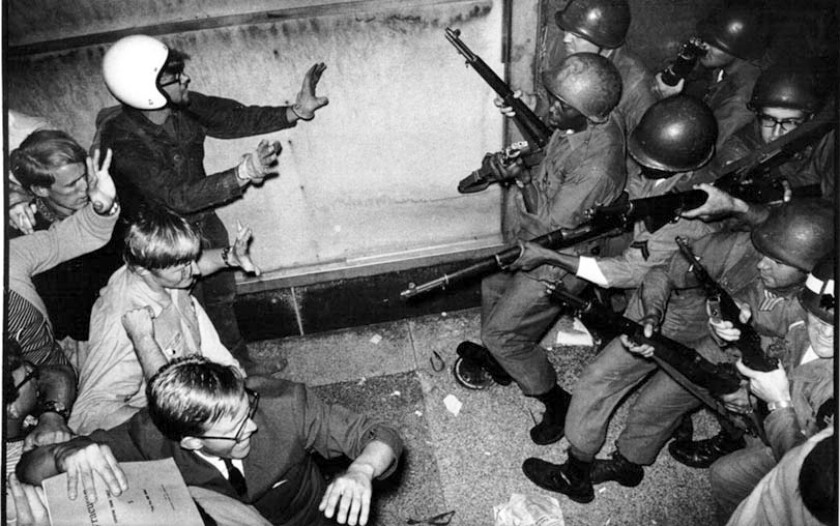
Soldiers and protesters confront each other along Michigan Avenue during the 1968 National Democratic Convention in Chicago. Duane Hall/Sun-Times
Chicago police officers come at crowds with nightsticks and tear gas as they try to break up protests during the the Democratic National Convention in Chicago in August 1968.Paul Sequeira/AP
Police reroute a big throng of hippies and Yippies as they try to clear Grant Park during the Democratic National Convention in Chicago on Aug. 28, 1968. One demonstrator fell at left as another lies on the ground at right while others huddle in the foreground.ASSOCIATED PRESS

From Eight to Seven

In March 1969, the newly inaugurated Nixon administration decided to prosecute eight men under the newly strengthened federal Anti-Riot Act:

Pictured are Lee Weiner, John Froines, Abbie Hoffman, Rennie Davis, Jerry Rubin, Tom Hayden, Bobby Seal and Dave Dellinger.
  • Abbie Hoffman and Jerry Rubin — founders of the countercultural Youth International Party (Yippies).
9th November 1970: Political activist Abbie Hoffman (1936 - 1989), wearing a shirt made from an American flag, speaks at a US flag-themed art show at the Hudson Memorial Church, New York City. Hoffman was charged with desecration of the flag for wearing a US flag shirt. Photo by Tyrone Dukes/New York Times Co./Getty Images
American social and political activist Jerry Rubin (1938 - 1994) speaks at an unspecified protest, circa 1970s. He wears a button that reads 'Hoffa for President.' Photo by David Fenton/Getty Images
  • Tom Hayden and Rennie Davis — leaders in the Students for a Democratic Society (SDS).
Thomas Emmet Hayden (December 11, 1939 – October 23, 2016) was an American social and political activist, author, and politician. Hayden was best known for his role as an anti-war, civil rights, and intellectual activist in the 1960s, becoming an influential figure in the rise of the New Left. As a leader of the leftist organization Students for a Democratic Society, he wrote the Port Huron Statement, helped lead protests at the 1968 Democratic National Convention, and stood trial in the resulting "Chicago Seven" case. In later years, he ran for political office numerous times, winning seats in both the California State Assembly and California State Senate. At the end of his life, he was the director of the Peace and Justice Resource Center in Los Angeles County. He was married to Jane Fonda for 17 years and is the father of actor Troy Garity.
Portrait of Chicago Seven member Rennie Davis in the press room of the Dirksen Federal Building, Chicago, Illinois, 1969. Photo by Paul Sequeira/Getty Images
  • David Dellinger — longtime pacifist and leader in the National Mobilization Committee to End the War in Vietnam (the Mobe).
American activist David Dellinger (1915 - 2004) speaks at a press conference after being sentenced for contempt of court, New York, New York, March 21, 1969. Dellinger and six other anti-Vietnam War protestors, known as the Chicago Seven, were indicted for conspiracy and inciting to riot during the 1968 Democratic National Convention in Chicago, Illinois. Photo by Manning/New York Times Co./Getty Images
  • John Froines and Lee Weiner — accused of making incendiary devices, though prosecutors admitted they played smaller roles.
Portrait of Chicago Seven member John Froines in the press room of the Dirksen Federal Building, Chicago, Illinois, 1969. Photo by Paul Sequeira/Getty Images
Portrait of Chicago Seven member Lee Weiner in the press room of the Dirksen Federal Building, Chicago, Illinois, 1969. Photo by Paul Sequeira/Getty Images
  • Bobby Seale — co-founder of the Black Panther Party, who had been in Chicago for less than 24 hours during the DNC.
Bobby Seale, 31, assistant defense minister of the Black Panthers being interviewed by journalists before proceedings. Seale had no charges filed against him and five others of conspiracy to commit murder and illegal possession of firearms.

The inclusion of Bobby Seale was politically calculated — the prosecution linked a Black revolutionary to a group of mostly white activists to make the defendants seem more threatening. Seale’s attorney was recovering from gallbladder surgery, yet Judge Julius Hoffman refused to grant him a continuance or separate trial.

(Original Caption) 2/27/1968-Berkeley, CA: Bobby Seale, 31, assistant defense minister of the Black Panthers speaks to a crowd of approximately 250, after his arraignment at Berkeley County Courthouse.
(Original Caption) 11/5/1969-Chicago, Illinois-U.S. District Court Judge Julius Hoffman, who declared a mistrial for Black Panther leader Bobby Seale on riot conspiracy charges and sentenced him to four years in prison for contempt of court in the tumultuous courtroom outbreaks that repeatedly stalled the trial of the Chicago Eight.
William Kunstler, Bobby Seale, and Judge Julius Hoffman, in a courtroom illustration (by Franklin McMahon) during the trial of the Chicago Eight, Chicago, Illinois, late 1969 or early 1970. The Eight, or Seven as they were known after Bobby Seale was severed from the case, were indicted for conspiracy and inciting a riot during the 1968 Democratic National Convention in Chicago, Illinois. Seale was sentenced to four years imprisonment for contempt, John Froines and Lee Weiner were acquitted on all charges, and the remaining five (Abbie Hoffman, Jerry Rubin, David Dellinger, Tom Hayden, and Rennie Davis) were convicted of inciting to riot, but the convictions were overturned on appeal. Photo by Franklin McMahon/Chicago History Museum/Getty Images
(Original Caption) 11/5/1973- Chicago, IL- Former Black Panther chairman Bobby Seale, who was shackled and gagged following his violent outbursts at the 1969 Chicago Seven conspiracy trial, talks to newsmen in the lobby of the Federal building after testifying at contempt of court proceedings. Seale returned here to testify at the trial of five members of the Chicago Seven and two of their attorneys on charges that they showed contempt toward U.S. District Court Judge Julius Hoffman in the original riot-conspiracy trial.
Demonstrators parade through City Hall Plaza carrying sign, tambourines, and other items, New York, New York, February 16, 1970. The protest was related to events surrounding the political demonstrations held at the Chicago Democratic Convention. Addressed to Judge Julius Hoffman, the sign reads "You Will Get The Respect You Earn - The People." Photo by Garth Eliassen/Pictorial Parade/Getty Images

Injustice in the Courtroom


The trial, which began in September 1969, quickly devolved into a spectacle. Judge Julius Hoffman — no relation to Abbie — made little effort to appear impartial. His rulings overwhelmingly favored the prosecution, and his disdain for the defendants was palpable.

Chaos in courtroom as defendants and marshals tussle, in a courtroom illustration (by Franklin McMahon) during the trial of the Chicago Eight, Chicago, Illinois, late 1969 or early 1970. The Eight, or Seven as they were known after Bobby Seale was severed from the case, were indicted for conspiracy and inciting a riot during the 1968 Democratic National Convention in Chicago, Illinois. Seale was sentenced to four years imprisonment for contempt, John Froines and Lee Weiner were acquitted on all charges, and the remaining five (Abbie Hoffman, Jerry Rubin, David Dellinger, Tom Hayden, and Rennie Davis) were convicted of inciting to riot, but the convictions were overturned on appeal. Photo by Franklin McMahon/Chicago History Museum/Getty Images
Judge Julius Hoffman, hand on chin, in a courtroom illustration (by Franklin McMahon) during the trial of the Chicago Eight, Chicago, Illinois, late 1969 or early 1970. The Eight, or Seven as they were known after Bobby Seale was severed from the case, were indicted for conspiracy and inciting a riot during the 1968 Democratic National Convention in Chicago, Illinois. Seale was sentenced to four years imprisonment for contempt, John Froines and Lee Weiner were acquitted on all charges, and the remaining five (Abbie Hoffman, Jerry Rubin, David Dellinger, Tom Hayden, and Rennie Davis) were convicted of inciting to riot, but the convictions were overturned on appeal. Photo by Franklin McMahon/Chicago History Museum/Getty Images
Judge Julius Hoffman speaking to defense attorney Leonard Weinglass, in a courtroom illustration (by Franklin McMahon) during the trial of the Chicago Eight, Chicago, Illinois, late 1969 or early 1970. The Eight, or Seven as they were known after Bobby Seale was severed from the case, were indicted for conspiracy and inciting a riot during the 1968 Democratic National Convention in Chicago, Illinois. Seale was sentenced to four years imprisonment for contempt, John Froines and Lee Weiner were acquitted on all charges, and the remaining five (Abbie Hoffman, Jerry Rubin, David Dellinger, Tom Hayden, and Rennie Davis) were convicted of inciting to riot, but the convictions were overturned on appeal. Photo by Franklin McMahon/Chicago History Museum/Getty Images
Prosecution witness Louis Salzburg and defendant Tom Hayden, in a courtroom illustration (by Franklin McMahon) during the trial of the Chicago Eight, Chicago, Illinois, late 1969 or early 1970. The Eight, or Seven as they were known after Bobby Seale was severed from the case, were indicted for conspiracy and inciting a riot during the 1968 Democratic National Convention in Chicago, Illinois. Seale was sentenced to four years imprisonment for contempt, John Froines and Lee Weiner were acquitted on all charges, and the remaining five (Abbie Hoffman, Jerry Rubin, David Dellinger, Tom Hayden, and Rennie Davis) were convicted of inciting to riot, but the convictions were overturned on appeal. Photo by Franklin McMahon/Chicago History Museum/Getty Images
Davis on the stand, in a courtroom illustration (by Franklin McMahon) during the trial of the Chicago Eight, Chicago, Illinois, late 1969 or early 1970. The Eight, or Seven as they were known after Bobby Seale was severed from the case, were indicted for conspiracy and inciting a riot during the 1968 Democratic National Convention in Chicago, Illinois. Seale was sentenced to four years imprisonment for contempt, John Froines and Lee Weiner were acquitted on all charges, and the remaining five (Abbie Hoffman, Jerry Rubin, David Dellinger, Tom Hayden, and Rennie Davis) were convicted of inciting to riot, but the convictions were overturned on appeal. Photo by Franklin McMahon/Chicago History Museum/Getty Images

The most infamous moment came in October, when Bobby Seale repeatedly insisted on his right to represent himself and denounced the court’s refusal to delay until his attorney recovered. Hoffman ordered him bound and gagged in the courtroom — a shocking violation that lasted several days. Eventually, Seale’s case was declared a mistrial, leaving seven defendants.

Bobby Seale, in a courtroom illustration (by Franklin McMahon) during the trial of the Chicago Eight, Chicago, Illinois, late 1969. The Eight, or Seven as they were known after Bobby Seale was severed from the case, were indicted for conspiracy and inciting a riot during the 1968 Democratic National Convention in Chicago, Illinois. Seale was sentenced to four years imprisonment for contempt, John Froines and Lee Weiner were acquitted on all charges, and the remaining five (Abbie Hoffman, Jerry Rubin, David Dellinger, Tom Hayden, and Rennie Davis) were convicted of inciting to riot, but the convictions were overturned on appeal. Photo by Franklin McMahon/Chicago History Museum/Getty Images
Judge Julius Hoffman, in a courtroom illustration (by Franklin McMahon) during the trial of the Chicago Eight, Chicago, Illinois, late 1969 or early 1970. The Eight, or Seven as they were known after Bobby Seale was severed from the case, were indicted for conspiracy and inciting a riot during the 1968 Democratic National Convention in Chicago, Illinois. Seale was sentenced to four years imprisonment for contempt, John Froines and Lee Weiner were acquitted on all charges, and the remaining five (Abbie Hoffman, Jerry Rubin, David Dellinger, Tom Hayden, and Rennie Davis) were convicted of inciting to riot, but the convictions were overturned on appeal. Photo by Franklin McMahon/Chicago History Museum/Getty Images
Bobby Seale defining a 'pig' as 'a person or policeman who is generally found violating the constitutional rights of the people.', in a courtroom illustration (by Franklin McMahon) during the trial of the Chicago Eight, Chicago, Illinois, late 1969. The Eight, or Seven as they were known after Bobby Seale was severed from the case, were indicted for conspiracy and inciting a riot during the 1968 Democratic National Convention in Chicago, Illinois. Seale was sentenced to four years imprisonment for contempt, John Froines and Lee Weiner were acquitted on all charges, and the remaining five (Abbie Hoffman, Jerry Rubin, David Dellinger, Tom Hayden, and Rennie Davis) were convicted of inciting to riot, but the convictions were overturned on appeal. Photo by Franklin McMahon/Chicago History Museum/Getty Images
Bobby Seale, Bound and Gagged Bobby Seale had not participated in the advance planning for the demonstration, but was arrested and tried with the MOBE members. A co-founder of the Black Panthers, Seale had gone to Chicago as a last-minute replacement for Eldridge Cleaver. Seale, whose lawyer was unavailable due to hospitalization, was denied both a continuance and self-representation. Seale verbally lashed out, interrupting the proceedings. On October 29, 1969, in an extraordinary move, Judge Julius Hoffman ordered Bobby Seale bound and gagged. His trial was severed from the Chicago Eight on November 5, 1969. Finding him in contempt, Hoffman sentenced Seale to four years in prison, appealed at, U.S. v. Seale, 461 F.2d 345 (1972). As he was led from the courtroom, spectators shouted "Free Bobby!"

The injustice didn’t end there. Judge Hoffman issued over 150 contempt citations, mostly against the defendants and their attorneys William Kunstler and Leonard Weinglass. He interrupted defense questioning, limited cross-examination, and allowed dubious government witnesses, including undercover agents who infiltrated protest groups.

Judge Julius Hoffman at the bench, side view, in a courtroom illustration (by Franklin McMahon) during the trial of the Chicago Eight, Chicago, Illinois, late 1969 or early 1970. The Eight, or Seven as they were known after Bobby Seale was severed from the case, were indicted for conspiracy and inciting a riot during the 1968 Democratic National Convention in Chicago, Illinois. Seale was sentenced to four years imprisonment for contempt, John Froines and Lee Weiner were acquitted on all charges, and the remaining five (Abbie Hoffman, Jerry Rubin, David Dellinger, Tom Hayden, and Rennie Davis) were convicted of inciting to riot, but the convictions were overturned on appeal. Photo by Franklin McMahon/Chicago History Museum/Getty Images
William Kunstler, Leonard Weinglass, and Dave Dellinger, as Dellinger speaks out, in a courtroom illustration (by Franklin McMahon) during the trial of the Chicago Eight, Chicago, Illinois, late 1969 or early 1970. The Eight, or Seven as they were known after Bobby Seale was severed from the case, were indicted for conspiracy and inciting a riot during the 1968 Democratic National Convention in Chicago, Illinois. Seale was sentenced to four years imprisonment for contempt, John Froines and Lee Weiner were acquitted on all charges, and the remaining five (Abbie Hoffman, Jerry Rubin, David Dellinger, Tom Hayden, and Rennie Davis) were convicted of inciting to riot, but the convictions were overturned on appeal. Photo by Franklin McMahon/Chicago History Museum/Getty Images
William Kunstler gives summation to Judge Julius Hoffman, in a courtroom illustration (by Franklin McMahon) during the trial of the Chicago Eight, Chicago, Illinois, late 1969 or early 1970. The Eight, or Seven as they were known after Bobby Seale was severed from the case, were indicted for conspiracy and inciting a riot during the 1968 Democratic National Convention in Chicago, Illinois. Seale was sentenced to four years imprisonment for contempt, John Froines and Lee Weiner were acquitted on all charges, and the remaining five (Abbie Hoffman, Jerry Rubin, David Dellinger, Tom Hayden, and Rennie Davis) were convicted of inciting to riot, but the convictions were overturned on appeal. Photo by Franklin McMahon/Chicago History Museum/Getty Images
The four attorneys: Leonard Weinglass, Thomas Foran, William Kunstler, and Richard Schultz, in a courtroom illustration (by Franklin McMahon) during the trial of the Chicago Eight, Chicago, Illinois, late 1969 or early 1970. The Eight, or Seven as they were known after Bobby Seale was severed from the case, were indicted for conspiracy and inciting a riot during the 1968 Democratic National Convention in Chicago, Illinois. Seale was sentenced to four years imprisonment for contempt, John Froines and Lee Weiner were acquitted on all charges, and the remaining five (Abbie Hoffman, Jerry Rubin, David Dellinger, Tom Hayden, and Rennie Davis) were convicted of inciting to riot, but the convictions were overturned on appeal. Photo by Franklin McMahon/Chicago History Museum/Getty Images
Judge Julius Hoffman sentencing defense Attorney William Kunstler for contempt, in a courtroom illustration (by Franklin McMahon) during the trial of the Chicago Eight, Chicago, Illinois, late 1969 or early 1970. The Eight, or Seven as they were known after Bobby Seale was severed from the case, were indicted for conspiracy and inciting a riot during the 1968 Democratic National Convention in Chicago, Illinois. Seale was sentenced to four years imprisonment for contempt, John Froines and Lee Weiner were acquitted on all charges, and the remaining five (Abbie Hoffman, Jerry Rubin, David Dellinger, Tom Hayden, and Rennie Davis) were convicted of inciting to riot, but the convictions were overturned on appeal. Photo by Franklin McMahon/Chicago History Museum/Getty Images

The trial ended in February 1970 with mixed verdicts: five defendants were convicted of crossing state lines to incite a riot (Froines and Weiner were acquitted). All were sentenced to five years in prison, but the convictions were overturned on appeal in 1972 due to Judge Hoffman’s bias and the FBI’s illegal wiretapping.

Full view of the jury box, in a courtroom illustration (by Franklin McMahon) during the trial of the Chicago Eight, Chicago, Illinois, late 1969 or early 1970. The Eight, or Seven as they were known after Bobby Seale was severed from the case, were indicted for conspiracy and inciting a riot during the 1968 Democratic National Convention in Chicago, Illinois. Seale was sentenced to four years imprisonment for contempt, John Froines and Lee Weiner were acquitted on all charges, and the remaining five (Abbie Hoffman, Jerry Rubin, David Dellinger, Tom Hayden, and Rennie Davis) were convicted of inciting to riot, but the convictions were overturned on appeal. Photo by Franklin McMahon/Chicago History Museum/Getty Images
(Original Caption) 2/18/1970-Chicago, IL- Chicago Seven defense attorneys Leonard Weinglass (l) and William Kuntsler (r) flank Paul Potter,member of the defense staff during news conference after jury found the Chicago Seven innocent of conspiracy charges 2/18.Five of the defendants were found guilty of crossing state lines to incite riots during the Democratic National Convention.Identified standing at rear are Tasha Dillinger,David Dillinger's daughter;Anita Hoffman and behind Potter,Nancy Rubin.
Three of the Chicago Seven, seated center, from left, American political activists and antiwar demonstrators Abbie Hoffman (1936 - 1989), Rennie Davis, and Jerry Rubin (1938 - 1994) hold a press conference during their trial for conspiracy to incite violence at the 1968 Democratic National Convention, Chicago, Illinois, February 13 or 14, 1970. Two of the group were ultimately acquitted, while the others were convicted of lesser charges (although those convictions were later overturned on appeal). Photo by David Fenton/Getty Images
(Original Caption) 3/9/1970-Bel Air, MD- William Kuntsler, attorney for H. Rap Brown, who faces charges of riot and arson in connection with racial violence in Cambridge, MD, is surrounded by supporters of Brown during a recess of the first day of Brown's trial 3/9. Kuntsler, talking with reporters, defended the Chicago Seven against riot conspiracy allegations.
(Original Caption) NEW YORK-02/23/70-: Surrounded by demonstrators protesting the sentencing of the "Chicago Seven" and the pre-trial confinement of the "Panther 21" in New York, Mrs. Abbie Hoffman, wife of one of the radical activists sentenced in Chicago, holds a microphone and checks her notes during her speech in Manhattan's Madison Square Park Feb. 23. Plate glass windows of three banks and several stores were smashed after the 5,000 protesters marched down Broadway. One was taken into custody.

The Film vs. Reality: Compression and Alteration


Directed by Aaron Sorkin Written by Aaron Sorkin Produced by Stuart M. Besser Matt Jackson Marc Platt Tyler Thompson Starring Yahya Abdul-Mateen II Sacha Baron Cohen Daniel Flaherty Joseph Gordon-Levitt Michael Keaton Frank Langella John Carroll Lynch Eddie Redmayne Noah Robbins Mark Rylance Alex Sharp Jeremy Strong Cinematography Phedon Papamichael Edited by Alan Baumgarten Music by Daniel Pemberton Production companies Paramount Pictures Cross Creek Pictures DreamWorks Pictures Marc Platt Productions ShivHans Pictures Distributed by Netflix

Sorkin’s film retains the essential outline of the trial but condenses and reorders events for dramatic clarity. Below is a side-by-side comparison showing where the film aligns with historical fact and where it diverges:

Event / ElementWhat Really HappenedIn the Film
Bobby Seale Bound and GaggedOccurred early in the trial over several days after Judge Hoffman refused a continuance for Seale’s attorney. Seale protested loudly even while gagged. Mistrial for Seale declared soon after.Placed later in the film as a major turning point; Seale is silent after gagging, creating a symbolic moment of outrage.
Reading of the Soldiers’ NamesDavid Dellinger, not Tom Hayden, read the names earlier in the trial, prompting Judge Hoffman’s anger.Moved to the climax where Tom Hayden reads the names, uniting the defendants and earning a standing ovation.
Defense Strategy FocusMultiple strategies: discrediting government witnesses, exposing FBI surveillance, showing police provocation.Streamlined to focus on personal and ideological tension between Abbie Hoffman and Tom Hayden.
Abbie Hoffman’s Courtroom BehaviorOften provocative and disruptive: wore judicial robes, presented a Vietnamese flag, gave sarcastic testimony.Portrayed as witty and audience-friendly; still rebellious but in a more sympathetic, polished way.
Judge Hoffman’s DemeanorBiased and rigid, more bureaucratic than overtly villainous; bias documented in appeals court ruling.Played by Frank Langella as openly antagonistic and sarcastic, functioning as a narrative villain.
Trial Duration and ComplexityNearly 5 months long with thousands of pages of testimony and many witnesses.Compressed into a few weeks of scenes, with limited legal minutiae.
Outcome of the TrialFive convicted, two acquitted; all convictions overturned in 1972 on appeal.Ends with an emotional act of unity, omitting the later appellate victory.
Political ContextDriven by Nixon administration’s desire to suppress dissent, tied to FBI COINTELPRO.Framed as a timeless struggle between protest and state repression, with clear parallels to modern politics.

Courtroom Injustice as Cinematic Theater


Sorkin is drawn to language, rhetoric, and verbal sparring — the lifeblood of his earlier works like A Few Good Men and The West Wing. Here, he treats the courtroom as a stage. This is fitting, because the real trial was often described as “political theater.”

Aaron Sorkin directing "The Trial of the Chicago 7" (2020) Photo Credit: Netflix
A Few Good Men film poster (1992)
Genre: Serial drama, Political drama, Created by Aaron Sorkin, Starring: Rob Lowe, Moira Kelly, Dulé Hill, Allison Janney, Richard Schiff, John Spencer, Bradley Whitford, Martin Sheen, Janel Moloney, Stockard Channing, Joshua Malina, Mary McCormack, Jimmy Smits, Alan Alda, Kristin Chenoweth, Composer: W. G. Snuffy Walden, Country of origin: United States, Original language: English, No. of seasons 7, No. of episodes 154, Executive producers: Aaron Sorkin, John Wells, Thomas Schlamme, Christopher Misiano, Alex Graves, Lawrence O'Donnell, Peter Noah, with Cinematography by Thomas Del Ruth, Running time: 42 minutes, Production companies: John Wells Productions, and Warner Bros. Television, Original Network: NBC. (1999-2006)
Political outburt during the trial in "The Trial of the Chicago 7" (2020) Photo Credit: Netflix

Abbie Hoffman and Jerry Rubin openly mocked the court, wearing judicial robes, making sarcastic remarks, and at one point offering Judge Hoffman a Vietnamese flag. Their antics were not simply comic relief — they were calculated acts of protest against a system they saw as illegitimate.

Jeremy Strong and Sacha Baron Cohen in "The Trial of the Chicago 7" (2020) Photo Credit: Netflix
In real life, Abbie Hoffman was every bit as theatrical, witty, and politically provocative as Cohen’s portrayal suggests. During the trial, he cracked jokes, quoted pop culture, and treated the proceedings as absurdist theater—once reading from the Bible and comparing the judge to Pontius Pilate. The real Hoffman also wore judicial robes in court (as shown in the film) to mock Judge Julius Hoffman’s authority. Where the film deviates: Sorkin condenses some of Abbie’s sharpest lines and exchanges for pacing, giving him a more polished “Sorkin-esque” wit than the often chaotic, rambling style found in transcripts.
Jeremy Strong and Sacha Baron Cohen in "The Trial of the Chicago 7" (2020) Photo Credit: Netflix
In real life, Abbie Hoffman was every bit as theatrical, witty, and politically provocative as Cohen’s portrayal suggests. During the trial, he cracked jokes, quoted pop culture, and treated the proceedings as absurdist theater—once reading from the Bible and comparing the judge to Pontius Pilate. The real Hoffman also wore judicial robes in court (as shown in the film) to mock Judge Julius Hoffman’s authority. Where the film deviates: Sorkin condenses some of Abbie’s sharpest lines and exchanges for pacing, giving him a more polished “Sorkin-esque” wit than the often chaotic, rambling style found in transcripts.
Jeremy Strong and Sacha Baron Cohen in "The Trial of the Chicago 7" (2020) Photo Credit: Netflix

In the film, Sorkin captures this theatricality but sometimes smooths its edges. Baron Cohen plays Abbie as a wry truth-teller, but in reality, Hoffman could be more abrasive, often provoking confrontations that disrupted proceedings. The courtroom was a battleground not just for legal arguments, but for the performance of ideology.

Sacha Baron Cohen as Abbie Hoffman in "The Trial of the Chicago 7" (2020) Photo Credit: Netflix

Performances and Historical Resonance


Mark Rylance, Eddie Redmayne, John Caroll Lynch, Jeremy Strong and Sacha Baron Cohen in "The Trial of the Chicago 7" (2020) Photo Credit: Netflix

The ensemble cast is one of the film’s greatest strengths.

  • Sacha Baron Cohen delivers a layered Abbie Hoffman — part jester, part prophet — without descending into caricature.
Sacha Baron Cohen as Abbie Hoffman in "The Trial of the Chicago 7" (2020) Photo Credit: Netflix
  • Eddie Redmayne’s Tom Hayden embodies the disciplined activist but feels more reserved than the real Hayden, whose speeches could be fiery.
Eddie Redmayne as Tom Hayden in "The Trial of the Chicago 7" (2020) Photo Credit: Netflix
  • Mark Rylance’s William Kunstler captures the defense attorney’s mix of brilliance and exasperation.
Mark Rylance and Eddie Redmayne in "The Trial of the Chicago 7" (2020) Photo Credit: Netflix
  • Frank Langella’s Judge Hoffman is chillingly believable in his condescension, though the real judge was less overtly villainous and more bureaucratically obstinate.
Frank Langella as Judge Julius Hoffman in "The Trial of the Chicago 7" (2020) Photo Credit: Netflix
  • Yahya Abdul-Mateen II imbues Bobby Seale with quiet dignity and righteous anger, ensuring that his wrongful treatment remains the film’s moral anchor.
Yahya Abdul-Mateen II as Bobby Seale in "The Trial of the Chicago 7" (2020) Photo Credit: Netflix

These performances make the historical stakes accessible, but they also risk personalizing what was, in reality, a systemic problem: the deliberate use of the justice system to criminalize dissent.

The Chicago Seven, Chicago Date: September 25, 1969 Artist: Richard Avedon American, 1923–2004 ABOUT THIS ARTWORK Pictured are Lee Weiner, John Froines, Abbie Hoffman, Rennie Davis, Jerry Rubin, Tom Hayden, and Dave Dellinger. Artist Richard Avedon Title The Chicago Seven, Chicago Place United States (Artist's nationality:) Date Made 1969 Medium Gelatin silver prints (triptych) Edition 18 of 50 Inscriptions Unmarked recto; verso, , center middle, artist certification information with signature Dimensions Each image: 24.4 × 19.4 cm (9 5/8 × 7 11/16 in.); Each paper: 25.1 × 20.2 cm (9 15/16 × 8 in.); Overall: 25.1 × 60.4 cm (9 15/16 × 23 13/16 in.) Credit Line Horace W. Goldsmith Foundation Fund Reference Number 2002.48 Copyright Copyright © The Richard Avedon Foundation. EXTENDED INFORMATION ABOUT THIS ARTWORK

The Risk of Hollywood Memory


One of the ongoing debates about The Trial of the Chicago 7 is whether it radicalizes audiences or reassures them. By framing the story as a clear-cut fight between principled activists and an unjust system, it invites moral clarity. Yet history is rarely so neat.

The court house in "The Trial of the Chicago 7" (2020) Photo Credit: Netflix

The real trial ended not with a triumphant final speech, but with an appeal that overturned convictions years later. The political divisions among the defendants persisted, and the broader anti-war movement faced fragmentation and government repression. The FBI’s COINTELPRO program continued to surveil and sabotage activists.

Chicago Seven, group of political activists who were arrested for their antiwar activities during the August 1968 Democratic National Convention in Chicago, Illinois. A series of riots occurred during the convention, and eight protest leaders—Abbie Hoffman and Jerry Rubin, cofounders of the Youth International Party (Yippies); Tom Hayden, cofounder of Students for a Democratic Society (SDS); Black Panther Chairman Bobby Seale, the only African American of the group; David Dellinger and Rennie Davis of the National Mobilization Committee to End the War in Vietnam (MOBE); and John Froines and Lee Weiner, who were alleged to have made stink bombs—were tried on charges of criminal conspiracy and incitement to riot.

By condensing and altering events, Sorkin risks creating what historian David Greenberg calls “feel-good radicalism” — the idea that dissent, while noble, ultimately fits neatly into a patriotic narrative. The danger is that viewers may leave believing justice eventually prevailed, when in fact the trial was an unmitigated example of state overreach.

Protest outside the 1968 Democratic National Convention in "The Trial of the Chicago 7" (2020) Photo Credit: Netflix

Protest, Memory, and the Meaning of Justice


The Trial of the Chicago 7 succeeds as a gripping legal drama and as a reminder of how far the justice system can be bent to serve political ends. It captures the energy, the personalities, and the moral urgency of the real trial, even as it condenses and reshapes the facts.

Directed by Aaron Sorkin Written by Aaron Sorkin Produced by Stuart M. Besser Matt Jackson Marc Platt Tyler Thompson Starring Yahya Abdul-Mateen II Sacha Baron Cohen Daniel Flaherty Joseph Gordon-Levitt Michael Keaton Frank Langella John Carroll Lynch Eddie Redmayne Noah Robbins Mark Rylance Alex Sharp Jeremy Strong Cinematography Phedon Papamichael Edited by Alan Baumgarten Music by Daniel Pemberton Production companies Paramount Pictures Cross Creek Pictures DreamWorks Pictures Marc Platt Productions ShivHans Pictures Distributed by Netflix
Democracy Is in Peril, Just Not the Way We Thought Steven Levitsky and Daniel Ziblatt explained “How Democracies Die.” Then they decided to look even deeper.

As a work of history, it is selective — it emphasizes unity over division, heroism over disillusionment, and resolution over the lingering wounds of injustice. But as a work of cinema, it invites viewers to engage with a moment when protest was criminalized, and when the courtroom itself became a theater for both repression and resistance.

Yahya Abdul-Mateen II and Ben Shenkman in "The Trial of the Chicago 7" (2020) Photo Credit: Netflix

The real legacy of the Chicago 7 trial is that it exposed the fragility of legal protections for dissenters in times of political crisis. Sorkin’s film, for all its liberties, ensures that this story is not forgotten — but it also challenges us to look beyond the movie screen, to the messy, unresolved reality that history books still contain.

Directed by Aaron Sorkin Written by Aaron Sorkin Produced by Stuart M. Besser Matt Jackson Marc Platt Tyler Thompson Starring Yahya Abdul-Mateen II Sacha Baron Cohen Daniel Flaherty Joseph Gordon-Levitt Michael Keaton Frank Langella John Carroll Lynch Eddie Redmayne Noah Robbins Mark Rylance Alex Sharp Jeremy Strong Cinematography Phedon Papamichael Edited by Alan Baumgarten Music by Daniel Pemberton Production companies Paramount Pictures Cross Creek Pictures DreamWorks Pictures Marc Platt Productions ShivHans Pictures Distributed by Netflix

The Trial of the Chicago 7 is available now with a subscription to Netflix…

Share this:

  • Share on X (Opens in new window) X
  • Share on Facebook (Opens in new window) Facebook
  • Share on LinkedIn (Opens in new window) LinkedIn

Like this:

Like Loading...
Pages: 1 2 3 4 5 6 7 8 9 10 11 12 13 14 15 16 17 18 19 20 21 22 23 24 25 26 27

Archives

  • May 2026
  • April 2026
  • March 2026
  • February 2026
  • January 2026
  • December 2025
  • November 2025
  • October 2025
  • September 2025
  • August 2025
  • July 2025
  • June 2025
  • May 2025
  • April 2025
  • March 2025
  • February 2025
  • January 2025
  • December 2024
  • November 2024
  • October 2024
  • September 2024
  • August 2024
  • July 2024
  • June 2024
  • May 2024
  • April 2024
  • March 2024
  • February 2024
  • January 2024
  • December 2023
  • November 2023
  • October 2023
  • September 2023
  • August 2023
  • July 2023
  • June 2023
  • May 2023
  • April 2023
  • March 2023
  • February 2023
  • January 2023
  • December 2022
  • November 2022
  • October 2022
  • September 2022
  • August 2022
  • July 2022
  • June 2022
  • May 2022
  • April 2022
  • March 2022

Categories

  • Blog Posts
  • Critics Choice Awards
  • Emmy Awards
  • Featured Blog
  • Golden Globe Awards
  • In Memoriam
  • Oscar History
  • SAG Awards
  • Screen Actors Guild Awards
  • Television
  • The Actor Awards
  • Top Ten List

ABOUT US

PRIVACY POLICY

TERMS & CONDITIONS

DISCLAIMER

All Rights Reserved © Copyright 2021, MoviestoHistory.com By Themespride

Manage Cookie Consent
To provide the best experiences, we use technologies like cookies to store and/or access device information. Consenting to these technologies will allow us to process data such as browsing behavior or unique IDs on this site. Not consenting or withdrawing consent, may adversely affect certain features and functions.
Functional Always active
The technical storage or access is strictly necessary for the legitimate purpose of enabling the use of a specific service explicitly requested by the subscriber or user, or for the sole purpose of carrying out the transmission of a communication over an electronic communications network.
Preferences
The technical storage or access is necessary for the legitimate purpose of storing preferences that are not requested by the subscriber or user.
Statistics
The technical storage or access that is used exclusively for statistical purposes. The technical storage or access that is used exclusively for anonymous statistical purposes. Without a subpoena, voluntary compliance on the part of your Internet Service Provider, or additional records from a third party, information stored or retrieved for this purpose alone cannot usually be used to identify you.
Marketing
The technical storage or access is required to create user profiles to send advertising, or to track the user on a website or across several websites for similar marketing purposes.
  • Manage options
  • Manage services
  • Manage {vendor_count} vendors
  • Read more about these purposes
View preferences
  • {title}
  • {title}
  • {title}
 

Loading Comments...
 

    %d