0 Comments


Regina King as Angela Abar / Sister Night in the limited series "Watchmen" (2019) Photo Credit: HBO Networks

When Watchmen premiered on HBO in 2019, it did something rare in mainstream American television: it opened not with spectacle, but with atrocity. The first images audiences saw were not masked vigilantes or alternate-history geopolitics, but the burning of Black Wall Street in 1921 Tulsa.

The Burning of Black Wall Street (1921 Tulsa Race Massacre) in the limited series "Watchmen" (2019) Photo Credit: HBO Networks

For a blog like MoviesToHistory.com, which interrogates the line between dramatization and historical record, Watchmen represents a case study in ethical adaptation. Showrunner Damon Lindelof did not merely adapt the graphic novel by Alan Moore and Dave Gibbons. He reframed its mythology through the lens of American racial violence — foregrounding a history long excluded from textbooks.

This is not just alternate history. It is corrective history.

I. The 1921 Tulsa Race Massacre: The Real Event


In May 31st to June 1st of 1921, white mobs in Tulsa, Oklahoma destroyed the prosperous Greenwood District — known as “Black Wall Street.” Sparked by a dubious accusation against a Black teenager, Dick Rowland, white vigilantes gathered outside the courthouse. When armed Black veterans arrived to prevent a lynching, violence erupted.

Smoke billowing over Tulsa, Oklahoma during 1921 race riots

Over the next 24 hours:

  • As many as 300 Black residents were killed (modern estimates vary).
  • More than 1,200 homes were burned.
  • Businesses, churches, and schools were reduced to ash.
  • Thousands were displaced into internment-style camps.

Eyewitness accounts describe private planes dropping incendiary devices — an act of domestic terrorism against American citizens.

For decades, the massacre was omitted from curricula, suppressed in civic memory, and minimized in public discourse. Survivors were silenced by shame, threat, and institutional indifference. The official report acknowledging the scale of destruction did not arrive until 2001.

Watchmen forces viewers to confront this event as foundational — not peripheral — to American history.

Established by the Oklahoma Legislature in 1997, the Oklahoma Commission to Study the Tulsa Race Riot of 1921 was a truth commission tasked with creating an official historical record of the Tulsa Race Massacre and recommending reparative actions. Key Findings & Report (2001) After nearly four years of investigation, the commission released its Final Report on February 28, 2001. Major conclusions included: Microsoft Microsoft +3 Official Culpability: The commission found that city and state officials failed to protect the Greenwood community and, in many cases, actively deputized white rioters who participated in the destruction. Casualties: While the 1921 official death toll was 36, the commission estimated that between 100 and 300 people died. Mass Graves: The investigation identified potential unmarked mass grave sites, leading to modern archaeological searches. Oklahoma State University Oklahoma State University +4 Recommended Reparations The commission recommended five specific reparations to the state legislature: Direct cash payments to the 121 then-living survivors and their descendants. Scholarship funds for students affected by the massacre. An economic enterprise zone in the historic Greenwood District. A physical memorial for victims, including the burial of remains found in unmarked graves. Reparations to descendants of massacre victims. Wikipedia Wikipedia +2 Outcome & Legacy While the report succeeded in officially reframing the event from a "riot" to a "massacre," the Oklahoma Legislature declined to fund direct reparations or cash payments. Instead, it passed the 1921 Tulsa Race Riot Reconciliation Act, which led to the creation of the John Hope Franklin Reconciliation Park in 2010. In August 2024, Tulsa officials announced a new commission to further study how to implement financial reparations for descendants.

II. Why Tulsa Was Erased


Historical erasure is rarely accidental. It is structural.

Believed to be the single worst incident of racial violence in American history, the bloody 1921 outbreak in Tulsa has continued to haunt Oklahomans. During the course of eighteen terrible hours on May 31 and June 1, 1921, more than one thousand homes and businesses were destroyed, while credible estimates of deaths range from fifty to three hundred. By the time the violence ended, the city had been placed under martial law, thousands of Tulsans were being held under armed guard, and the state's second-largest African American community had been burned to the ground. One of a number of similar episodes nationwide, the outbreak occurred during an era of acute racial tensions, characterized by the birth and rapid growth of the so-called second Ku Klux Klan and by the determined efforts of African Americans to resist attacks upon their communities, particularly in the matter of lynching. Such trends were mirrored both statewide and in Tulsa. By early 1921 Tulsa was a modern city with a population of more than one hundred thousand. Most of the city's ten thousand African American residents lived in the Greenwood District, a vibrant neighborhood that was home to two newspapers, several churches, a library branch, and scores of Black-owned businesses. However, Tulsa was also a deeply troubled town. Crime rates were extremely high, and the city had been plagued by vigilantism, including the August 1920 lynching, by a white mob, of a white teenager accused of murder. Newspaper reports confirmed that the Tulsa police had done little to protect the lynching victim, who had been taken from his jail cell at the county courthouse. Eight months later an incident involving Dick Rowland, an African American shoe shiner, and Sarah Page, a white elevator operator, would set the stage for tragedy. While it is still uncertain as to precisely what happened in the Drexel Building on May 30, 1921, the most common explanation is that Rowland stepped on Page's foot as he entered the elevator, causing her to scream. The next day, however, the Tulsa Tribune, the city's afternoon daily newspaper, reported that Rowland, who had been picked up by police, had attempted to rape Page. Moreover, according to eyewitnesses, the Tribune also published a now-lost editorial about the incident, titled "To Lynch Negro Tonight." By early evening there was, once again, lynch talk on the streets of Tulsa. Talk soon turned to action. By 7:30 p.m. hundreds of whites had gathered outside the Tulsa County Courthouse, demanding that the authorities hand over Dick Rowland, but the sheriff refused. At about 9 p.m., after reports of the dire conditions downtown reached Greenwood, a group of approximately twenty-five armed African American men, many of them World War I veterans, went down to the courthouse and offered their services to the authorities to help protect Rowland. The sheriff, however, turned them down, and the men returned to Greenwood. Stunned, and then enraged, members of the white mob then tried to break into the National Guard armory but were turned away by a handful of local guardsmen. At about 10 p.m. a false rumor hit Greenwood that whites were storming the courthouse. This time, a second contingent of African American men, perhaps seventy-five in number, went back to the courthouse and offered their services to the authorities. Once again, they were turned down. As they were leaving, a white man tried to disarm a Black veteran, and a shot was fired. The riot began. Over the next six hours Tulsa was plunged into chaos as angry whites, frustrated over the failed lynching, began to vent their rage at African Americans in general. Furious fighting erupted along the Frisco railroad tracks, where Black defenders were able to hold off members of the white mob. An unarmed African American man was murdered inside a downtown movie theater, while carloads of armed whites began making "drive-by" shootings in Black residential neighborhoods. By midnight fires had been set along the edge of the African American commercial district. In some of the city's all-night cafes, whites began to organize for a dawn invasion of Greenwood. During the early hours of the conflict local authorities did little to stem the growing crisis. Indeed, shortly after the outbreak of gunfire at the courthouse, Tulsa police officers deputized former members of the lynch mob and, according to an eyewitness, instructed them to "get a gun and get a nigger." Local units of the National Guard were mobilized, but they spent most of the night protecting a white neighborhood from a feared, but nonexistent, Black counterattack. Shortly before dawn on June 1, thousands of armed whites had gathered along the fringes of Greenwood. When daybreak came, they poured into the African American district, looting homes and businesses and setting them on fire. Numerous atrocities occurred, including the murder of A. C. Jackson, a renowned Black surgeon, who was shot after he surrendered to a group of whites. At least one machine gun was utilized by the invading whites, and some participants have claimed that airplanes were also used in the attack. Black Tulsans fought hard to protect their homes and businesses, with particularly sharp fighting occurring off of Standpipe Hill. In the end, they were simply outgunned and outnumbered. By the time that additional National Guard troops arrived in Tulsa at approximately 9:15 a.m. on the morning of June 1, most of Greenwood had already been put to the torch. A brief period of martial law was followed by recriminations and legal maneuvering. Even though Dick Rowland was exonerated, an all-white grand jury blamed Black Tulsans for the lawlessness. Despite overwhelming evidence, no whites were ever sent to prison for the murders and arson that occurred. The vast majority of Tulsa's African American population had been made homeless by the event. Yet, despite efforts by the white establishment to force the relocation of the Black community, within days of the violence Black Tulsans had already begun the long and arduous process of rebuilding Greenwood. Thousands, however, were forced to spend the winter of 1921–22 living in tents. The deep scars left by the tragedy remained visible for years. While Greenwood was eventually rebuilt, many families never truly recovered from the disaster. Moreover, for many years the violence became something of a taboo subject, particularly in Tulsa. A state commission was formed in 1997 to investigate. The report recommended that reparations be paid to the remaining Black survivors. A team of scientists and historians uncovered evidence supporting long-held beliefs that unidentified victims had been buried in unmarked grave sites. One of the great tragedies of Oklahoma history, this eruption of bloodshed and destruction in Tulsa has lived on as a potent symbol of the ongoing struggle of Black and white Oklahomans to forge a common destiny out of an often troubled past. Scott Ellsworth

After 1921:

Believed to be the single worst incident of racial violence in American history, the bloody 1921 outbreak in Tulsa has continued to haunt Oklahomans. During the course of eighteen terrible hours on May 31 and June 1, 1921, more than one thousand homes and businesses were destroyed, while credible estimates of deaths range from fifty to three hundred. By the time the violence ended, the city had been placed under martial law, thousands of Tulsans were being held under armed guard, and the state's second-largest African American community had been burned to the ground. One of a number of similar episodes nationwide, the outbreak occurred during an era of acute racial tensions, characterized by the birth and rapid growth of the so-called second Ku Klux Klan and by the determined efforts of African Americans to resist attacks upon their communities, particularly in the matter of lynching. Such trends were mirrored both statewide and in Tulsa. By early 1921 Tulsa was a modern city with a population of more than one hundred thousand. Most of the city's ten thousand African American residents lived in the Greenwood District, a vibrant neighborhood that was home to two newspapers, several churches, a library branch, and scores of Black-owned businesses. However, Tulsa was also a deeply troubled town. Crime rates were extremely high, and the city had been plagued by vigilantism, including the August 1920 lynching, by a white mob, of a white teenager accused of murder. Newspaper reports confirmed that the Tulsa police had done little to protect the lynching victim, who had been taken from his jail cell at the county courthouse. Eight months later an incident involving Dick Rowland, an African American shoe shiner, and Sarah Page, a white elevator operator, would set the stage for tragedy. While it is still uncertain as to precisely what happened in the Drexel Building on May 30, 1921, the most common explanation is that Rowland stepped on Page's foot as he entered the elevator, causing her to scream. The next day, however, the Tulsa Tribune, the city's afternoon daily newspaper, reported that Rowland, who had been picked up by police, had attempted to rape Page. Moreover, according to eyewitnesses, the Tribune also published a now-lost editorial about the incident, titled "To Lynch Negro Tonight." By early evening there was, once again, lynch talk on the streets of Tulsa. Talk soon turned to action. By 7:30 p.m. hundreds of whites had gathered outside the Tulsa County Courthouse, demanding that the authorities hand over Dick Rowland, but the sheriff refused. At about 9 p.m., after reports of the dire conditions downtown reached Greenwood, a group of approximately twenty-five armed African American men, many of them World War I veterans, went down to the courthouse and offered their services to the authorities to help protect Rowland. The sheriff, however, turned them down, and the men returned to Greenwood. Stunned, and then enraged, members of the white mob then tried to break into the National Guard armory but were turned away by a handful of local guardsmen. At about 10 p.m. a false rumor hit Greenwood that whites were storming the courthouse. This time, a second contingent of African American men, perhaps seventy-five in number, went back to the courthouse and offered their services to the authorities. Once again, they were turned down. As they were leaving, a white man tried to disarm a Black veteran, and a shot was fired. The riot began. Over the next six hours Tulsa was plunged into chaos as angry whites, frustrated over the failed lynching, began to vent their rage at African Americans in general. Furious fighting erupted along the Frisco railroad tracks, where Black defenders were able to hold off members of the white mob. An unarmed African American man was murdered inside a downtown movie theater, while carloads of armed whites began making "drive-by" shootings in Black residential neighborhoods. By midnight fires had been set along the edge of the African American commercial district. In some of the city's all-night cafes, whites began to organize for a dawn invasion of Greenwood. During the early hours of the conflict local authorities did little to stem the growing crisis. Indeed, shortly after the outbreak of gunfire at the courthouse, Tulsa police officers deputized former members of the lynch mob and, according to an eyewitness, instructed them to "get a gun and get a nigger." Local units of the National Guard were mobilized, but they spent most of the night protecting a white neighborhood from a feared, but nonexistent, Black counterattack. Shortly before dawn on June 1, thousands of armed whites had gathered along the fringes of Greenwood. When daybreak came, they poured into the African American district, looting homes and businesses and setting them on fire. Numerous atrocities occurred, including the murder of A. C. Jackson, a renowned Black surgeon, who was shot after he surrendered to a group of whites. At least one machine gun was utilized by the invading whites, and some participants have claimed that airplanes were also used in the attack. Black Tulsans fought hard to protect their homes and businesses, with particularly sharp fighting occurring off of Standpipe Hill. In the end, they were simply outgunned and outnumbered. By the time that additional National Guard troops arrived in Tulsa at approximately 9:15 a.m. on the morning of June 1, most of Greenwood had already been put to the torch. A brief period of martial law was followed by recriminations and legal maneuvering. Even though Dick Rowland was exonerated, an all-white grand jury blamed Black Tulsans for the lawlessness. Despite overwhelming evidence, no whites were ever sent to prison for the murders and arson that occurred. The vast majority of Tulsa's African American population had been made homeless by the event. Yet, despite efforts by the white establishment to force the relocation of the Black community, within days of the violence Black Tulsans had already begun the long and arduous process of rebuilding Greenwood. Thousands, however, were forced to spend the winter of 1921–22 living in tents. The deep scars left by the tragedy remained visible for years. While Greenwood was eventually rebuilt, many families never truly recovered from the disaster. Moreover, for many years the violence became something of a taboo subject, particularly in Tulsa. A state commission was formed in 1997 to investigate. The report recommended that reparations be paid to the remaining Black survivors. A team of scientists and historians uncovered evidence supporting long-held beliefs that unidentified victims had been buried in unmarked grave sites. One of the great tragedies of Oklahoma history, this eruption of bloodshed and destruction in Tulsa has lived on as a potent symbol of the ongoing struggle of Black and white Oklahomans to forge a common destiny out of an often troubled past. Scott Ellsworth
  • Insurance companies refused to pay claims.
  • City officials attempted to rezone Greenwood to prevent rebuilding.
  • Newspapers destroyed archives or excised incriminating editorials.
  • Schools simply did not teach it.

This was narrative control as civic strategy.

Believed to be the single worst incident of racial violence in American history, the bloody 1921 outbreak in Tulsa has continued to haunt Oklahomans. During the course of eighteen terrible hours on May 31 and June 1, 1921, more than one thousand homes and businesses were destroyed, while credible estimates of deaths range from fifty to three hundred. By the time the violence ended, the city had been placed under martial law, thousands of Tulsans were being held under armed guard, and the state's second-largest African American community had been burned to the ground. One of a number of similar episodes nationwide, the outbreak occurred during an era of acute racial tensions, characterized by the birth and rapid growth of the so-called second Ku Klux Klan and by the determined efforts of African Americans to resist attacks upon their communities, particularly in the matter of lynching. Such trends were mirrored both statewide and in Tulsa. By early 1921 Tulsa was a modern city with a population of more than one hundred thousand. Most of the city's ten thousand African American residents lived in the Greenwood District, a vibrant neighborhood that was home to two newspapers, several churches, a library branch, and scores of Black-owned businesses. However, Tulsa was also a deeply troubled town. Crime rates were extremely high, and the city had been plagued by vigilantism, including the August 1920 lynching, by a white mob, of a white teenager accused of murder. Newspaper reports confirmed that the Tulsa police had done little to protect the lynching victim, who had been taken from his jail cell at the county courthouse. Eight months later an incident involving Dick Rowland, an African American shoe shiner, and Sarah Page, a white elevator operator, would set the stage for tragedy. While it is still uncertain as to precisely what happened in the Drexel Building on May 30, 1921, the most common explanation is that Rowland stepped on Page's foot as he entered the elevator, causing her to scream. The next day, however, the Tulsa Tribune, the city's afternoon daily newspaper, reported that Rowland, who had been picked up by police, had attempted to rape Page. Moreover, according to eyewitnesses, the Tribune also published a now-lost editorial about the incident, titled "To Lynch Negro Tonight." By early evening there was, once again, lynch talk on the streets of Tulsa. Talk soon turned to action. By 7:30 p.m. hundreds of whites had gathered outside the Tulsa County Courthouse, demanding that the authorities hand over Dick Rowland, but the sheriff refused. At about 9 p.m., after reports of the dire conditions downtown reached Greenwood, a group of approximately twenty-five armed African American men, many of them World War I veterans, went down to the courthouse and offered their services to the authorities to help protect Rowland. The sheriff, however, turned them down, and the men returned to Greenwood. Stunned, and then enraged, members of the white mob then tried to break into the National Guard armory but were turned away by a handful of local guardsmen. At about 10 p.m. a false rumor hit Greenwood that whites were storming the courthouse. This time, a second contingent of African American men, perhaps seventy-five in number, went back to the courthouse and offered their services to the authorities. Once again, they were turned down. As they were leaving, a white man tried to disarm a Black veteran, and a shot was fired. The riot began. Over the next six hours Tulsa was plunged into chaos as angry whites, frustrated over the failed lynching, began to vent their rage at African Americans in general. Furious fighting erupted along the Frisco railroad tracks, where Black defenders were able to hold off members of the white mob. An unarmed African American man was murdered inside a downtown movie theater, while carloads of armed whites began making "drive-by" shootings in Black residential neighborhoods. By midnight fires had been set along the edge of the African American commercial district. In some of the city's all-night cafes, whites began to organize for a dawn invasion of Greenwood. During the early hours of the conflict local authorities did little to stem the growing crisis. Indeed, shortly after the outbreak of gunfire at the courthouse, Tulsa police officers deputized former members of the lynch mob and, according to an eyewitness, instructed them to "get a gun and get a nigger." Local units of the National Guard were mobilized, but they spent most of the night protecting a white neighborhood from a feared, but nonexistent, Black counterattack. Shortly before dawn on June 1, thousands of armed whites had gathered along the fringes of Greenwood. When daybreak came, they poured into the African American district, looting homes and businesses and setting them on fire. Numerous atrocities occurred, including the murder of A. C. Jackson, a renowned Black surgeon, who was shot after he surrendered to a group of whites. At least one machine gun was utilized by the invading whites, and some participants have claimed that airplanes were also used in the attack. Black Tulsans fought hard to protect their homes and businesses, with particularly sharp fighting occurring off of Standpipe Hill. In the end, they were simply outgunned and outnumbered. By the time that additional National Guard troops arrived in Tulsa at approximately 9:15 a.m. on the morning of June 1, most of Greenwood had already been put to the torch. A brief period of martial law was followed by recriminations and legal maneuvering. Even though Dick Rowland was exonerated, an all-white grand jury blamed Black Tulsans for the lawlessness. Despite overwhelming evidence, no whites were ever sent to prison for the murders and arson that occurred. The vast majority of Tulsa's African American population had been made homeless by the event. Yet, despite efforts by the white establishment to force the relocation of the Black community, within days of the violence Black Tulsans had already begun the long and arduous process of rebuilding Greenwood. Thousands, however, were forced to spend the winter of 1921–22 living in tents. The deep scars left by the tragedy remained visible for years. While Greenwood was eventually rebuilt, many families never truly recovered from the disaster. Moreover, for many years the violence became something of a taboo subject, particularly in Tulsa. A state commission was formed in 1997 to investigate. The report recommended that reparations be paid to the remaining Black survivors. A team of scientists and historians uncovered evidence supporting long-held beliefs that unidentified victims had been buried in unmarked grave sites. One of the great tragedies of Oklahoma history, this eruption of bloodshed and destruction in Tulsa has lived on as a potent symbol of the ongoing struggle of Black and white Oklahomans to forge a common destiny out of an often troubled past. Scott Ellsworth

The massacre contradicted the mythology of American progress and racial reconciliation. To acknowledge it would mean acknowledging:

  • State complicity.
  • Organized white supremacist violence.
  • The fragility of Black prosperity in Jim Crow America.
Believed to be the single worst incident of racial violence in American history, the bloody 1921 outbreak in Tulsa has continued to haunt Oklahomans. During the course of eighteen terrible hours on May 31 and June 1, 1921, more than one thousand homes and businesses were destroyed, while credible estimates of deaths range from fifty to three hundred. By the time the violence ended, the city had been placed under martial law, thousands of Tulsans were being held under armed guard, and the state's second-largest African American community had been burned to the ground. One of a number of similar episodes nationwide, the outbreak occurred during an era of acute racial tensions, characterized by the birth and rapid growth of the so-called second Ku Klux Klan and by the determined efforts of African Americans to resist attacks upon their communities, particularly in the matter of lynching. Such trends were mirrored both statewide and in Tulsa. By early 1921 Tulsa was a modern city with a population of more than one hundred thousand. Most of the city's ten thousand African American residents lived in the Greenwood District, a vibrant neighborhood that was home to two newspapers, several churches, a library branch, and scores of Black-owned businesses. However, Tulsa was also a deeply troubled town. Crime rates were extremely high, and the city had been plagued by vigilantism, including the August 1920 lynching, by a white mob, of a white teenager accused of murder. Newspaper reports confirmed that the Tulsa police had done little to protect the lynching victim, who had been taken from his jail cell at the county courthouse. Eight months later an incident involving Dick Rowland, an African American shoe shiner, and Sarah Page, a white elevator operator, would set the stage for tragedy. While it is still uncertain as to precisely what happened in the Drexel Building on May 30, 1921, the most common explanation is that Rowland stepped on Page's foot as he entered the elevator, causing her to scream. The next day, however, the Tulsa Tribune, the city's afternoon daily newspaper, reported that Rowland, who had been picked up by police, had attempted to rape Page. Moreover, according to eyewitnesses, the Tribune also published a now-lost editorial about the incident, titled "To Lynch Negro Tonight." By early evening there was, once again, lynch talk on the streets of Tulsa. Talk soon turned to action. By 7:30 p.m. hundreds of whites had gathered outside the Tulsa County Courthouse, demanding that the authorities hand over Dick Rowland, but the sheriff refused. At about 9 p.m., after reports of the dire conditions downtown reached Greenwood, a group of approximately twenty-five armed African American men, many of them World War I veterans, went down to the courthouse and offered their services to the authorities to help protect Rowland. The sheriff, however, turned them down, and the men returned to Greenwood. Stunned, and then enraged, members of the white mob then tried to break into the National Guard armory but were turned away by a handful of local guardsmen. At about 10 p.m. a false rumor hit Greenwood that whites were storming the courthouse. This time, a second contingent of African American men, perhaps seventy-five in number, went back to the courthouse and offered their services to the authorities. Once again, they were turned down. As they were leaving, a white man tried to disarm a Black veteran, and a shot was fired. The riot began. Over the next six hours Tulsa was plunged into chaos as angry whites, frustrated over the failed lynching, began to vent their rage at African Americans in general. Furious fighting erupted along the Frisco railroad tracks, where Black defenders were able to hold off members of the white mob. An unarmed African American man was murdered inside a downtown movie theater, while carloads of armed whites began making "drive-by" shootings in Black residential neighborhoods. By midnight fires had been set along the edge of the African American commercial district. In some of the city's all-night cafes, whites began to organize for a dawn invasion of Greenwood. During the early hours of the conflict local authorities did little to stem the growing crisis. Indeed, shortly after the outbreak of gunfire at the courthouse, Tulsa police officers deputized former members of the lynch mob and, according to an eyewitness, instructed them to "get a gun and get a nigger." Local units of the National Guard were mobilized, but they spent most of the night protecting a white neighborhood from a feared, but nonexistent, Black counterattack. Shortly before dawn on June 1, thousands of armed whites had gathered along the fringes of Greenwood. When daybreak came, they poured into the African American district, looting homes and businesses and setting them on fire. Numerous atrocities occurred, including the murder of A. C. Jackson, a renowned Black surgeon, who was shot after he surrendered to a group of whites. At least one machine gun was utilized by the invading whites, and some participants have claimed that airplanes were also used in the attack. Black Tulsans fought hard to protect their homes and businesses, with particularly sharp fighting occurring off of Standpipe Hill. In the end, they were simply outgunned and outnumbered. By the time that additional National Guard troops arrived in Tulsa at approximately 9:15 a.m. on the morning of June 1, most of Greenwood had already been put to the torch. A brief period of martial law was followed by recriminations and legal maneuvering. Even though Dick Rowland was exonerated, an all-white grand jury blamed Black Tulsans for the lawlessness. Despite overwhelming evidence, no whites were ever sent to prison for the murders and arson that occurred. The vast majority of Tulsa's African American population had been made homeless by the event. Yet, despite efforts by the white establishment to force the relocation of the Black community, within days of the violence Black Tulsans had already begun the long and arduous process of rebuilding Greenwood. Thousands, however, were forced to spend the winter of 1921–22 living in tents. The deep scars left by the tragedy remained visible for years. While Greenwood was eventually rebuilt, many families never truly recovered from the disaster. Moreover, for many years the violence became something of a taboo subject, particularly in Tulsa. A state commission was formed in 1997 to investigate. The report recommended that reparations be paid to the remaining Black survivors. A team of scientists and historians uncovered evidence supporting long-held beliefs that unidentified victims had been buried in unmarked grave sites. One of the great tragedies of Oklahoma history, this eruption of bloodshed and destruction in Tulsa has lived on as a potent symbol of the ongoing struggle of Black and white Oklahomans to forge a common destiny out of an often troubled past. Scott Ellsworth

Watchmen positions this erasure as the real “conspiracy” at the heart of the American story. Before masked vigilantes, before squid rain and nuclear brinkmanship, there was the deliberate forgetting of racial terror.

By dramatizing Tulsa in its premiere, the series performs an act of cultural restitution.

The Burning of Black Wall Street (1921 Tulsa Race Massacre) in the limited series "Watchmen" (2019) Photo Credit: HBO Networks

III. The Hooded Justice Retcon: Rewriting the Canon


One of the show’s boldest interventions is the reimagining of Hooded Justice.

In the original 1986–87 graphic novel, Hooded Justice was a mysterious, possibly fascistic vigilante whose identity remained ambiguous. In the HBO series, he is revealed to be Will Reeves (played by Jevon Adepo), a Black survivor of the Tulsa massacre.

Jovan Adepo as Will Reeves/Hooded Justice in the limited series "Watchmen" (2019) Photo Credit: HBO Networks

This retcon does several critical things:

  1. It reframes American superhero mythology as rooted in racial trauma.
  2. It exposes how white audiences consumed masked violence without questioning its origins.
  3. It critiques how history credits white figures while obscuring Black agency.

The episode “This Extraordinary Being” functions as a thesis statement: the superhero genre itself is born from the inability of institutions to protect Black citizens.

The episode “This Extraordinary Being” functions as a thesis statement: the superhero genre itself is born from the inability of institutions to protect Black citizens.

The hood, originally a tool of intimidation, becomes a reclamation. The noose becomes costume. Terror becomes defiance. This is not nostalgia. It is historiographical intervention.

Jovan Adepo as Will Reeves/Hooded Justice in the limited series "Watchmen" (2019) Photo Credit: HBO Networks

IV. Policing, Masks, and Surveillance


Set in an alternate 2019 Tulsa, Watchmen imagines a police force authorized to conceal their identities after a white supremacist terrorist attack by the Seventh Kavalry.

Masked police officers. State-sanctioned anonymity. Expanded surveillance powers.

The visual symmetry is intentional. When law enforcement adopts the aesthetics of vigilantism, legitimacy becomes unstable.

Regina King as Angela Abar / Sister Night in the limited series "Watchmen" (2019) Photo Credit: HBO Networks

The show interrogates:

  • Who gets to wear a mask?
  • When does protection become concealment?
  • Is secrecy a defense against terrorism — or a gateway to authoritarianism?
Regina King as Angela Abar / Sister Night in the limited series "Watchmen" (2019) Photo Credit: HBO Networks

Angela Abar, portrayed by Regina King, operates as Sister Night — simultaneously a cop, a vigilante, and a descendant of racial terror. Her identity collapses the binary between state power and extralegal justice.

Regina King as Angela Abar / Sister Night in the limited series "Watchmen" (2019) Photo Credit: HBO Networks

The series critiques both white supremacist extremism and institutional overreach. In doing so, it situates racial violence within modern debates about surveillance, counterterrorism, and policing reform.

Don Johnson and Frances Fisher in the limited series "Watchmen" (2019) Photo Credit: HBO Networks

V. Afrofuturism and Counter-History


Afrofuturism imagines Black futures unbound by historical constraints while refusing to ignore historical wounds.

Afrofuturism imagines Black futures unbound by historical constraints while refusing to ignore historical wounds.

Watchmen employs Afrofuturist logic in several ways:

  • It embeds speculative technology (genetic memory transfer, extradimensional phenomena) within Black historical experience.
  • It literalizes generational trauma through the “nostalgia” device — memories inherited and re-lived.
  • It allows a Black woman to occupy narrative centrality in a traditionally white, male superhero canon.

By integrating cosmic mythology with racial history, the series suggests that alternate futures require historical reckoning. In this sense, Watchmen is less about rewriting the past than about revealing it.

Regina King as Angela Abar / Sister Night in the limited series "Watchmen" (2019) Photo Credit: HBO Networks

VI. Trauma Inheritance and Memory as Resistance


The emotional architecture of the series rests on inheritance. Angela inherits more than memories. She inherits unresolved violence.

The massacre is not backstory; it is bloodstream.

Regina King as Angela Abar / Sister Night in the limited series "Watchmen" (2019) Photo Credit: HBO Networks

Trauma in Watchmen is both psychological and structural:

  • Personal trauma (family loss, racial violence).
  • Institutional trauma (police brutality, extremist infiltration).
  • Cultural trauma (erased history).

By forcing Angela to relive Will Reeves’s memories, the show argues that unexamined history resurface — often violently.

Regina King and Louis Gossett Jr. in the limited series "Watchmen" (2019) Photo Credit: HBO Networks

This aligns with contemporary scholarship on transgenerational trauma, particularly within communities impacted by systemic oppression. Memory, suppressed or inherited, becomes political.

In this framework, the mask is not concealment. It is a symbol of accumulated survival.

Regina King as Angela Abar / Sister Night in the limited series "Watchmen" (2019) Photo Credit: HBO Networks

Superheroes as Historical Witnesses


Unlike many adaptations of Moore’s work, the HBO Watchmen does not ask whether power corrupts absolutely.

It asks a more unsettling question: What if the original sin was forgetting?
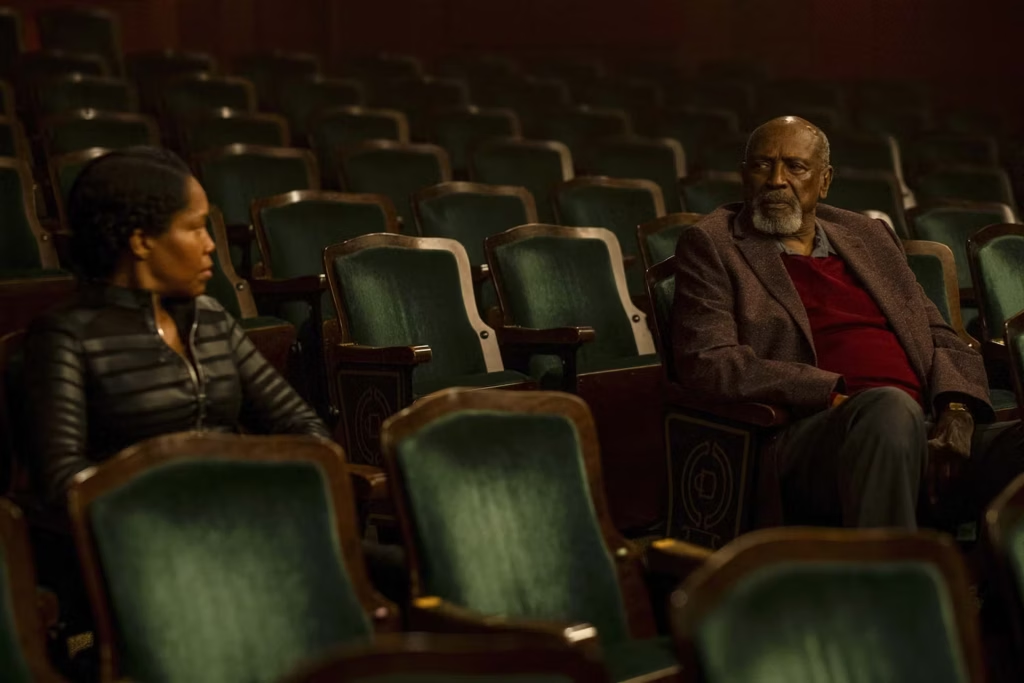
Regina King and Louis Gossett Jr. in the limited series "Watchmen" (2019) Photo Credit: HBO Networks

By anchoring its narrative in the Tulsa Race Massacre, the series reframes American heroism. It argues that masked justice is born not from fantasy, but from institutional failure. That white supremacy is not an aberration, but a throughline. That the past is not past.

Regina King as Angela Abar / Sister Night in the limited series "Watchmen" (2019) Photo Credit: HBO Networks

For MoviesToHistory.com, this makes Watchmen one of the most significant historical reinterpretations of the modern television era. It does not merely dramatize history. It restores it.

And in doing so, it suggests that before America can imagine new futures, it must unmask the old ones.

Genre Drama Dystopia Superhero Created by Damon Lindelof Based on Watchmen by Alan Moore (uncredited) Dave Gibbons Showrunner Damon Lindelof Starring Regina King Don Johnson Tim Blake Nelson Yahya Abdul-Mateen II Andrew Howard Jacob Ming-Trent Tom Mison Sara Vickers Dylan Schombing Louis Gossett Jr. Jeremy Irons Jean Smart Hong Chau Music by Trent Reznor Atticus Ross Country of origin United States Original language English No. of episodes 9 Production Executive producers Damon Lindelof Tom Spezialy Nicole Kassell Stephen Williams Joseph E. Iberti Producers Karen Wacker John Blair Production locations United States Wales Cinematography Alex Disenhof Xavier Pérez Grobet Gregory Middleton Andrij Parekh Chris Seager Editors David Eisenberg Anna Hauger Henk Van Eeghen Running time 52–67 minutes Production companies White Rabbit Paramount Television DC Entertainment Warner Bros. Television Original release Network HBO Release October 20 – December 15, 2019

Watchmen is available now with a subscription to HBO Max

https://moviestohistory.com/wp-content/uploads/2022/03/cropped-d3d0f4de5c874cf7a06b2f50e0bc7820-2-10.png
Connecting Movies To Reel Life…

Leave a Reply

Related Posts

"Air Force One" (1997), "Dave" (1993), "The American President" (1995)

My Top Ten President Movies:

As MoviesToHistory.com moves through January’s Featured Television Blog, Death by Lightning, it feels like the perfect moment to revisit how cinema has portrayed the American presidency. The office of President of the United States has long…