

Translating the “Unfilmable”…
Few modern American novels carry the same aura of mystique, density, and resistance to adaptation as Vineland. Published in 1990 by the famously reclusive Thomas Pynchon, the novel arrived as both a departure from and continuation of his earlier postmodern epics — less sprawling than Gravity’s Rainbow, yet no less slippery in tone, politics, and structure.
![Vineland is a 1990[a] postmodern novel by Thomas Pynchon set in California in 1984, the year of President Ronald Reagan's reelection.[6] Through flashbacks, its characters, who lived through the 1960s, account for the free spirit of rebellion of that decade, and describe the traits of the "fascistic Nixonian repression" and the war on drugs that clashed with it. The book portrays transformations in U.S. society from the 1960s to the 1980s.[6][7][8] The novel provided the inspiration for the loosely-adapted script of the 2025 film One Battle After Another by director Paul Thomas Anderson.](https://i0.wp.com/moviestohistory.com/wp-content/uploads/2026/03/61XLk9vX0KL._AC_UF10001000_QL80_.jpg?ssl=1)

![Thomas Ruggles Pynchon Jr. (/ˈpɪntʃɒn/ PIN-chon,[1][2] commonly /ˈpɪntʃən/ PIN-chən;[3] born May 8, 1937) is an American novelist. He is known for his dense, complex works of postmodern fiction, which are distinguished by their paranoid tone, absurd humor, and references to history, art, science, and popular culture. He is widely regarded as one of the greatest American novelists. Pynchon is notoriously reclusive. Few photographs of him have been published, and rumors about his location and identity have circulated since the 1960s. Born on Long Island, Pynchon served two years in the United States Navy and earned an English degree from Cornell University. After publishing several short stories in the late 1950s and early 1960s, he began composing the novels for which he is best known: V. (1963), The Crying of Lot 49 (1966), and Gravity's Rainbow (1973). For the latter, Pynchon won the 1974 U.S. National Book Award for Fiction.[4] Pynchon followed with the novels Vineland (1990), Mason & Dixon (1997), Against the Day (2006), Inherent Vice (2009), and Bleeding Edge (2013). Pynchon's latest novel, Shadow Ticket, was published in 2025. Two films by Paul Thomas Anderson; Inherent Vice (2014) and One Battle After Another (2025) were adapted from Pynchon novels, and the latter won the Best Picture at the 98th Academy Awards.](https://i0.wp.com/moviestohistory.com/wp-content/uploads/2026/03/4ada8a8c157ddd435258710b626c60d07d-23-thomas-pynchon-2.2x.h368.w245.jpg.webp?ssl=1)
![Gravity's Rainbow is a 1973 novel by Thomas Pynchon. The narrative is set primarily in Europe at the end of World War II and centers on the design, production and dispatch of V-2 rockets by the German military. In particular, it features the quest undertaken by several characters to uncover the secret of a mysterious device, the Schwarzgerät ('black device'), which is slated to be installed in a rocket with the serial number "00000". Gravity's Rainbow shared the 1974 US National Book Award for Fiction with A Crown of Feathers and Other Stories by Isaac Bashevis Singer.[1] Although selected by the Pulitzer Prize jury on fiction for the 1974 Pulitzer Prize for Fiction, the Pulitzer Advisory Board was offended by its content, some of which was described as "'unreadable', 'turgid', 'overwritten', and in parts 'obscene'".[2] No Pulitzer Prize was awarded for fiction that year.[2][3] The novel was nominated for the 1973 Nebula Award for Best Novel.[4] Time named Gravity's Rainbow one of its "All-Time 100 Greatest Novels", a list of the best English-language novels from 1923 to 2005[5] and it is considered by many critics to be one of the greatest American novels ever written](https://i0.wp.com/moviestohistory.com/wp-content/uploads/2026/04/Gravitys_Rainbow_1973_1st_ed_cover-707x1024.jpg?ssl=1)
For over three decades, Vineland lingered in the cultural imagination as a work that seemed inherently “unfilmable” — not because of scale, but because of form. Its narrative is recursive, fragmented, and soaked in paranoia, satire, and countercultural residue. It resists the clean arcs and emotional legibility that cinema, particularly American cinema, traditionally demands.

And yet, Paul Thomas Anderson — one of the most formally ambitious filmmakers of his generation — spent over twenty years attempting to do precisely that: adapt it.


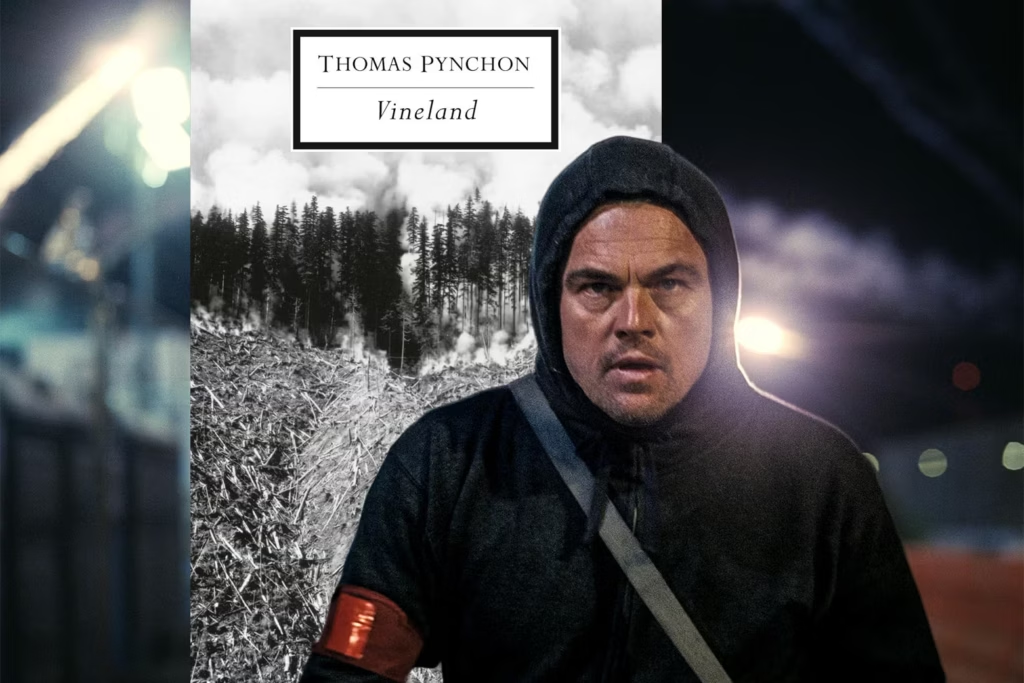
With One Battle After Another, Anderson did not simply translate Vineland to the screen. He reconstructed it, filtering Pynchon’s world through his own cinematic language, thematic obsessions, and generational concerns. The result is not a faithful adaptation in the traditional sense — it is something far more complex: a dialogue between two auteurs across mediums.
This is the story of how that translation happened — and why it ultimately works.


The Cult Status of Vineland…
By the time Vineland was published, Pynchon had already cemented himself as one of the defining voices of postmodern American literature.

His work is characterized by:
- Nonlinear narratives
- Dense intertextual references
- Political paranoia and institutional critique
- A blending of high and low cultural registers
Vineland, however, occupies a unique position within his bibliography. Set in a fictional Northern California town, the novel examines the aftermath of 1960s radicalism, particularly the erosion of countercultural ideals in the face of Reagan-era conservatism.
At its core, the novel is about inheritance — political, emotional, and generational.


The central dynamic between Zoyd Wheeler and his daughter Prairie serves as a narrative anchor, but even that relationship is refracted through layers of flashbacks, government conspiracies, and surreal digressions. The novel is less concerned with plot than with cultural residue — what remains after movements fail, revolutions stall, and ideals are commodified.
![Vineland is a 1990[a] postmodern novel by Thomas Pynchon set in California in 1984, the year of President Ronald Reagan's reelection.[6] Through flashbacks, its characters, who lived through the 1960s, account for the free spirit of rebellion of that decade, and describe the traits of the "fascistic Nixonian repression" and the war on drugs that clashed with it. The book portrays transformations in U.S. society from the 1960s to the 1980s.[6][7][8] The novel provided the inspiration for the loosely-adapted script of the 2025 film One Battle After Another by director Paul Thomas Anderson.](https://i0.wp.com/moviestohistory.com/wp-content/uploads/2026/04/81njPgBIVqL._AC_UF10001000_QL80_.jpg?resize=525%2C805&ssl=1)
This is precisely what gives Vineland its cult status:
- It captures a specific American disillusionment
- It resists narrative closure
- It privileges atmosphere and ideology over conventional storytelling
For readers, this creates a rich, immersive experience. For filmmakers, it presents a structural nightmare.

2. Why Hollywood Avoided It
The label “unfilmable” is often overused. In the case of Vineland, it is unusually precise.
Hollywood’s hesitation to adapt the novel stems from several core issues:
A. Narrative Fragmentation

Unlike traditional novels, Vineland does not follow a clear three-act structure.
Its storytelling is:
- Episodic
- Digressive
- Temporally unstable
Cinema, by contrast, typically relies on narrative compression and clarity. Translating Pynchon’s structure directly would risk alienating audiences or collapsing into incoherence.

B. Tonal Volatility
Pynchon moves seamlessly between:
- Slapstick absurdity
- Political critique
- Emotional intimacy
- Surreal hallucination
Maintaining tonal cohesion in a film adaptation would require a director capable of balancing contradiction without flattening it — a rare skill.

C. Political Density
![Vineland is a 1990[a] postmodern novel by Thomas Pynchon set in California in 1984, the year of President Ronald Reagan's reelection.[6] Through flashbacks, its characters, who lived through the 1960s, account for the free spirit of rebellion of that decade, and describe the traits of the "fascistic Nixonian repression" and the war on drugs that clashed with it. The book portrays transformations in U.S. society from the 1960s to the 1980s.[6][7][8] The novel provided the inspiration for the loosely-adapted script of the 2025 film One Battle After Another by director Paul Thomas Anderson.](https://i0.wp.com/moviestohistory.com/wp-content/uploads/2026/04/91F5bN32HL._AC_UF10001000_QL80_.jpg?resize=525%2C782&ssl=1)
Vineland is deeply embedded in:
- FBI surveillance culture
- Anti-establishment movements
- Media manipulation
These themes are not just background — they are structural to the narrative itself. A superficial adaptation risks reducing them to aesthetic texture rather than ideological substance.

D. The Problem of Interiority
Much of Pynchon’s power lies in:
- Internal monologue
- Narrative voice
- Linguistic play
These are notoriously difficult to translate into visual storytelling without heavy-handed exposition.

3. Anderson’s Early Attempts
Anderson’s relationship with Pynchon predates One Battle After Another by decades.

His earlier film Inherent Vice — also adapted from a Pynchon novel — served as both a proving ground and a warning. While Inherent Vice demonstrated that Pynchon could be adapted, it also revealed the limitations of direct translation:
![Directed by Paul Thomas Anderson Screenplay by Paul Thomas Anderson Based on Inherent Vice by Thomas Pynchon Produced by JoAnne Sellar Daniel Lupi Paul Thomas Anderson Starring Joaquin Phoenix Josh Brolin Owen Wilson Katherine Waterston Reese Witherspoon Benicio del Toro Martin Short Jena Malone Joanna Newsom Cinematography Robert Elswit Edited by Leslie Jones Music by Jonny Greenwood Production companies IAC Films[1] RatPac-Dune Entertainment[1] Ghoulardi Film Company[1] Distributed by Warner Bros. Pictures[1]](https://i0.wp.com/moviestohistory.com/wp-content/uploads/2026/04/Inherent_Vice_film_poster.webp?resize=525%2C778&ssl=1)
- Critics noted narrative opacity
- Audiences struggled with coherence
- The film leaned heavily on voiceover to preserve Pynchon’s prose

For Anderson, this experience clarified a crucial insight:
A faithful adaptation of Pynchon is less effective than an interpretive one.

Over the next two decades, Anderson reportedly returned to Vineland repeatedly, not with the goal of strict fidelity, but with a broader question:
What does Vineland feel like — and how can that feeling be cinematic?

This shift — from adaptation to interpretation — would ultimately define One Battle After Another.
4. Transforming the Story
Rather than attempting to compress Vineland into a conventional screenplay, Anderson restructured its core elements:

A. Narrative Consolidation

The film narrows its focus to a more linear storyline centered on:
- A former revolutionary
- A resurging political threat
- A family caught in the crossfire
This provides a clearer emotional throughline while still preserving the novel’s thematic concerns.
B. Character Reconfiguration

Composite characters and altered relationships allow Anderson to:
- Streamline exposition
- Heighten emotional stakes
- Maintain thematic integrity
This aligns with a recurring adaptation strategy: emotional truth over literal accuracy.

C. Tonal Calibration

Anderson retains Pynchon’s tonal shifts but grounds them in:
- Performance-driven realism
- Controlled visual language
- Rhythmic editing
The result is a film that feels unstable — but intentionally so.

D. Political Reframing

While the novel is rooted in Reagan-era anxieties, the film expands its scope to resonate with contemporary audiences:
- Surveillance culture
- Institutional distrust
- The cyclical nature of political repression
This temporal layering transforms Vineland from a period piece into a living political text.

5. The Revolutionary Family Narrative
At the heart of both Vineland and One Battle After Another is a deceptively simple question:
What do we inherit from our parents’ revolutions?
Anderson sharpens this into the film’s central emotional axis.

A. Generational Disillusionment
The older generation — once radical, now compromised — embodies the collapse of idealism. Their past is not heroic; it is unfinished.


B. The Burden on the Next Generation

Younger characters are left to navigate:
- Fragmented histories
- Incomplete narratives
- Moral ambiguity
This dynamic transforms political history into personal conflict.

C. Memory as Narrative

Both the novel and the film treat memory as unstable:
- Stories shift depending on who tells them
- Truth becomes subjective
- History becomes contested terrain
This aligns directly with my site’s core thesis:
history in media is not just represented — it is interpreted, contested, and reshaped.

6. Pynchon’s Influence on Modern Cinema
Even before Anderson’s adaptation, Pynchon’s influence had already permeated modern cinema.

His thematic DNA can be found in:
- Conspiracy-driven narratives
- Fragmented storytelling structures
- Blending of satire and dread

Directors like Anderson have effectively translated Pynchon’s literary techniques into cinematic language:
| Pynchon Technique | Cinematic Equivalent |
|---|---|
| Nonlinear narrative | Fragmented editing structures |
| Dense prose | Visual symbolism and mise-en-scène |
| Paranoia | Sound design and pacing |
| Satire | Tonal juxtaposition |
In this sense, One Battle After Another is not just an adaptation — it is a culmination of decades of indirect influence.

7. Why the Adaptation Works
The success of Anderson’s adaptation lies in a fundamental principle:
It does not try to be Vineland. It tries to be true to what Vineland is about.

A. Fidelity to Theme, Not Structure

The film preserves:
- Political skepticism
- Generational tension
- Emotional ambiguity
while abandoning the novel’s more unwieldy narrative architecture.

B. Cinematic Translation, Not Replication

Anderson uses:
- Visual storytelling
- Performance
- Rhythm
to achieve effects that Pynchon achieves through prose.

C. Emotional Accessibility Without Simplification
The film is more accessible than the novel — but not reductive. It invites audiences in without diluting its complexity.
D. Authorial Dialogue

Ultimately, the adaptation functions as a conversation between:
- Pynchon’s literary worldview
- Anderson’s cinematic sensibility
Neither dominates. Instead, they coexist — sometimes in tension, sometimes in harmony.
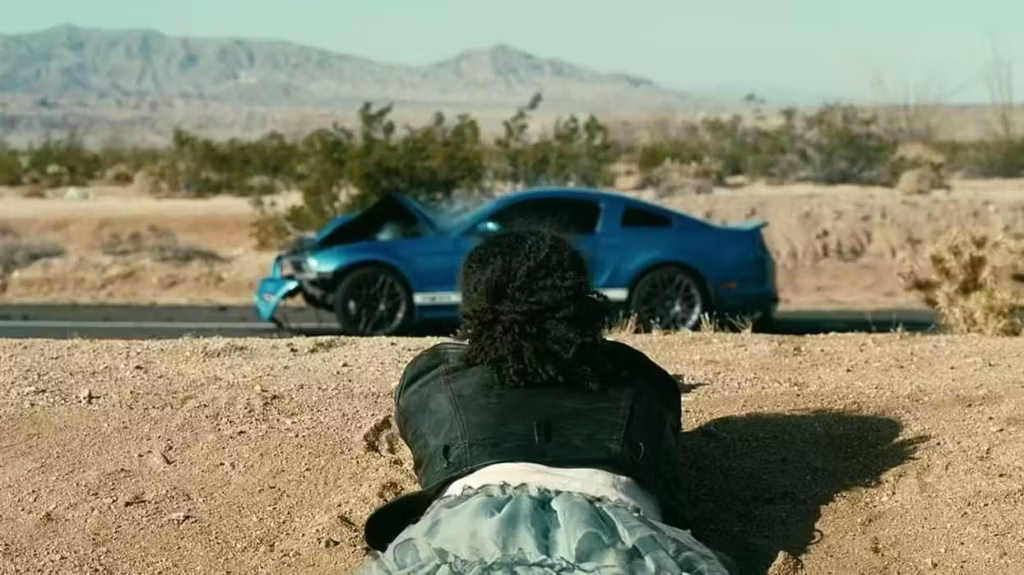
Adaptation as Interpretation
The journey from Vineland to One Battle After Another is not a story of fidelity — it is a story of translation across mediums, generations, and artistic philosophies.
![Vineland is a 1990[a] postmodern novel by Thomas Pynchon set in California in 1984, the year of President Ronald Reagan's reelection.[6] Through flashbacks, its characters, who lived through the 1960s, account for the free spirit of rebellion of that decade, and describe the traits of the "fascistic Nixonian repression" and the war on drugs that clashed with it. The book portrays transformations in U.S. society from the 1960s to the 1980s.[6][7][8] The novel provided the inspiration for the loosely-adapted script of the 2025 film One Battle After Another by director Paul Thomas Anderson.](https://i0.wp.com/moviestohistory.com/wp-content/uploads/2026/04/81njPgBIVqL._AC_UF10001000_QL80_.jpg?ssl=1)
Where Hollywood once saw an “unfilmable” novel, Anderson saw an opportunity — not to replicate, but to reinterpret.

In doing so, he demonstrates a broader truth about historical and literary adaptation:
The most effective adaptations are not the most accurate — they are the most intentional.
For MoviesToHistory.com, this raises a critical question worth extending to your audience:
When a story changes form, what matters more — what is preserved, or what is transformed?
Because in the case of Vineland, the answer is both.

One Battle After Another is available now with a subscription to HBO Max…

Discover more from Movies To History.com
Subscribe to get the latest posts sent to your email.
Related Posts
ELVIS – Official Trailer:
ELVIS PRESLEY IS IN THE BUILDING! The highly anticipated bio-drama about his life and career is here, and so is the Official Trailer on my blog! Presley's life was epic, so it would take an…
JFK (1991): The Film That Made Conspiracy Mainstream:
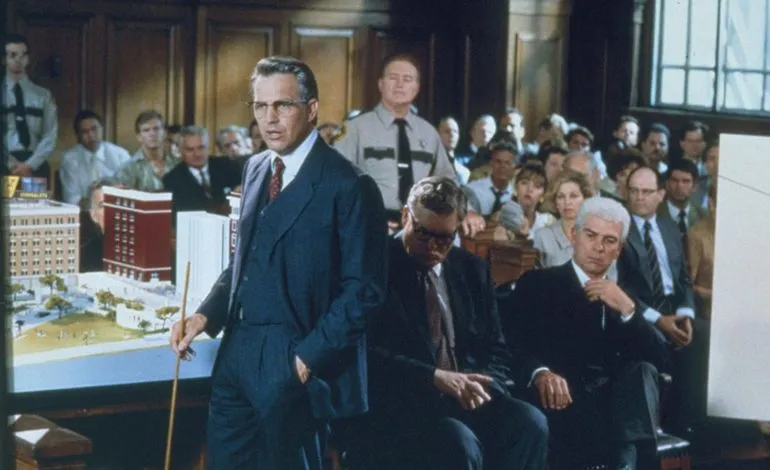
When JFK premiered in December 1991, it was not just another historical drama. It arrived at a moment of national uncertainty and cultural transition — and detonated a new era of mainstream skepticism about American institutions. Blending…

White House Plumbers vs. History: The True Story Behind the Watergate Break-In:
When HBO’s White House Plumbers premiered in 2023, it brought the chaotic story of E. Howard Hunt and G. Gordon Liddy into the spotlight — two men whose mix of zealotry, incompetence, and loyalty to President Richard…