

The Road to the Oscars
By the time One Battle After Another arrived at the 98th Academy Awards, its victory felt both inevitable and improbable — a paradox that defines many Best Picture winners in retrospect.

![The 98th Academy Awards ceremony, presented by the Academy of Motion Picture Arts and Sciences (AMPAS), will take place on March 15, 2026, at the Dolby Theatre in Hollywood, Los Angeles, United States. During the gala, the AMPAS will present Academy Awards (commonly referred to as Oscars) in 24 categories, honoring films released in 2025. The ceremony will be televised in the United States by ABC and streamed on Hulu.[2] Comedian Conan O'Brien is set to host the show for the second consecutive time, after receiving acclaim for hosting the previous year, with Raj Kapoor and Katy Mullan returning as executive producers for the third consecutive year, and Hamish Hamilton returning as director.[a] In related events, the Academy held its 16th Governors Awards ceremony at the Ray Dolby Ballroom of the Ovation Hollywood complex in Hollywood on November 16, 2025.[8] The Academy Scientific and Technical Awards will be presented on April 28, 2026, in a ceremony at the Academy Museum of Motion Pictures in Los Angeles.[9] This year, Best Casting will be presented as a categorial debut, bringing the total number of competitive Oscar categories to 24.](https://i0.wp.com/moviestohistory.com/wp-content/uploads/2026/03/Screenshot-2026-03-14-at-4.00.51-AM-1015x1024.png?ssl=1)
The film entered awards season with momentum that began not in Hollywood, but on the festival circuit and critics’ lists, where it quickly established itself as more than a genre hybrid. It was read as a political text, a historical echo, and a formal experiment all at once. That multi-dimensionality allowed it to dominate across major precursors:

- Wins at the Critics Choice Awards reinforced its critical consensus
- Strong recognition from the BAFTA Awards signaled transatlantic appeal
- Momentum from the Golden Globe Awards positioned it as both industry and media-friendly


But Oscar success is rarely just about accumulation — it is about narrative. And One Battle After Another had the strongest narrative of the season: a long-gestating passion project from one of American cinema’s most respected auteurs finally aligning with the political and cultural anxieties of its moment.

Paul Thomas Anderson’s Career Evolution


For over two decades, Paul Thomas Anderson has occupied a paradoxical position in Hollywood: revered but rarely rewarded at the highest level.

From the sprawling ambition of Magnolia to the austere brutality of There Will Be Blood, Anderson built a filmography defined by:
- Moral ambiguity
- Structural experimentation
- Deep psychological excavation of American identity


Yet, until now, the Academy had consistently stopped short of awarding him Best Picture or Best Director. His films were often seen as too challenging, too idiosyncratic, or simply too unconcerned with accessibility.


![Directed by Paul Thomas Anderson Written by Paul Thomas Anderson Produced by Sara Murphy Adam Somner Paul Thomas Anderson Starring Alana Haim Cooper Hoffman Sean Penn Tom Waits Bradley Cooper Benny Safdie Cinematography Michael Bauman Paul Thomas Anderson Edited by Andy Jurgensen Music by Jonny Greenwood Production companies Metro-Goldwyn-Mayer Pictures Focus Features[1] Bron Creative Ghoulardi Film Company Distributed by United Artists Releasing (United States) Universal Pictures (international)](https://i0.wp.com/moviestohistory.com/wp-content/uploads/2022/04/Licorice-Pizza-Poster-814x1024.png?ssl=1)

One Battle After Another represents a synthesis of Anderson’s career-long tendencies:
- The political paranoia of Inherent Vice
- The character-driven intensity of The Master
- The historical undercurrents of There Will Be Blood
![Directed by Paul Thomas Anderson Screenplay by Paul Thomas Anderson Based on Inherent Vice by Thomas Pynchon Produced by JoAnne Sellar Daniel Lupi Paul Thomas Anderson Starring Joaquin Phoenix Josh Brolin Owen Wilson Katherine Waterston Reese Witherspoon Benicio del Toro Martin Short Jena Malone Joanna Newsom Cinematography Robert Elswit Edited by Leslie Jones Music by Jonny Greenwood Production companies IAC Films[1] RatPac-Dune Entertainment[1] Ghoulardi Film Company[1] Distributed by Warner Bros. Pictures[1]](https://i0.wp.com/moviestohistory.com/wp-content/uploads/2026/04/Inherent_Vice_film_poster-691x1024.webp?ssl=1)

But crucially, this time, those elements are packaged within a narrative that feels urgent rather than abstract. The film does not merely observe American systems — it confronts them.
That shift — from observer to interrogator — proved decisive.

From Vineland to Screen
Adapting Thomas Pynchon has long been considered one of the most difficult tasks in American cinema. His work resists conventional storytelling — dense, nonlinear, saturated with paranoia and cultural critique.
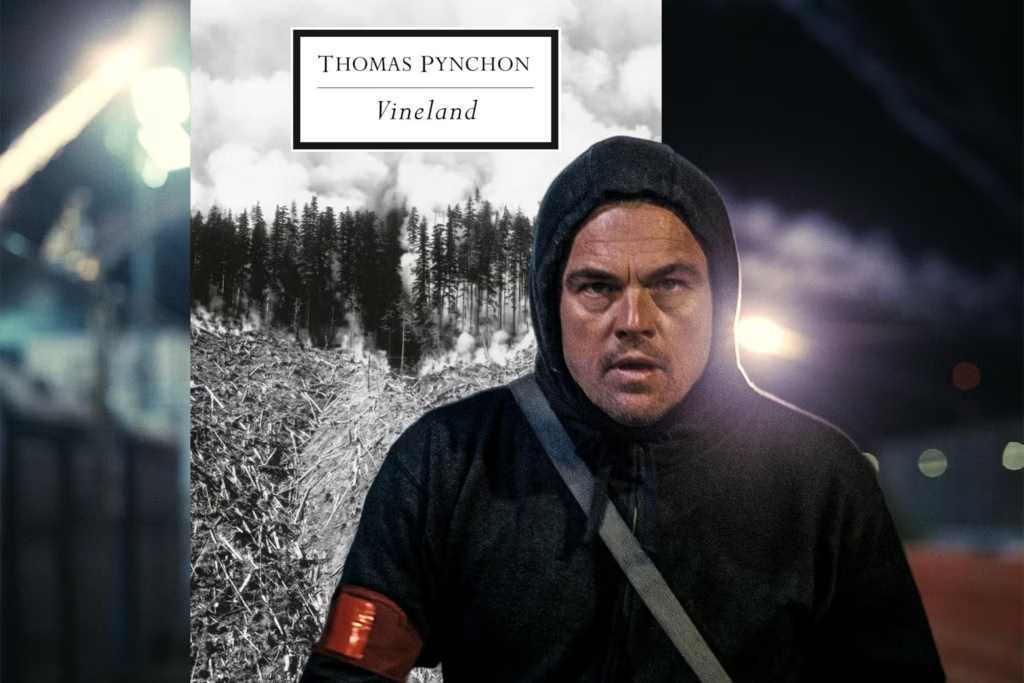
Vineland, published in 1990, is particularly elusive:
- It interrogates the collapse of 1960s idealism
- It explores state surveillance and countercultural failure
- It blends absurdism with political tragedy


Anderson’s adaptation is less a direct translation and more a reinterpretation. He retains the ideological DNA of Pynchon’s work while restructuring it into a cinematic narrative that can operate within mainstream distribution.

Key transformation strategies include:
- Narrative consolidation: Streamlining Pynchon’s sprawling plot into a character-driven arc
- Emotional anchoring: Centering the story on personal stakes rather than abstract systems
- Genre hybridity: Framing political critique within action-thriller conventions

This is not fidelity in the traditional sense — it is functional adaptation. And the Academy, historically wary of overly experimental literature adaptations, rewarded that balance.

Why the Academy Responded


The Academy’s embrace of One Battle After Another can be understood through three overlapping criteria:

1. Political Relevance Without Didacticism
The film engages with themes of institutional corruption, militarization, and ideological fatigue — but avoids overt moralizing. This allows it to feel timely without being reductive.

2. Formal Ambition Within Accessibility
Unlike some of Anderson’s earlier work, the film maintains narrative propulsion. It is structurally sophisticated, but not alienating.

3. Industry Narrative Alignment
Hollywood often rewards films that reflect its own anxieties.

In an era of:
- Streaming disruption
- Franchise dominance
- Shrinking theatrical windows
One Battle After Another represents a reaffirmation of cinema as an art form capable of scale, intelligence, and risk.
In other words, the Academy was not just rewarding a film — it was making a statement about what films should be.
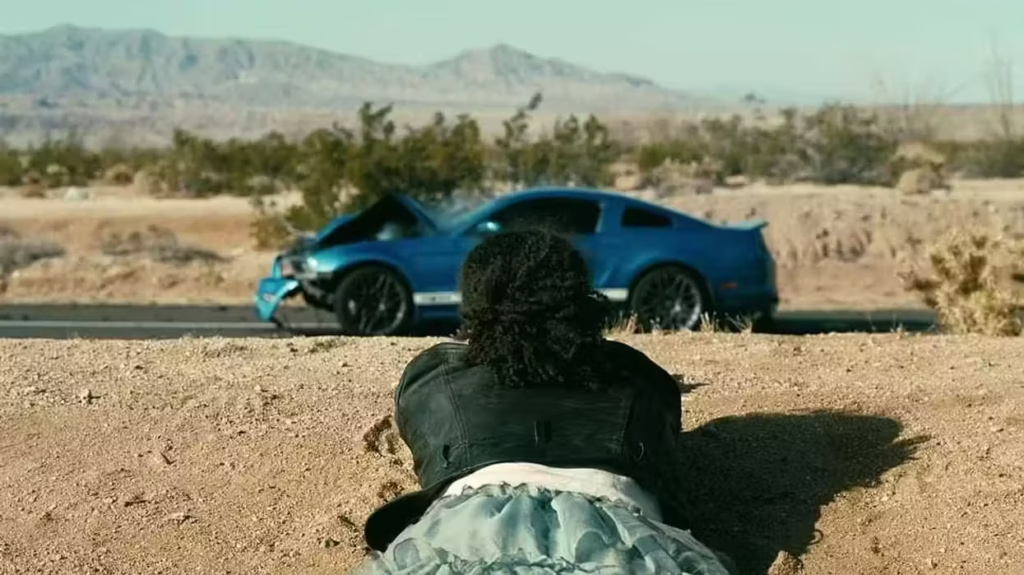
The Return of Risky Studio Films
For much of the 2010s and early 2020s, mid-budget, adult-oriented films were increasingly marginalized.


![Directed by Ryan Coogler Written by Ryan Coogler Produced by Zinzi Coogler Sev Ohanian Ryan Coogler Starring Michael B. Jordan Hailee Steinfeld Miles Caton Jack O'Connell Wunmi Mosaku Jayme Lawson Omar Miller Delroy Lindo Cinematography Autumn Durald Arkapaw Edited by Michael P. Shawver Music by Ludwig Göransson Production companies Warner Bros. Pictures[1] Proximity Media[1] Domain Entertainment[1] Distributed by Warner Bros. Pictures](https://i0.wp.com/moviestohistory.com/wp-content/uploads/2026/01/Sinners.jpg.webp?ssl=1)
Studios prioritized:
- Franchise IP
- Superhero universes
- Algorithm-driven streaming content
One Battle After Another disrupts that trend.


Its success signals:
- Renewed viability for director-driven projects
- Audience appetite for intellectually demanding narratives
- Industry willingness to invest in non-franchise storytelling
This positions the film within a broader historical cycle. Hollywood has repeatedly oscillated between:
- Commercial spectacle
- Artistic risk
This victory suggests the pendulum may be swinging — however briefly — back toward the latter.

The Cultural Moment Behind the Win
Every Best Picture winner is, to some degree, a reflection of its cultural moment.


One Battle After Another emerges from a landscape defined by:
- Political polarization
- Institutional distrust
- Historical reevaluation of American power structures
The film does not provide solutions — it offers diagnosis. And that diagnostic quality resonates with audiences navigating similar uncertainties.
In this sense, its victory aligns with a broader Academy pattern: rewarding films that capture not just stories, but states of mind.

What the Victory Means for Future Filmmaking
The long-term significance of One Battle After Another lies not in its awards tally, but in its potential ripple effects.

For Directors
It reinforces the viability of auteur-driven filmmaking within the studio system.

For Studios
It provides a case study in the commercial and critical success of non-franchise cinema.

For Audiences
It challenges the assumption that complexity and accessibility are mutually exclusive.

For the Industry
It reopens a question that has lingered for over a decade:
Can Hollywood sustain films that are politically engaged, formally ambitious, and broadly distributed?

Final Analysis
The Best Picture win for One Battle After Another is not merely a recognition of excellence — it is a recalibration.

It acknowledges:
- A director at the height of his craft
- A film that bridges art and accessibility
- A moment in which audiences and institutions are once again receptive to challenging narratives
Whether this marks a lasting shift or a temporary deviation remains to be seen.

But for now, the message is clear:
Risk — when executed with precision and purpose — can still define the future of American cinema.

One Battle After Another is available now with a subscription to HBO Max…

Discover more from Movies To History.com
Subscribe to get the latest posts sent to your email.
Related Posts
‘Dopesick’ – Official Trailer:
"Inspired By The True Story Of How America Got Hooked On A Lie" - Dopesick ADDICTED TO THE LIE... Dopesick is an American biographical drama limited series that was created by Danny Strong for Hulu.…
CODA – Official Trailer:
CODA (2021) This week's FEATURED BLOG is Academy Award Winner for "Best Picture" and AFI Movie of the Year, CODA and here is the OFFICIAL TRAILER!!!! CODA also won the Academy Award for " Best…
‘Hidden Figures’ (2016) – Official Trailer:
The Women History Tried to Forget — and the Film That Brought Them Back... In the mythology of the American Space Race, the spotlight has long been fixed on rockets, astronauts, and presidential ambition. But Hidden…