

When we talk about A League of Their Own, the conversation usually begins with the people in front of the camera.
Geena Davis. Tom Hanks. Lori Petty. Madonna. Rosie O’Donnell.


But the person who may have mattered most to the film’s identity was standing behind it.

A League of Their Own did more than turn the forgotten history of the All-American Girls Professional Baseball League into a Hollywood sports movie. It placed women—not as girlfriends in the stands or wives waiting at home, but as athletes—at the center of a baseball story.
And Marshall understood that story began long before Hollywood arrived.


Before the Hollywood Movie, There Was a Documentary…
The road to A League of Their Own did not begin in a studio boardroom.
It began with the women who had actually played.

In 1987, Kelly Candaele and Kim Wilson produced a documentary called A League of Their Own about the All-American Girls Professional Baseball League. The AAGPBL Players Association identifies that documentary as the inspiration for the feature film that followed. (AAGPBL Players Association)
For Candaele, the subject was personal.


His mother, Helen Callaghan Candaele St. Aubin, and his aunt, Marge Callaghan, had both played professional baseball. According to the Players Association, Candaele wrote the story in honor of the two women. (AAGPBL Players Association)

The documentary therefore performed an important act of historical recovery before Marshall ever became involved: it treated women’s baseball as history worth preserving.

Helen Callaghan’s AAGPBL biography records that Candaele and Wilson were producing the documentary in 1987 and that the experiences of Helen and Marge helped inspire the idea of using sisters at the center of a fictional story about the league. (AAGPBL Players Association)
That distinction matters.
![Margaret “Marge” and Helen “Kelly” Callaghan, who were born and raised in Vancouver, British Columbia, made the wartime All-American Girls Professional Baseball League (AAGPBL) and became regulars in 1944. The Vancouver girls, the first two sisters to play in the new women’s professional circuit, were not the fictional siblings featured in Penny Marshall’s famous 1992 movie, A League of Their Own, but both enjoyed good careers in the historic All-American league. The two were the fourth and fifth of the six children of Albert and Hazel Callaghan, and their names, with the eldest first, were Kay, Pearl, Lewis, Margaret, Helen, and Patrick. Their mother died early, Albert remarried, and he and his wife Anne had three children, Wayne, Elaine (Lani), and Dan. All of the Callaghans were athletic, but Marge, born on December 23, 1921, and her sister Helen, almost 15 months younger, grew up playing sports like softball, soccer, lacrosse, and roller hockey in the streets with neighborhood kids, mostly boys. The Irish Catholic sisters went to the same elementary and junior high schools, and both attended King Edward High. Sharing the same interests, they played on the same teams, including basketball in the winter and track and field in the chilly spring. Marge left school in 1939 and Helen in 1940, and they were teammates on the fast-pitch Young Liberals, later renamed (due to a different sponsor) the Western Mutuals, a traveling team made up of local players from Vancouver’s city league. During World War II the pretty Callaghan girls worked for Boeing Aircraft and played for the Mutuals. The team competed in the World Championship Tournament in Detroit in 1943, and the sisters were scouted by the All-American League. As a result, Helen was invited to the All-American League’s spring training at Peru-LaSalle, Illinois, in May 1944. The left-handed hitting Vancouver outfielder made the second-year circuit and was allocated to one of the loop’s two expansion teams, the Minneapolis Millerettes. In mid-summer Marge, after their father encouraged her to go, obtained special permission to leave her wartime position with Boeing, where she was a squad leader on the assembly line. She joined the Millerettes, who started the season playing games at Nicollet Park, home of the American Association’s Minneapolis Millers. However, the Millerettes didn’t draw well with a Double-A men’s team in town, and due to declining attendance, the girls’ nine became an “orphan” team in mid-season. Marge, who was interviewed in 2011, remembered the difference between playing for the Mutuals in Canada compared to the Millerettes in the USA wasn’t great. During the war years the All-American League was playing a hybrid of baseball and softball, and the league used underhand pitching until the middle of the 1946 season. However, by the time Marge joined the Minneapolis team, the girls were playing all road games, living out of suitcases, and she needed a bigger glove. The sisters performed well as rookies, with Marge, a right-handed hitter who loved to bunt and hit-and-run, batting .182, while Helen hit .287, the second-best mark in the league after South Bend’s Betsy Jochum, who averaged .296. Marge, a 5’3” right-handed thrower and batter, and Helen, who was two inches shorter and threw and batted left-handed, moved with the franchise in 1945 to Fort Wayne, Indiana, where the girls played together for three seasons (Helen didn’t play in 1947). Both were fast, but Helen was faster. “My reflexes were faster than hers,” recalled Marge, “and I got started faster, but she always beat me. She finished faster by about a step.” Helen, who was interviewed by People Magazine in 1987, observed, “We were supposed to play like men and look like women.” She talked about the charm school offered by the league again in 1944. The players, many of whom grew up on farms, learned how to walk, sit, talk, wear their hair, and do their makeup properly. “That was an important to us as our playing,” Helen recalled. “And we weren’t supposed to drink or smoke in public since we were supposed to be ladies at all times.” The AAGPBL, launched with four teams, developed from a hardball game using men’s baseball rules and underhand pitching in 1943 to a 10-team expanded league in 1948 that adopted overhand pitching, and the Callaghans lived through most of the changes. In 1943 the All-American League played games with a 12-inch circumference ball, the same as used in men and women’s fast-pitch softball. The ball was reduced in increments, starting with an 11 ½ ball in mid-1944, moving to an 11-inch ball in 1946, and through a 10 3/8 inch ball in 1948 to a 10-inch red-seamed livelier ball in mid-1949. As the league decreased the size of the ball, the distance from the pitcher’s mound to home plate and the length of the base paths were increased, also in increments, because the batters could hit the smaller ball harder. The ball and diamond size continued to evolve, since the league’s founders and managers always envisioned the girls playing baseball. For example, the original pitching distance was 40 feet, compared to 35 feet in softball, and the first base paths were 65 feet, compared to softball’s 60 feet. However, All-American runners could lead off and steal from the beginning, making the game faster-paced. In mid-1944, when the ball was reduced to 11 1/2 inches, the base paths were lengthened from 65 to 68 feet. In 1945 the pitching distance was moved to 42 feet in mid-season to help the hitters, but no other dimensions were altered. In 1946, when the ball’s size was reduced to 11 inches, the base paths were reset at 70 feet. Sidearm pitching was introduced in mid-1946, and the sidearm style was fully adopted in 1947. In 1948, when the 10 3/8 inch ball was introduced, the mound was moved to 50 feet and the base paths to 72 feet. In mid-1949, when the livelier ball came into play, the pitching distance was 55 feet. In 1953 the pitching distance was moved to 56 feet and the bases paths to 75 feet. Finally, the league, facing demise in mid-1954, introduced a regulation baseball and made the pitching distance 60 feet and the base paths 85 feet. Thus, the AAGPBL evolved almost by the season, and the players kept adjusting. In that era many grew up as tomboys, playing baseball with boys on diamonds in the country, in small towns, and in cities. During World War II and the immediate postwar years, the AAGPBL, a circuit that recruited, signed, and allocated the girls to teams, played mainly “small ball,” and the sisters thrived on that style of play. Marge and Helen enjoyed their golden summers, including living in homes of local families and sporting the Daisies’ pink uniforms with burgundy trim. A graceful fielder with quick hands, Marge played mostly third base, where her strong arm made her a fixture. She also played second base, but seldom shortstop. The Vancouver speedster batted second, following Helen, who was usually the Daisies’ leadoff hitter. Marge loved to bunt, and though her average always ranked below Helen’s, they worked well together. Marge bunted to advance her sister to the next base, or if Helen stole second and maybe third base, Marge sacrificed to score the run. Besides other Canadians, the sisters’ best friend with the Daisies was Dottie Collins, the circuit’s great underhand pitcher who was known as the “Strikeout Queen.” The Callaghans, quiet but quick to smile, were first-rate athletes who understood the game and became exceptional baseball players, even though they came out of a softball background. Marge, bright, spirited, and likeable, with her long brown hair and dark brown eyes, always gave the game her best effort. Helen, whose flowing brown hair was a bit darker and whose hazel eyes flashed liked Marge’s, was the better hitter, but both loved every day they spent on the field. The 1944 season proved difficult for the Millerettes, since the 16-player team lost its home base on July 22. Staffed largely with rookies such as the Callaghans, pitcher Dottie Wiltse, hurler Audrey Haine, and first baseman Vivian Kellogg, the Millerettes finished sixth (last) in both halves of the season (the league introduced a single-season format in 1945). For the season’s first half, when other teams made the six-hour train trip from Chicago to play at Nicollet Park, the Millerettes finished 23-36. In the second half as a road team, the Minneapolis entry posted a 22-36 record. Dottie Wiltse, a curveballer who led the league with 205 strikeouts in 38 games, produced the team’s only winning record, 20-16. Annabelle “Lefty” Lee fashioned an 11-14 ledger, but Audrey Haine, the team’s number-three pitcher, finished with an 8-20 mark. In a loop dominated by fast pitchers, notably during the underhand years, Helen Callaghan, who had pop in her bat, topped the Millerettes’ hitters with her .287 mark. The fleet Vancouver star stole 112 bases, connected for five doubles, four triples, and three home runs (all inside-the-park shots), and contributed 17 RBIs from the leadoff spot. Margaret Wigiser, traded to the Rockford (Illinois) Peaches partway through the season, ranked second with her .212 average, Elizabeth “Lib” Mahon, traded to the Kenosha Comets after a few weeks, hit .211, and cleanup batter Viv Kellogg, never a speedster, batted .202 and paced her team with 46 RBIs. Despite the hardships from traveling and living on the road, the Millerettes, in the words of Dottie (Wiltse) Collins (she married to Harvey Collins, a Fort Wayne native and Navy veteran, before the 1946 season), were being paid to play baseball, and they had a great time. Dottie, interviewed in 1997, recalled, “We were young, we were having a good time, and we had money in our pockets. I mean, what more could you ask for?” The Callaghans echoed that sentiment. Further, the sisters liked having several Canadian teammates, making the league seem more like home. Marge said, “In 1945, after we moved to Fort Wayne, we had half a dozen Canadians on the team. Besides me and Helen, we had Penny O’Brian [later Cooke], and we had Yolande Teillet and Audrey Haine [later Daniels], and Arleene Johnson, but I don’t remember all the names.” The Minneapolis franchise moved to Fort Wayne in 1945, and the expansion Milwaukee Chicks, who won the Shaughnessy Championship in 1944 over the Kenosha Comets, moved to Grand Rapids. In Fort Wayne the team held a contest, and a fan picked the new name, the Daisies. Fort Wayne, full of rookies who grew into professionals in 1944, ranked second in the six-team circuit with a 62-47 ledger, right behind the Rockford Peaches and their loop-best 67-43 mark. The Peaches won the Shaughnessy Championship (first place versus third place, second place versus fourth place, and winner versus winner) in the league’s last wartime postseason. The Fort Wayne team, managed in 1945 and 1946 by former major leaguer Bill Wambsganss, or Wamby, was led by Canadians and Californians, many of whom were fun-loving girls. Helen Callaghan, who played all 111 games, led the circuit in 1945 with her .299 average. Enjoying a standout season, the speedy Helen contributed 17 doubles, four triples, and three homers, stole 92 bases, and produced 29 RBIs. She was followed in hitting on her team by Canadians such as catcher Yolande Teillet, who averaged .231 in 10 games. Third sacker Arleene Johnson batted .222 in 15 games. Outfielder Penny O’Brian hit .216 in 83 games. Viv Kellogg, who played the full 111 games, averaged .214 with 10 doubles, six triples, and one home run (she lost speed after injuring her knee), leading led her team in RBIs with 38. Marge Callaghan, a lifetime .196 batter, hit that exact mark in 1945. She played 99 games, mostly at third base, and her .912 fielding mark at the position was second only to Kenosha’s Ann Harnett at .922. The top pitcher, also voted the league’s first Player of the Year, was Grand Rapids’ Connie Wisniewski, a tireless right-handed windmiller who fashioned a 32-11 record, and she was followed by Dottie Wiltse and her 29-10 mark. Dottie also hurled a pair of no-hitters against Rockford, achieving the feats on June 29 and July 15, 1945. The Daisies’ next best hurler was Annabelle Lee with a 13-16 record and a 1.63 ERA, and Lee no-hit Grand Rapids on July 7, 1945. Winnipeg’s Audrey Haine improved to 16-10 with a 2.46 ERA, and on August 26, 1944, she won a seven-inning no-hitter against Kenosha. On June 15, 1945, Haine participated in the league’s only double no-hit contest, a six-inning tilt against the Comets at Kenosha’s Lakefront Stadium. Following the 1945 season, Helen married Bobby Candaele, also from Vancouver, but she returned to the league and played under her maiden name. The Callaghans enjoyed the first postwar season with Fort Wayne, but Helen’s hitting tailed off in 1946, and she didn’t play in 1947. The 5’1” 115-pound brunette, short of stature but long on spirit and determination, played all 112 games, but she averaged only .213. She still hit 10 doubles, three triples, and one home run, and she swiped 114 bases and contributed 26 RBIs. Marge, enjoying another stellar season at third base, hit .188 with two doubles, three triples, and a single home run, her second career home run. The expanded eight-team league, featuring the Muskegon Lassies and Peoria Redwings in 1946, used a new 11-inch ball and allowed sidearm hurling at mid-season. Dottie Collins, a natural sidearmer, produced a 22-20 record, and strong-armed outfielder Faye Dancer, trying the mound after sidearming was allowed, posted a 10-9 ledger, but the Daisies, hitting just .184 as a team (seventh in the league), finished in fifth place with a 52-60 record. In 1947, when the league adopted sidearm hurling and held spring training in Havana, Cuba, the Daisies finished seventh with a 45-67 record. Marge averaged .201 with a pair of doubles, one triple, and one home run, a long blast at South Bend (she also homered in an exhibition game in Havana), stealing 57 bases and adding 23 RBIs. Helen, pregnant, stayed home. The Candaeles’ first son Richard was born before the 1948 campaign began with spring training at Opa-Locka, Florida. Fort Wayne limped through another losing season in 1948, suffering a major blow when Dottie Collins, almost five months pregnant, left the team on August 1 in order to have her first child. Also, the Callaghan sisters played their final All-American season together. In 1948 the league expanded again, adding the Springfield (Illinois) Sallies and the Chicago Colleens, but both teams were staffed largely with rookies and players not among the protected top ten on the rosters of the eight established teams. Predictably, the Sallies and the Colleens finished last in the loop’s Western and Eastern Divisions, respectively. Fort Wayne ranked fourth (53-72), but the Daisies lacked the hitting and pitching to become a successful playoff team. Helen played 54 games in the first of the season, hitting .191, her lowest mark to date, but she suffered a ruptured tubal pregnancy, needed emergency surgery, and returned home in late July. Marge, who played all 112 games at second base, averaged .187 and helped anchor the Daisies’ infield. Marge returned for the 1949 season and was swapped to South Bend, and Helen also returned, but she was traded to Kenosha. In mid-July the league adopted a livelier 10-inch ball, and most of the players saw their hitting improve. Helen Candaele, playing under her married name, finished her career with the Comets and made a comeback at the plate, averaging .251, the seventh-best mark in the league, and Marge, playing third base for most of the second half of the season in South Bend, hit .169. In the end, Helen left the game she loved to raise her family and help with her husband’s taxi business in Vancouver. The Blue Sox traded Marge to the Peoria Redwings before the 1950 season. She played just 30 games as an infielder. She broke her ankle in a game on June 19, and her average for the season fell to .157. At one point, after manager Leo Murphy resigned in an economy move to help the financially strapped Redwings, the savvy Marge was considered for the post of interim manager, but the job went to Mary Reynolds. Marge returned to Peoria in 1951, but after an argument with the manager, she was traded to the Battle Creek Belles for the remainder of a season, hitting a combined .236 in 107 games. “You wouldn’t believe how I got traded from Peoria to Battle Creek in the last part of the 1951 season,” Marge later explained. “In one game I was playing third base, and I picked up a grounder, and I turned around to throw to second, and the runner was there, but not the second baseman. So I turned and threw the ball to first base, and I got the runner going down to first. I was always taught, ‘If you can’t get two, get one.’ After the inning was over, the manager, Johnny Rawlings, came screaming out of the dugout, and he said, ‘What the hell do you think you’re doing?’ “I got my Irish temper up, and I screamed right back, ‘What the hell do you think I was doing?’ All the people in the stands stood up and yelled, ‘Atta girl, Marge – You tell him!’ And I guess that made him mad. “I said to Johnny Rawlings, ‘I was always taught if I couldn’t get two outs, get one.’ He said, ‘You should have thrown to second base.’ I said, ‘It would have gone out between center field and right field, and the run would have scored.’ He said, ‘You should have thrown it anyway.’ “I couldn’t believe it! That just doesn’t make sense. I didn’t say any more, and I went over and sat down on the bench. Three weeks later, I got traded to Battle Creek. After Johnny Rawlings traded me, he got fired. He made everyone mad in Peoria, and he got fired. All those years and I never talked back to the coaches. I did what they told me, but I couldn’t see any sense to what the manager said on that play. He would have blasted me if I hadn’t thrown it to first. And I couldn’t figure out why he didn’t wait until I got into the dugout to say something to me.” Marge added that the trade didn’t matter because she already had decided 1951 would be her final season. She met her future husband, Merv Maxwell, before leaving for the renamed American Girls Baseball League, and she was married after returning home to Vancouver. The Callaghan sisters were both finished as active professional players. They did team up again on local fast-pitch teams, until Helen and her family moved to California in 1956. Both sisters had good memories from playing baseball in the AAGPBL. In her 1987 interview, recorded in part because her youngest son Casey Candaele was playing for the Montreal Expos, Helen explained that she grew up excelling at sports, notably softball. After she and Marge were scouted at the World Tournament in Detroit in 1943, she tried out with the second-year AAGPBL, made the league, signed a contract for $75 a week, and spent the season with the Millerettes. They played men’s rules but dressed in different uniforms: “We wore short, one-piece skirts, with shorts underneath, and knee socks, hats, and spikes.” The fans loved their uniforms: “This was the 1940s, and the team chaperones had skirts down to their ankles. But here we were in these little short skirts, thinking we were very feminine.” Helen thrived in the All-American League. “I was a quiet and very intense gal,” she said. “I just went out every day and did what I could to earn a starting position.” She ranked second in the loop in hitting, earning her a raise to the highest possible salary, $125 a week for 1945. “We were supposed to play like men and look like women,” Helen explained. The girls were supposed to behave like ladies at all times, and not to drink or smoke in public. “That didn’t always happen,” she reminisced, because sometimes the girls sneaked out after bed checks (the curfew was two hours after a road game ended). “Once during spring training we went to an Army camp, but the chaperones caught us there and gave us a slap on the wrist.” She indicated that boys followed the teams and wanted to date the girls. “And wherever we were, guys used to hang outside our hotel, hollering up to us, and we’d throw our bras down at them.” The players also played tricks on the managers, the chaperones, and rookies, maybe short-sheeting their beds. “Fun times,” Helen remembered, “but we played tough, even when we were hurt.” The girls would have “strawberries” (bruises) on their legs from sliding in the skirted uniforms, but chaperones taped them up and they’d play again. The season lasted four months and ended with playoffs after Labor Day. “After a double-header,” Helen observed, “we’d shower, get dressed, travel all night on the bus, get to our hotel at 8 or 9 in the morning, shower, play two games of baseball in 110 degrees of heat, then do it all over again the next day.” In 1987, when Helen’s middle son Kelly Candaele (she had five) and his friend Kim Wilson were producing a filmed documentary entitled A League of Their Own (Penny Marshall’s more famous movie took the same title in 1992), the experiences of Helen and Marge evidently motivated Kelly to envision a pair of sisters as central to the success of a fictional film about the league. Both sisters were modest, and as Helen later observed, “I seldom talked about it [the league] to my boys while they were growing up, but now I think the memories are great.” Helen later contracted breast cancer. After a long battle against the disease, she died in Santa Barbara on December 8, 1992, at age 69. Marge, however, pointed out that the film was not about the Callaghans, or any family. “The movie was written about the league,” Marge explained in 2011. “When anybody asks me, I always say the movie was about the league. My nephew, Kelly Candaele, took the idea of the movie to Penny Marshall in the first place. He produced a documentary, called A League of Their Own, about our league. Kelly took the story to Penny Marshall, but he did not have the rights to the title, so Penny Marshall and the producers called the movie A League of Their Own. But as I said, the story was not about anybody in particular – it was about the league.” Marge had many favorite memories. Asked if the league made a big impact on her life, she agreed, saying, “Playing in the league was what I call a tremendous time in my life. There’s a lot of good things to remember. I really met some wonderful people, and I made a lot of friends. Penny O’Brian, who played the 1945 season, later moved out here from Edmonton, and we kept in touch over the years, until Penny passed away last year [2010]. We kept in touch and visited back and forth a lot. I kept in touch with Colleen (Smith) McCulloch. She played the one year for Grand Rapids [in 1949], and she was from Vancouver too.” Asked if she and Helen were alike in personality, Marge laughed, recalling, “Helen was more forward than I was. She was more of a flamboyant type of ballplayer. We had a few ballplayers on our Daisies team that were like that. I was a little more reserved. I wasn’t going to go down and play in the league at first, but Dad wanted me to go because of Helen. He wanted me to keep an eye on her. That’s what he told me anyway!” Helen always hit for a higher average and with more power than Marge, but the oldest sister still slugged three career home runs. “I did hit a few long balls,” Marge said. “I recall one game at South Bend where they recorded a home run I hit as the longest hit ball at that point in the league. The article in the paper said, ‘Marge Callaghan, who is one hundred and some odd pounds soaking wet, hit the longest ball of the season, and Betsy Jochum is still chasing it!’ I thought it was hilarious. I only hit two or three home runs all the time I played in the league, but I really hit that one!” On July 25, 1947, reported the South Bend Tribune, Marge hit a long two-run home run in the ninth inning off right-hander Ruth Williams in Fort Wayne’s 7-0 victory over the Blue Sox at South Bend’s Playland Park. The ball carried over Betsy Jochum’s head in left field and bounced into Playland’s bleachers. Jim Costin, sports editor of the Tribune, compared Marge to a “feminine Ted Williams.” Costin called Callaghan’s home run “the longest ball ever hit in a girls’ pro game here, and probably as long as any other ever hit in any other park in the league, too.” Marge (Callaghan) Maxwell’s long ago blast left the kind of indelible memory that endures for ballplayers, women and men alike, as well as fans of the national pastime. Marge Maxwell, who was divorced many years ago, retired and lived near her sister Lani in Delta, a city of 100,000 located 25 miles south of Vancouver, where the family lived during the league years. Marge valued her league memories as well as the friends she made playing baseball. She died at the age of 97 on January 11, 2019.](https://i0.wp.com/moviestohistory.com/wp-content/uploads/2026/09/Callaghan-Marge-and-Helen-1024x753.jpg?ssl=1)

Dottie Hinson and Kit Keller were not simply renamed versions of Helen and Marge. The feature would fictionalize its central characters and combine aspects of the experiences of women who actually played in the league. The Players Association explicitly describes the film’s characters as fictionalized characters and composites. (AAGPBL Players Association)

The history supplied the foundation. Hollywood would construct the narrative.
And Penny Marshall would determine how that narrative reached the screen.

Penny Marshall Sees the Movie…
Marshall encountered the story when she saw the documentary on PBS.

The American Film Institute’s production history notes that producers Bill Pace and Ronnie Clemmer had already become interested in the AAGPBL after reading about the league and attending one of its reunions. Around the same period, Marshall saw the documentary and contacted the producers—without realizing that she was already their preferred choice to direct the project. (American Film Institute)

It is one of those moments in film history that seems obvious only in retrospect.
Marshall saw something cinematic in a piece of American history that had largely disappeared from popular memory.

Women had played professional baseball. They had traveled from city to city. They had competed before paying crowds.
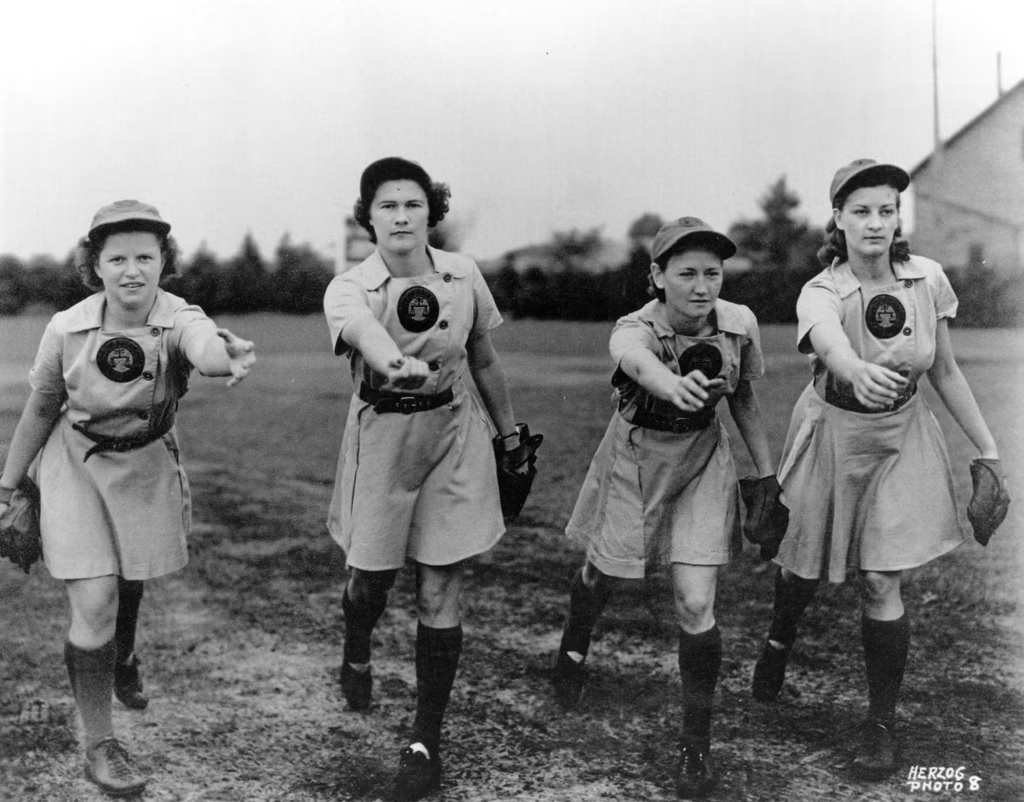
They had endured demanding schedules, injuries, publicity requirements and expectations about how female athletes were supposed to behave.

And yet their league had largely vanished from mainstream American historical consciousness.
Marshall recognized that there was a movie there.


More importantly, she recognized that there was a movie in their experience.

From Documentary to Screenplay…
The transition from documentary history to Hollywood narrative required another layer of invention.

Candaele and Wilson developed an early treatment, while screenwriters Lowell Ganz and Babaloo Mandel eventually took over the screenplay. The University of Illinois Rare Book & Manuscript Library holds a first-draft typescript written by Ganz and Mandel in 1989 and describes it as having been inspired by the documentary. (University Library)


The project itself went through substantial development.
It was initially established at Twentieth Century Fox. Marshall temporarily departed to direct Awakenings. Casting configurations changed. The project eventually moved to Columbia Pictures, and Marshall returned as director. (American Film Institute)


By the time the movie reached production, the historical documentary had evolved into something quite different.
This was no longer simply an attempt to document what happened to the women of the AAGPBL.
It was historical fiction.

Dottie and Kit could embody conflicts that were larger than any single player’s biography. Jimmy Dugan could represent the condescension women athletes encountered from the male baseball establishment. The Rockford Peaches could become the dramatic center of a much larger league.
Marshall could use fictional characters to introduce audiences to a real institution.


That is precisely where A League of Their Own becomes such an interesting MoviesToHistory case study.
Historical accuracy is not limited to whether every character existed.
Sometimes the more revealing question is whether fictional characters communicate something truthful about the historical world they inhabit.

A Woman Directing Women Inside a Male Institution…
Marshall’s position behind the camera gives the film another historical dimension.

Baseball has long occupied a privileged position in American mythology. Its cinematic mythology has traditionally been male as well.
The players are men. The managers are men. The scouts are men. The executives are men.
The fathers teaching their sons to throw baseballs are men.


A League of Their Own enters that tradition and changes the person standing at its center.
These women are not watching baseball history.
They are making it.
That distinction becomes especially significant because a woman was directing the film.


Marshall was not approaching the AAGPBL merely as an unusual footnote in baseball history. Her movie repeatedly examines the contradictions surrounding women who were permitted to enter a traditionally male institution while simultaneously being required to reassure the public that they remained conventionally feminine.

The players can slide into home plate.
But they are expected to look attractive doing it.
They can throw, hit and compete.

But they are also subjected to charm-school expectations, uniforms designed partly around spectacle and a promotional culture interested in selling femininity alongside athletic ability.
The contradiction is central to the history of the league. And Marshall does not treat it merely as background decoration.
She turns it into comedy, conflict and character.


The Camera Takes Their Athleticism Seriously…
One of Marshall’s most consequential choices is also one of the easiest to overlook.
She lets the women play baseball. Not pretend to play it.
Not simply pose in uniforms.
Play.

The cast underwent intensive baseball preparation before filming. AFI notes that the ensemble trained at a baseball camp at USC for three months before production began. (American Film Institute)

That preparation matters because Marshall’s camera repeatedly gives the players physical credibility.
They swing. They throw. They slide. They collide. They get dirty. They get hurt.
They compete.


The baseball is not simply a novelty attached to the characters. It becomes part of their characterization.
Dottie does not need to tell the audience that she is an extraordinary athlete.
Marshall shows us.

Kit’s frustration is not merely sibling jealousy. It exists within competition. Mae Mordabito’s sexuality does not cancel out her athleticism. Doris Murphy’s humor does not make her less serious as a player.
The women are allowed to possess multiple identities simultaneously.
That is one of the film’s most important achievements.


Jimmy Dugan Isn’t Actually the Center of the Baseball Story…
Tom Hanks delivers one of the movie’s most memorable performances, and Jimmy Dugan provides its most quoted line:
“There’s no crying in baseball!”

But Marshall makes an important structural decision.
Jimmy may be the most recognizable representative of traditional male baseball culture inside the film, but he is not ultimately the person whose history matters most.
At first, he barely respects the women he has been hired to manage. Then something changes.
He watches them play.
The women do not become legitimate baseball players because Jimmy grants them legitimacy.
Instead, Jimmy changes because their legitimacy becomes impossible for him to ignore.
That reversal matters.


A less careful version of this story could easily have become a movie about a disgraced male ballplayer who discovers himself by teaching women how to play baseball.
Marshall’s movie moves in another direction.
The women already know how to play. Jimmy has to learn how to see them.

Marshall Also Understood the Power of Memory…
The film’s framing device transforms A League of Their Own from a straightforward sports comedy into something closer to a meditation on historical memory.
We begin decades after the league. An older Dottie travels to Cooperstown.
Then the movie returns to 1943.


By the end, past and present meet again at the Baseball Hall of Fame.
That framing changes the meaning of everything between those scenes. We are not simply watching whether the Rockford Peaches win.
We are watching a history that almost disappeared.

That was particularly appropriate because the real women of the AAGPBL had experienced precisely that kind of rediscovery.
In 1988, the National Baseball Hall of Fame opened its permanent Women in Baseball display recognizing the league and women’s contributions to the sport. The final week of the movie’s production later took place in Cooperstown, where 65 former AAGPBL players participated in scenes recreating that recognition. (American Film Institute)


The fictional movie therefore ends by reconnecting itself to the women whose lives made the fiction possible.
That may be Marshall’s most significant achievement.
She did not simply make audiences care about Dottie Hinson. She made audiences curious about who came before Dottie Hinson.

![The All-American Girls Professional Baseball League (AAGPBL) was a professional women's baseball league founded by Philip K. Wrigley, which existed from 1943 to 1954. The AAGPBL is the forerunner of women's professional league sports in the United States. Over 600 women played in the league, which eventually consisted of 10 teams located in the American Midwest. In 1948, league attendance peaked at over 900,000 spectators. The most successful team, the Rockford Peaches, won a league-best four championships. The 1992 film A League of Their Own and the 2022 television show of the same name are mostly fictionalized accounts of the league and its stars. Sixty-five original AAGPBL members appeared in scenes for the movie filmed in October 1991 recreating the induction of the league into the Baseball Hall of Fame in 1988.[1]](https://i0.wp.com/moviestohistory.com/wp-content/uploads/2026/09/images9.jpeg?ssl=1)

Hollywood Fiction Became a Gateway to Forgotten History…
There is an irony at the heart of A League of Their Own.
The movie is filled with fictional characters.
Yet those fictional characters helped preserve the memory of real women.

The Players Association itself acknowledges the film’s enormous role in popular awareness of the league. Its historical materials repeatedly discuss Marshall’s movie as the cultural reference point through which many people discovered the AAGPBL. (AAGPBL Players Association)

That does not mean Marshall’s version should be mistaken for documentary history.
It means something more interesting happened. A documentary recovered the history. Penny Marshall saw its cinematic potential. Screenwriters transformed that history into narrative.
Actors embodied fictionalized characters.

And millions of moviegoers encountered a chapter of women’s sports history they might otherwise never have known existed.
That is the complicated relationship between cinema and historical memory at its most powerful.
Hollywood can distort history. Hollywood can simplify history.
But Hollywood can also rescue history from obscurity.

Would A League of Their Own Have Been the Same Movie Without Penny Marshall?
Probably not.

Another director could have filmed the same screenplay.
Another filmmaker could have staged the baseball games, delivered the jokes and constructed the sibling rivalry between Dottie and Kit.
But direction is more than translating words from a screenplay onto film.
It determines whose experience matters.

Marshall’s movie understands that the remarkable thing about the AAGPBL was not simply that women temporarily filled baseball stadiums while men went to war.
The remarkable thing was that these women demonstrated that they belonged there—and then watched much of their history fade from popular memory.

Marshall gives them the mythology traditionally reserved for male baseball players.
The road trips. The locker rooms. The rivalries. The injuries. The championship. The manager. The crowds. The heartbreak. The reunion.
And finally, Cooperstown.


She takes the visual and emotional vocabulary of the American baseball movie and places women inside it.
That is why A League of Their Own remains more than a successful sports comedy.
It is a movie about who gets remembered as part of America’s national pastime.

Kelly Candaele and Kim Wilson helped recover the story. The women of the AAGPBL lived it. Lowell Ganz and Babaloo Mandel helped transform it into a screenplay.
But Penny Marshall gave that history its enduring cinematic language.
![Kelly Candaele is a Canadian-born politician, filmmaker, teacher, and writer. For the past fifteen years, he has written extensively for the Los Angeles Times, the New York Times, The Nation and other national publications. While writing for the Los Angeles Times,[1] he traveled to Ireland three times during President Bill Clinton’s attempts to push the Northern Ireland peace process forward. His journalistic work has focused primarily on the political developments in Los Angeles, history, athletics and culture. In addition to Northern Ireland he has worked as a journalist in Great Britain, Brazil, Sweden, Cuba, Spain, Vietnam, Argentina and India. He has lectured at Hebrew University of Jerusalem, Occidental College, and University of California, Irvine. He has been an Adjunct Associate Professor of Philosophy and Communications at California State University, Chico. Early life His mother Helen Callaghan [4] played five seasons in the All-American Girls Professional Baseball League and won the batting title in 1945. He attended Lompoc High School in Lompoc, California. His brother Casey Candaele is a former Major League Baseball player for the Houston Astros and Montreal Expos and is currently manager for the Buffalo Bisons, the Toronto Blue Jays Triple-A affiliate.](https://i0.wp.com/moviestohistory.com/wp-content/uploads/2026/09/QsRxu3Co_400x400.jpeg?ssl=1)

More than three decades later, audiences who have never heard the names Helen Callaghan, Marge Callaghan, Dorothy Kamenshek, Sophie Kurys or Pepper Paire Davis can recognize the Rockford Peaches uniform.


That is the extraordinary—and sometimes complicated—power of historical filmmaking.
A fictional Dottie Hinson can lead an audience toward a real Dorothy Kamenshek.
A fictional championship can lead someone toward the actual league standings.
A comedy can lead someone toward an archive.
And a Hollywood movie can make people ask why they were never taught this history in the first place.

MoviesToHistory Question…
Would A League of Their Own have become the same cultural landmark without Penny Marshall behind the camera?
For me, the answer is no.
Marshall didn’t discover the history herself. That credit belongs first to the women who preserved their experiences and to filmmakers such as Candaele and Wilson who brought those experiences back into public view.

What Marshall did was recognize what that history could become on the big screen.
She turned a nearly forgotten chapter of women’s sports history into an American baseball movie.
And in doing so, Penny Marshall changed what an American baseball movie could look like.
MoviesToHistory.com | Where Reel History Meets Real History

A League of Their Own is available now with a subscription to Netflix…

Discover more from Movies To History.com
Subscribe to get the latest posts sent to your email.
Related Posts
‘Where the Crawdads Sing’ – Interview:
Reese Witherspoon and Delia Owens on "Where the Crawdads Sing"... In this interview from July 10, 2022, which aired on CBS Sunday Morning, producer Reese Witherspoon and author Delia Owens discuss bringing the New York…
Katherine Johnson: The Human Computer Who Sent America to Space…
The Mind Behind the Mission When astronaut John Glenn prepared to become the first American to orbit the Earth in 1962, he did not place his trust solely in machines. Instead, he asked for something far more…
“Tower, This Is GhostRider requesting a flyby..”
Scene from Top Gun: Maverick (2022) “Tower, this is GhostRider requesting a flyby..” I’m sure you can guess already what this week’s FEATURED BLOG film is! #TopGunMaverick!! In 1986, right in the…