

The Movie That Made America Remember
Historical Accuracy Rating: 85%
Few sports movies have entered American popular culture as completely as Penny Marshall’s A League of Their Own.
“There’s no crying in baseball!”
More than three decades after the film’s 1992 release, Tom Hanks‘s exasperated declaration as Rockford Peaches manager Jimmy Dugan remains one of the most recognizable lines in sports-movie history. Even people who have never watched the entire film know it.

Audiences remember Geena Davis as Dottie Hinson, the extraordinarily gifted catcher whose ability threatens to overshadow everyone around her. They remember Lori Petty as Dottie’s younger sister Kit Keller, struggling simultaneously to prove herself as a pitcher and escape Dottie’s shadow. They remember Madonna and Rosie O’Donnell as Mae Mordabito and Doris Murphy, trading insults and jokes inside the Rockford clubhouse.


They remember the skirts. They remember the bruises. They remember the bus rides, the chaperones and the charm-school lessons. And they remember the climactic collision at home plate when Kit barrels into Dottie during the championship game and the baseball rolls free.
Did Dottie drop the ball intentionally? Fans have debated that question for decades. But there is a larger historical question lurking behind the fictional one:
How much of A League of Their Own actually happened?


The answer is one of the reasons Penny Marshall’s film remains such a fascinating example of historical filmmaking. Dottie Hinson did not exist. Neither did Kit Keller. Jimmy Dugan was not the actual manager of the 1943 Rockford Peaches. Mae Mordabito and Doris Murphy were fictional.


Walter Harvey—the candy magnate behind the league in the movie—was fictional too, although his historical inspiration certainly was not.

The championship drama at the center of the movie is Hollywood storytelling. Yet the world surrounding these invented characters is remarkably authentic. There really was a Rockford Peaches. There really were Racine Belles, Kenosha Comets and South Bend Blue Sox.
Women really traveled hundreds or thousands of miles to try out for professional baseball.


![The All-American Girls Professional Baseball League (AAGPBL) was a professional women's baseball league founded by Philip K. Wrigley, which existed from 1943 to 1954. The AAGPBL is the forerunner of women's professional league sports in the United States. Over 600 women played in the league, which eventually consisted of 10 teams located in the American Midwest. In 1948, league attendance peaked at over 900,000 spectators. The most successful team, the Rockford Peaches, won a league-best four championships. The 1992 film A League of Their Own and the 2022 television show of the same name are mostly fictionalized accounts of the league and its stars. Sixty-five original AAGPBL members appeared in scenes for the movie filmed in October 1991 recreating the induction of the league into the Baseball Hall of Fame in 1988.[1]](https://i0.wp.com/moviestohistory.com/wp-content/uploads/2026/09/0.png?ssl=1)
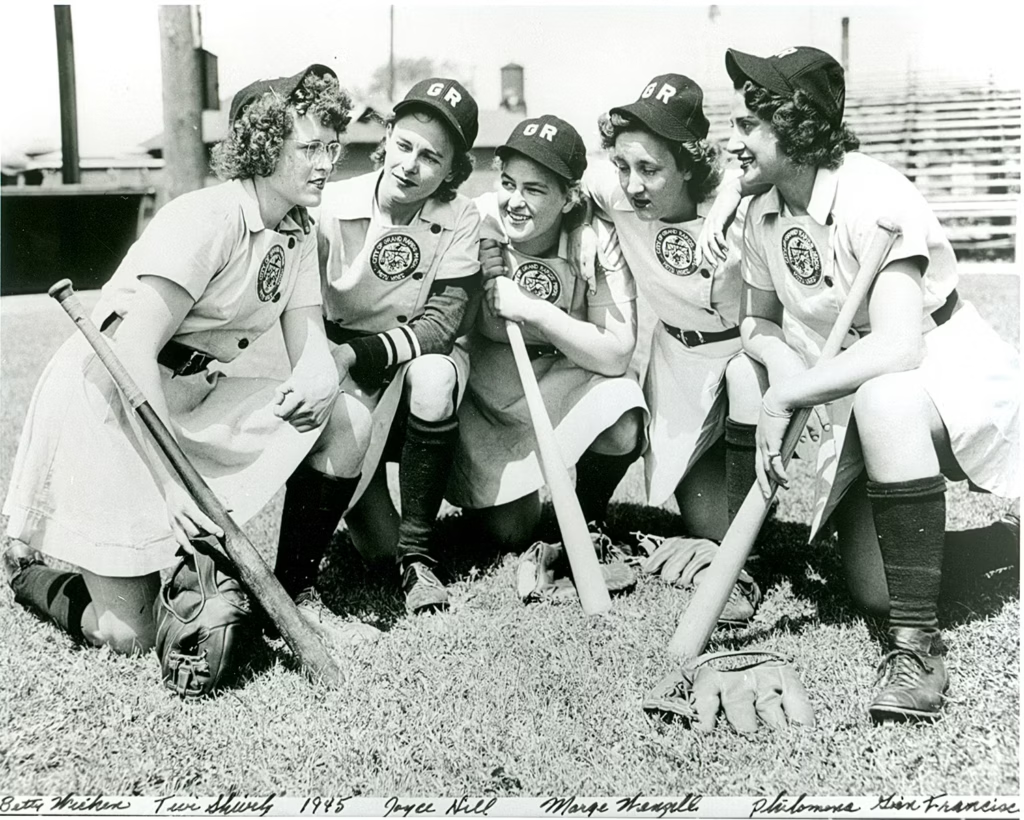
They really wore short-skirted uniforms. They really attended charm school. They really traveled with chaperones. They really were expected to wear lipstick. They really suffered painful abrasions from sliding in skirts. They really played exhausting professional schedules.
And they really were exceptionally talented baseball players.
![The All-American Girls Professional Baseball League (AAGPBL) was a professional women's baseball league founded by Philip K. Wrigley, which existed from 1943 to 1954. The AAGPBL is the forerunner of women's professional league sports in the United States. Over 600 women played in the league, which eventually consisted of 10 teams located in the American Midwest. In 1948, league attendance peaked at over 900,000 spectators. The most successful team, the Rockford Peaches, won a league-best four championships. The 1992 film A League of Their Own and the 2022 television show of the same name are mostly fictionalized accounts of the league and its stars. Sixty-five original AAGPBL members appeared in scenes for the movie filmed in October 1991 recreating the induction of the league into the Baseball Hall of Fame in 1988.[1]](https://i0.wp.com/moviestohistory.com/wp-content/uploads/2026/09/images9.jpeg?resize=525%2C391&ssl=1)
That distinction—between fictional biography and authentic historical environment—is essential to understanding A League of Their Own.
Penny Marshall was not attempting to make a biopic about one famous player. Instead, she constructed fictional characters capable of representing the experiences of hundreds of real women whose careers had largely disappeared from America’s popular understanding of baseball.
That disappearance makes the film’s legacy especially important.


The All-American Girls Professional Baseball League operated from 1943 through 1954 and provided professional baseball opportunities to more than 600 women. At its attendance peak in 1948, ten teams drew approximately 910,000 paid spectators.
Yet decades later, much of that history had faded from popular memory.
Former players had already begun changing that. Their reunions helped reconnect women scattered across North America, and their campaign for recognition contributed to the National Baseball Hall of Fame opening its Women in Baseball exhibit in Cooperstown in November 1988.
![The All-American Girls Professional Baseball League (AAGPBL) was a professional women's baseball league founded by Philip K. Wrigley, which existed from 1943 to 1954. The AAGPBL is the forerunner of women's professional league sports in the United States. Over 600 women played in the league, which eventually consisted of 10 teams located in the American Midwest. In 1948, league attendance peaked at over 900,000 spectators. The most successful team, the Rockford Peaches, won a league-best four championships. The 1992 film A League of Their Own and the 2022 television show of the same name are mostly fictionalized accounts of the league and its stars. Sixty-five original AAGPBL members appeared in scenes for the movie filmed in October 1991 recreating the induction of the league into the Baseball Hall of Fame in 1988.[1]](https://i0.wp.com/moviestohistory.com/wp-content/uploads/2026/09/images5.jpeg?ssl=1)


Then came Hollywood.
Marshall’s movie transformed an increasingly recovered piece of baseball history into a cultural phenomenon.
The National Baseball Hall of Fame has noted that the movie gave national exposure both to the AAGPBL and to the Hall’s exhibit, while former players recalled that many Americans simply had not known the league existed until the film appeared.

Twenty years after its release, the Library of Congress selected A League of Their Own for the National Film Registry in 2012. Its description praised Marshall’s film for illuminating a fascinating but under-reported part of American sports history while examining women’s changing roles during wartime.
That may be the most appropriate way to judge its historical importance.


A League of Their Own is not accurate because Dottie Hinson existed.
She didn’t. It is accurate because women like Dottie existed. Women who could hit. Women who could pitch. Women who could steal bases. Women who could throw runners out from the outfield. Women who played hurt. Women who traveled constantly. Women who earned professional salaries.


![45 "Doris "Sammye" Sams' National Women's Baseball Hall of Fame Nomination Statement" Doris Jane Sams, who played in the AAGPBL for the Muskegon Lassies, 1946-1949, and Kalamazoo Lassies, 1950-1953, was a well-recognized pitcher, fielder, and batter in the league; and because of her accomplishments she [was] recommended for 2012 induction into the NWB Hall of Fame. Although selections by the National Committee traditionally occur annually in October, nominations may be received anytime during the year. Sams was born in Knoxville, February 2, 1927 and passed away June 28, 2012 at the age 85 in her hometown. After her baseball playing days concluded in the 1950s, she returned to Knoxville and found an administrative position with a utility company. Among Sams' accomplishments were: pitching a perfect game onAugust 18, 1947, hitting a league season record of 12 home runs in 1952, and maintaining a .300 batting average with Kalamazoo. She was chosen AAGPBL Player of the Year in 1947 and 1949, and appeared in 5 league All-Star Games. Her 2,485 career at-bats yielded a lifetime total of 22 homeruns, 286 RBIs, and a .290 average which was 6th overall in the league. "Sams' achievements among her league contemporaries certainly deserves consideration for national recognition represented by this new nomination," said Jaffeson with the NWB Hall of Fame ."Besides field performance, she was nominated and selected for 5 All-Star games during an 8 year career." The All-American Girls Professional Baseball League (AAGPBL)operated from 1943-1954 consisting of several teams locatedprimarily in small towns within the midwest, e.g., Muskegon,Kalamazoo, Racine, Kenosha, Peoria, Rockford, Grand Rapids,South Bend, and Battle Creek. The AAGPBL began in 1943 with four teams, Rockford Peaches,South Bend Blue Sox, Racine Belles, and Kenosha Comets; an dwas initially financed by Philip K. Wrigley of crewing gum and Chicago Cubs fame. Each franchise received a start-upstipend of $45,000, and he provided $100,000 for the league central office. However, after two seasons, Wrigley sold his interests while annually losing $100,000 on the project. After the 1944 season finished, the league was purchased by Arthur Meyerhoff for a mere $10,000, and consisted of six franchises adding for the 1945 season the Grand Rapids Chicks and Fort Wayne Daisies. Sams played exclusively under the Meyerhoff regime. The 1992 film on this theme serves as a classic representation on how false images may substitute for reality. Baseball is based upon actual accomplishments on the field, such as Sams', and deliberate fictitious accounts perpetuate a disservice to the players, coaches, and the game; and are a disappointment once discovered. It remains unanswered, What was the purpose of presenting such inaccuracies? The AAGPBL as correctly portrayed, featured underhand pitching from 1943-1946, and switched to sidearm in 1947, and overhand for the 1948-1954 seasons. Ball size started at 12" in 1943, changed to 11" in 1944-1947, was 10" 1948-1953, and 9" in 1954. Basepath distances also varied beginning with 65' in 1943,68' during 1944-1945, 72' from 1946-1952, 75' in 1953, and finally 85' in 1954. Correspondingly, the pitching distances (rubber to homeplate) were proportionally reduced. Although often modified over several seasons, the fields never reached regulation dimensions, and initially the game was more akin to softball than baseball. Many AAGPBL recruits were found on community and corporate softball teams, as was Sams. In addition, all players initially received training on proper conduct with a finishing course and manual which was prepared and presented by Helena Rubinstein. Chaperones were assigned to every team to ensure that high standards were maintained. In remembrance, along with other locations, an AAGPBL exhibi tis found within facilities at Cooperstown. By comparison when sometimes asked, it is mentioned that venue consists of two components, Hall of Fame for MLB players, and baseball museum.Induction into the former at a minimum requires 10 years of playing experience on major league teams with performance at exceptional levels. As for the latter activity, there are hundreds of specialized baseball museums across the country. Sams once commented to the press regarding the museum's AAGPBL exhibit, "I look over to the right and see Babe Ruth. I lookover on the left and see Ted Williams," she humbly observed."Then I look to the mirror and say, 'What are you doing here? 'It’s all so unbelievable. I never dreamed our league would get this kind of recognition." Her view was entirely correct.](https://i0.wp.com/moviestohistory.com/wp-content/uploads/2026/09/45.jpg?ssl=1)

Women who were simultaneously celebrated as athletes and constrained by rigid expectations about how female athletes were supposed to look and behave.
Marshall fictionalized individual lives in order to resurrect a largely forgotten collective experience.
And in doing so, she helped make America remember that professional baseball had once belonged to women, too.

I. Why Was the AAGPBL Created?
To understand why women suddenly found themselves playing professional baseball across the Midwest in 1943, we first have to understand what World War II was doing to American life. After the United States entered the war in December 1941, millions of American men entered military service. Baseball players were no exception.
Stars and ordinary players alike left professional baseball for the armed forces. The wartime draft created an obvious question for team owners:
What would happen if the available supply of male professional players became so depleted that baseball could no longer operate normally?


President Franklin D. Roosevelt famously supported continuing professional baseball during the war, believing the sport provided valuable recreation for Americans working long hours in wartime industries.

But owners could not know exactly what would happen. Among those thinking about baseball’s uncertain future was Philip K. Wrigley. Wrigley was the chewing-gum executive who owned the Chicago Cubs, and in the fall of 1942 he began considering what could fill professional ballparks if the men’s game were disrupted or suspended.
His answer was radical by the standards of mainstream professional sports: Women.
There was already a substantial pool of female athletic talent available. Women’s softball was extremely popular throughout the United States and Canada. Amateur, industrial and semiprofessional teams had produced highly skilled players, particularly in the Midwest and Canada.


![Chicago Cubs 2026 Chicago Cubs season Logo Cap insignia Established in 1870 Major league affiliations National League (1876–present) Central Division (1994–present) East Division (1969–1993) National Association[a] (1871–1875) Current uniform Retired numbers 10142326313142 Colors Dark blue, red, white[1][2][3] Name Chicago Cubs (1903–present) Chicago Orphans (1898–1902) Chicago Colts (1890–1897) Chicago White Stockings (1871–1889) Nicknames The Cubbies The North Siders The North Side Nine The Boys in Blue The Lovable Losers Ballpark Wrigley Field (1916–present) West Side Park (II) (1893–1915) South Side Park (1891–1893) West Side Park (I) (1885–1891) Lakefront Park (II) (1883–1884) Lakefront Park (I) (1878–1882) 23rd Street Grounds (1874–1877) Lake Park (1871) Ogden Park and Dexter Park (1870) Major league titles World Series titles (3) 190719082016 NL pennants (17) 18761880188118821885188619061907190819101918192919321935193819452016 NA Pennants (1) 1870 Central Division titles (6) 200320072008201620172020 East Division titles (2) 19841989 Wild card berths (4) 1998201520182025 Rivalries St. Louis Cardinals Milwaukee Brewers Chicago White Sox Front office Principal owners Thomas S. Ricketts Laura Ricketts Pete Ricketts Todd Ricketts Joe Ricketts President of baseball operations Jed Hoyer General manager Carter Hawkins Manager Craig Counsell Mascot Clark the Cub Website mlb.com/cubs The Chicago Cubs are an American professional baseball team based in Chicago. The Cubs compete in Major League Baseball (MLB) as a member club of the National League (NL) Central Division. The club plays its home games at Wrigley Field, which is located on Chicago's North Side. They are one of two major league teams based in Chicago, alongside the American League (AL)’s Chicago White Sox. The Cubs, first known as the White Stockings, were founded in 1870 and are one of two remaining NL charter franchises that debuted in 1876. They have been known as the Chicago Cubs since 1903.[4][5] Throughout the club's history, the Cubs have played in a total of 11 World Series. The 1906 Cubs won 116 games, finishing 116–36 and posting a modern-era record winning percentage of .763, before losing the World Series to the Chicago White Sox by four games to two. The Cubs won back-to-back World Series championships in 1907 and 1908, becoming the first major league team to play in three consecutive World Series, and the first to win it twice. Most recently, the Cubs won the 2016 National League Championship Series and 2016 World Series, which ended a 71-year National League pennant drought and a 108-year World Series championship drought,[6] both of which are record droughts in Major League Baseball.[7][8] The 108-year drought was also the longest such occurrence in all major professional sports leagues in the United States and Canada.[6][9] Since the start of divisional play in 1969, the Cubs have appeared in the postseason 12 times through the 2025 season.[10] The Cubs are known as "the North Siders", a reference to the location of Wrigley Field within the city of Chicago, and in contrast to the White Sox, whose home field (Rate Field) is located on the South Side. Through 2024, the franchise has played the most games in MLB history, with an all-time regular season record of 11,419–10,837–161 (.513).[11]](https://i0.wp.com/moviestohistory.com/wp-content/uploads/2026/09/2ZJMVQLMHBG7LB65NKSNBPFRFA.jpg.webp?ssl=1)

Meanwhile, American society was undergoing a much broader transformation.
Women were entering jobs previously associated almost exclusively with men. Wartime propaganda celebrated the female industrial worker through images such as Rosie the Riveter.
If women could build aircraft, manufacture weapons and work in factories while men served overseas, why couldn’t they play professional ball?
Wrigley began investigating precisely that possibility.


From Softball Toward Baseball
What eventually became known as the All-American Girls Professional Baseball League did not immediately begin as conventional baseball. Its original 1943 incarnation was called the All-American Girls Softball League.
But even that name can be misleading. The game incorporated baseball rules while initially retaining some softball characteristics. In 1943, pitchers threw underhand from 40 feet. The ball measured 12 inches in circumference, and the bases were 65 feet apart.
Those dimensions changed repeatedly. The league gradually made the sport resemble men’s baseball more closely. Base paths grew longer. Pitching distances increased. The ball became smaller. Sidearm pitching appeared.
Then, in 1948, overhand pitching arrived.
By 1954—the league’s final season—the women were using a regulation-size nine-inch baseball, and the pitching distance had reached 60 feet. The base paths had expanded to 85 feet, only five feet shorter than Major League Baseball’s 90-foot distance.
This evolution matters because describing the AAGPBL simply as a “women’s softball league” significantly understates what it became. These women were professional ballplayers competing in a hybrid sport that progressively evolved toward conventional baseball.
Finding the Players
Wrigley’s organizers needed athletes.
Scouts searched the United States and Canada for talented women, drawing particularly heavily from established softball programs. More than 200 women were invited to the major tryout at Wrigley Field in Chicago in 1943; approximately 60 made the final roster.


But athletic ability was only one qualification. The league was selling something more complicated than baseball. It was selling the idea that women could perform at an elite athletic level without threatening conventional ideas about femininity. That tension would define the league throughout its existence. The player had to be good enough to compete professionally. But she also had to fit the public image of the “All-American Girl.”
That meant the league wasn’t simply scouting athletes. It was casting a public image.
And that contradiction—play like an elite athlete while looking like a conventionally feminine 1940s woman—is one of the historical realities A League of Their Own captures best.


II. Were the Rockford Peaches Real?
Yes. Absolutely.
The Rockford Peaches were not invented for the movie. Neither were their original opponents.

When the league began play in 1943, four franchises formed its inaugural structure:
- Rockford Peaches — Rockford, Illinois
- Racine Belles — Racine, Wisconsin
- Kenosha Comets — Kenosha, Wisconsin
- South Bend Blue Sox — South Bend, Indiana
That makes the basic geography of Marshall’s movie remarkably accurate. These were real teams playing real professional schedules in Midwestern cities. The film uses their actual names because it doesn’t need to invent the institutional framework.
History had already supplied it.


The Real Rockford Peaches
The Peaches became one of the AAGPBL’s most recognizable franchises and remained in the league throughout its entire existence. But the movie’s 1943 Peaches should not be confused with the actual 1943 roster.

Dottie Hinson wasn’t there. Kit Keller wasn’t there. Mae Mordabito wasn’t there. Doris Murphy wasn’t there. Jimmy Dugan wasn’t managing them.
What Marshall does instead is place fictional protagonists inside a real historical institution. This technique is common in historical cinema. It gives filmmakers narrative freedom while preserving the larger historical environment.

Rather than attempting to compress the careers of dozens of women into a rigid biographical reconstruction, A League of Their Own creates characters whose experiences can dramatize broader realities.
The uniforms are recognizable. The cities are correct. The transportation difficulties are grounded in reality. The league’s publicity strategy is authentic. The gender expectations are authentic. The competition is authentic. The players themselves are fictionalized.
That is an important distinction when calculating the movie’s historical accuracy.

The League Became Much Larger
The four-team league audiences see in the movie represents only the beginning.
The AAGPBL expanded into additional Midwestern cities during its twelve seasons, eventually reaching places including Fort Wayne, Grand Rapids, Kalamazoo, Battle Creek, Minneapolis and Springfield.


At its 1948 peak, the league had ten teams.
That same year produced the league’s highest attendance: roughly 910,000 paid spectators.


This wasn’t a novelty act performing before a handful of curious spectators. It became a legitimate professional sports attraction. That fact complicates the common assumption that women’s professional baseball existed only because men were fighting overseas.
The war created the opening. But the league survived the war.
Germany surrendered in May 1945. Japan surrendered in August. American servicemen came home. Major League Baseball resumed its peacetime identity. And women kept playing professional baseball. The AAGPBL survived until 1954.

That means almost a decade of the league’s history occurred after World War II ended. The movie focuses on the wartime origin because it provides the cleanest dramatic explanation for the league’s creation.
But the real history became something larger.
Women weren’t merely temporary substitutes keeping ballparks occupied. They built a professional sports institution with its own stars, rivalries, champions and fan cultures.

III. Were Dottie Hinson and Kit Keller Real?
No. And yes.
That seemingly contradictory answer gets to the heart of how A League of Their Own uses history. There was no Dottie Hinson. There was no Kit Keller. The famous sibling rivalry—the gifted catcher and the ambitious pitcher—is fictional.
But the idea behind the sisters has genuine historical roots.

Helen and Marge Callaghan
One of the most important connections between the film and the actual league comes through Helen Callaghan and her sister Marge.
Both women played professionally.
And decades later, Helen’s son Kelly Candaele helped bring their story to the screen.
![Margaret “Marge” and Helen “Kelly” Callaghan, who were born and raised in Vancouver, British Columbia, made the wartime All-American Girls Professional Baseball League (AAGPBL) and became regulars in 1944. The Vancouver girls, the first two sisters to play in the new women’s professional circuit, were not the fictional siblings featured in Penny Marshall’s famous 1992 movie, A League of Their Own, but both enjoyed good careers in the historic All-American league. The two were the fourth and fifth of the six children of Albert and Hazel Callaghan, and their names, with the eldest first, were Kay, Pearl, Lewis, Margaret, Helen, and Patrick. Their mother died early, Albert remarried, and he and his wife Anne had three children, Wayne, Elaine (Lani), and Dan. All of the Callaghans were athletic, but Marge, born on December 23, 1921, and her sister Helen, almost 15 months younger, grew up playing sports like softball, soccer, lacrosse, and roller hockey in the streets with neighborhood kids, mostly boys. The Irish Catholic sisters went to the same elementary and junior high schools, and both attended King Edward High. Sharing the same interests, they played on the same teams, including basketball in the winter and track and field in the chilly spring. Marge left school in 1939 and Helen in 1940, and they were teammates on the fast-pitch Young Liberals, later renamed (due to a different sponsor) the Western Mutuals, a traveling team made up of local players from Vancouver’s city league. During World War II the pretty Callaghan girls worked for Boeing Aircraft and played for the Mutuals. The team competed in the World Championship Tournament in Detroit in 1943, and the sisters were scouted by the All-American League. As a result, Helen was invited to the All-American League’s spring training at Peru-LaSalle, Illinois, in May 1944. The left-handed hitting Vancouver outfielder made the second-year circuit and was allocated to one of the loop’s two expansion teams, the Minneapolis Millerettes. In mid-summer Marge, after their father encouraged her to go, obtained special permission to leave her wartime position with Boeing, where she was a squad leader on the assembly line. She joined the Millerettes, who started the season playing games at Nicollet Park, home of the American Association’s Minneapolis Millers. However, the Millerettes didn’t draw well with a Double-A men’s team in town, and due to declining attendance, the girls’ nine became an “orphan” team in mid-season. Marge, who was interviewed in 2011, remembered the difference between playing for the Mutuals in Canada compared to the Millerettes in the USA wasn’t great. During the war years the All-American League was playing a hybrid of baseball and softball, and the league used underhand pitching until the middle of the 1946 season. However, by the time Marge joined the Minneapolis team, the girls were playing all road games, living out of suitcases, and she needed a bigger glove. The sisters performed well as rookies, with Marge, a right-handed hitter who loved to bunt and hit-and-run, batting .182, while Helen hit .287, the second-best mark in the league after South Bend’s Betsy Jochum, who averaged .296. Marge, a 5’3” right-handed thrower and batter, and Helen, who was two inches shorter and threw and batted left-handed, moved with the franchise in 1945 to Fort Wayne, Indiana, where the girls played together for three seasons (Helen didn’t play in 1947). Both were fast, but Helen was faster. “My reflexes were faster than hers,” recalled Marge, “and I got started faster, but she always beat me. She finished faster by about a step.” Helen, who was interviewed by People Magazine in 1987, observed, “We were supposed to play like men and look like women.” She talked about the charm school offered by the league again in 1944. The players, many of whom grew up on farms, learned how to walk, sit, talk, wear their hair, and do their makeup properly. “That was an important to us as our playing,” Helen recalled. “And we weren’t supposed to drink or smoke in public since we were supposed to be ladies at all times.” The AAGPBL, launched with four teams, developed from a hardball game using men’s baseball rules and underhand pitching in 1943 to a 10-team expanded league in 1948 that adopted overhand pitching, and the Callaghans lived through most of the changes. In 1943 the All-American League played games with a 12-inch circumference ball, the same as used in men and women’s fast-pitch softball. The ball was reduced in increments, starting with an 11 ½ ball in mid-1944, moving to an 11-inch ball in 1946, and through a 10 3/8 inch ball in 1948 to a 10-inch red-seamed livelier ball in mid-1949. As the league decreased the size of the ball, the distance from the pitcher’s mound to home plate and the length of the base paths were increased, also in increments, because the batters could hit the smaller ball harder. The ball and diamond size continued to evolve, since the league’s founders and managers always envisioned the girls playing baseball. For example, the original pitching distance was 40 feet, compared to 35 feet in softball, and the first base paths were 65 feet, compared to softball’s 60 feet. However, All-American runners could lead off and steal from the beginning, making the game faster-paced. In mid-1944, when the ball was reduced to 11 1/2 inches, the base paths were lengthened from 65 to 68 feet. In 1945 the pitching distance was moved to 42 feet in mid-season to help the hitters, but no other dimensions were altered. In 1946, when the ball’s size was reduced to 11 inches, the base paths were reset at 70 feet. Sidearm pitching was introduced in mid-1946, and the sidearm style was fully adopted in 1947. In 1948, when the 10 3/8 inch ball was introduced, the mound was moved to 50 feet and the base paths to 72 feet. In mid-1949, when the livelier ball came into play, the pitching distance was 55 feet. In 1953 the pitching distance was moved to 56 feet and the bases paths to 75 feet. Finally, the league, facing demise in mid-1954, introduced a regulation baseball and made the pitching distance 60 feet and the base paths 85 feet. Thus, the AAGPBL evolved almost by the season, and the players kept adjusting. In that era many grew up as tomboys, playing baseball with boys on diamonds in the country, in small towns, and in cities. During World War II and the immediate postwar years, the AAGPBL, a circuit that recruited, signed, and allocated the girls to teams, played mainly “small ball,” and the sisters thrived on that style of play. Marge and Helen enjoyed their golden summers, including living in homes of local families and sporting the Daisies’ pink uniforms with burgundy trim. A graceful fielder with quick hands, Marge played mostly third base, where her strong arm made her a fixture. She also played second base, but seldom shortstop. The Vancouver speedster batted second, following Helen, who was usually the Daisies’ leadoff hitter. Marge loved to bunt, and though her average always ranked below Helen’s, they worked well together. Marge bunted to advance her sister to the next base, or if Helen stole second and maybe third base, Marge sacrificed to score the run. Besides other Canadians, the sisters’ best friend with the Daisies was Dottie Collins, the circuit’s great underhand pitcher who was known as the “Strikeout Queen.” The Callaghans, quiet but quick to smile, were first-rate athletes who understood the game and became exceptional baseball players, even though they came out of a softball background. Marge, bright, spirited, and likeable, with her long brown hair and dark brown eyes, always gave the game her best effort. Helen, whose flowing brown hair was a bit darker and whose hazel eyes flashed liked Marge’s, was the better hitter, but both loved every day they spent on the field. The 1944 season proved difficult for the Millerettes, since the 16-player team lost its home base on July 22. Staffed largely with rookies such as the Callaghans, pitcher Dottie Wiltse, hurler Audrey Haine, and first baseman Vivian Kellogg, the Millerettes finished sixth (last) in both halves of the season (the league introduced a single-season format in 1945). For the season’s first half, when other teams made the six-hour train trip from Chicago to play at Nicollet Park, the Millerettes finished 23-36. In the second half as a road team, the Minneapolis entry posted a 22-36 record. Dottie Wiltse, a curveballer who led the league with 205 strikeouts in 38 games, produced the team’s only winning record, 20-16. Annabelle “Lefty” Lee fashioned an 11-14 ledger, but Audrey Haine, the team’s number-three pitcher, finished with an 8-20 mark. In a loop dominated by fast pitchers, notably during the underhand years, Helen Callaghan, who had pop in her bat, topped the Millerettes’ hitters with her .287 mark. The fleet Vancouver star stole 112 bases, connected for five doubles, four triples, and three home runs (all inside-the-park shots), and contributed 17 RBIs from the leadoff spot. Margaret Wigiser, traded to the Rockford (Illinois) Peaches partway through the season, ranked second with her .212 average, Elizabeth “Lib” Mahon, traded to the Kenosha Comets after a few weeks, hit .211, and cleanup batter Viv Kellogg, never a speedster, batted .202 and paced her team with 46 RBIs. Despite the hardships from traveling and living on the road, the Millerettes, in the words of Dottie (Wiltse) Collins (she married to Harvey Collins, a Fort Wayne native and Navy veteran, before the 1946 season), were being paid to play baseball, and they had a great time. Dottie, interviewed in 1997, recalled, “We were young, we were having a good time, and we had money in our pockets. I mean, what more could you ask for?” The Callaghans echoed that sentiment. Further, the sisters liked having several Canadian teammates, making the league seem more like home. Marge said, “In 1945, after we moved to Fort Wayne, we had half a dozen Canadians on the team. Besides me and Helen, we had Penny O’Brian [later Cooke], and we had Yolande Teillet and Audrey Haine [later Daniels], and Arleene Johnson, but I don’t remember all the names.” The Minneapolis franchise moved to Fort Wayne in 1945, and the expansion Milwaukee Chicks, who won the Shaughnessy Championship in 1944 over the Kenosha Comets, moved to Grand Rapids. In Fort Wayne the team held a contest, and a fan picked the new name, the Daisies. Fort Wayne, full of rookies who grew into professionals in 1944, ranked second in the six-team circuit with a 62-47 ledger, right behind the Rockford Peaches and their loop-best 67-43 mark. The Peaches won the Shaughnessy Championship (first place versus third place, second place versus fourth place, and winner versus winner) in the league’s last wartime postseason. The Fort Wayne team, managed in 1945 and 1946 by former major leaguer Bill Wambsganss, or Wamby, was led by Canadians and Californians, many of whom were fun-loving girls. Helen Callaghan, who played all 111 games, led the circuit in 1945 with her .299 average. Enjoying a standout season, the speedy Helen contributed 17 doubles, four triples, and three homers, stole 92 bases, and produced 29 RBIs. She was followed in hitting on her team by Canadians such as catcher Yolande Teillet, who averaged .231 in 10 games. Third sacker Arleene Johnson batted .222 in 15 games. Outfielder Penny O’Brian hit .216 in 83 games. Viv Kellogg, who played the full 111 games, averaged .214 with 10 doubles, six triples, and one home run (she lost speed after injuring her knee), leading led her team in RBIs with 38. Marge Callaghan, a lifetime .196 batter, hit that exact mark in 1945. She played 99 games, mostly at third base, and her .912 fielding mark at the position was second only to Kenosha’s Ann Harnett at .922. The top pitcher, also voted the league’s first Player of the Year, was Grand Rapids’ Connie Wisniewski, a tireless right-handed windmiller who fashioned a 32-11 record, and she was followed by Dottie Wiltse and her 29-10 mark. Dottie also hurled a pair of no-hitters against Rockford, achieving the feats on June 29 and July 15, 1945. The Daisies’ next best hurler was Annabelle Lee with a 13-16 record and a 1.63 ERA, and Lee no-hit Grand Rapids on July 7, 1945. Winnipeg’s Audrey Haine improved to 16-10 with a 2.46 ERA, and on August 26, 1944, she won a seven-inning no-hitter against Kenosha. On June 15, 1945, Haine participated in the league’s only double no-hit contest, a six-inning tilt against the Comets at Kenosha’s Lakefront Stadium. Following the 1945 season, Helen married Bobby Candaele, also from Vancouver, but she returned to the league and played under her maiden name. The Callaghans enjoyed the first postwar season with Fort Wayne, but Helen’s hitting tailed off in 1946, and she didn’t play in 1947. The 5’1” 115-pound brunette, short of stature but long on spirit and determination, played all 112 games, but she averaged only .213. She still hit 10 doubles, three triples, and one home run, and she swiped 114 bases and contributed 26 RBIs. Marge, enjoying another stellar season at third base, hit .188 with two doubles, three triples, and a single home run, her second career home run. The expanded eight-team league, featuring the Muskegon Lassies and Peoria Redwings in 1946, used a new 11-inch ball and allowed sidearm hurling at mid-season. Dottie Collins, a natural sidearmer, produced a 22-20 record, and strong-armed outfielder Faye Dancer, trying the mound after sidearming was allowed, posted a 10-9 ledger, but the Daisies, hitting just .184 as a team (seventh in the league), finished in fifth place with a 52-60 record. In 1947, when the league adopted sidearm hurling and held spring training in Havana, Cuba, the Daisies finished seventh with a 45-67 record. Marge averaged .201 with a pair of doubles, one triple, and one home run, a long blast at South Bend (she also homered in an exhibition game in Havana), stealing 57 bases and adding 23 RBIs. Helen, pregnant, stayed home. The Candaeles’ first son Richard was born before the 1948 campaign began with spring training at Opa-Locka, Florida. Fort Wayne limped through another losing season in 1948, suffering a major blow when Dottie Collins, almost five months pregnant, left the team on August 1 in order to have her first child. Also, the Callaghan sisters played their final All-American season together. In 1948 the league expanded again, adding the Springfield (Illinois) Sallies and the Chicago Colleens, but both teams were staffed largely with rookies and players not among the protected top ten on the rosters of the eight established teams. Predictably, the Sallies and the Colleens finished last in the loop’s Western and Eastern Divisions, respectively. Fort Wayne ranked fourth (53-72), but the Daisies lacked the hitting and pitching to become a successful playoff team. Helen played 54 games in the first of the season, hitting .191, her lowest mark to date, but she suffered a ruptured tubal pregnancy, needed emergency surgery, and returned home in late July. Marge, who played all 112 games at second base, averaged .187 and helped anchor the Daisies’ infield. Marge returned for the 1949 season and was swapped to South Bend, and Helen also returned, but she was traded to Kenosha. In mid-July the league adopted a livelier 10-inch ball, and most of the players saw their hitting improve. Helen Candaele, playing under her married name, finished her career with the Comets and made a comeback at the plate, averaging .251, the seventh-best mark in the league, and Marge, playing third base for most of the second half of the season in South Bend, hit .169. In the end, Helen left the game she loved to raise her family and help with her husband’s taxi business in Vancouver. The Blue Sox traded Marge to the Peoria Redwings before the 1950 season. She played just 30 games as an infielder. She broke her ankle in a game on June 19, and her average for the season fell to .157. At one point, after manager Leo Murphy resigned in an economy move to help the financially strapped Redwings, the savvy Marge was considered for the post of interim manager, but the job went to Mary Reynolds. Marge returned to Peoria in 1951, but after an argument with the manager, she was traded to the Battle Creek Belles for the remainder of a season, hitting a combined .236 in 107 games. “You wouldn’t believe how I got traded from Peoria to Battle Creek in the last part of the 1951 season,” Marge later explained. “In one game I was playing third base, and I picked up a grounder, and I turned around to throw to second, and the runner was there, but not the second baseman. So I turned and threw the ball to first base, and I got the runner going down to first. I was always taught, ‘If you can’t get two, get one.’ After the inning was over, the manager, Johnny Rawlings, came screaming out of the dugout, and he said, ‘What the hell do you think you’re doing?’ “I got my Irish temper up, and I screamed right back, ‘What the hell do you think I was doing?’ All the people in the stands stood up and yelled, ‘Atta girl, Marge – You tell him!’ And I guess that made him mad. “I said to Johnny Rawlings, ‘I was always taught if I couldn’t get two outs, get one.’ He said, ‘You should have thrown to second base.’ I said, ‘It would have gone out between center field and right field, and the run would have scored.’ He said, ‘You should have thrown it anyway.’ “I couldn’t believe it! That just doesn’t make sense. I didn’t say any more, and I went over and sat down on the bench. Three weeks later, I got traded to Battle Creek. After Johnny Rawlings traded me, he got fired. He made everyone mad in Peoria, and he got fired. All those years and I never talked back to the coaches. I did what they told me, but I couldn’t see any sense to what the manager said on that play. He would have blasted me if I hadn’t thrown it to first. And I couldn’t figure out why he didn’t wait until I got into the dugout to say something to me.” Marge added that the trade didn’t matter because she already had decided 1951 would be her final season. She met her future husband, Merv Maxwell, before leaving for the renamed American Girls Baseball League, and she was married after returning home to Vancouver. The Callaghan sisters were both finished as active professional players. They did team up again on local fast-pitch teams, until Helen and her family moved to California in 1956. Both sisters had good memories from playing baseball in the AAGPBL. In her 1987 interview, recorded in part because her youngest son Casey Candaele was playing for the Montreal Expos, Helen explained that she grew up excelling at sports, notably softball. After she and Marge were scouted at the World Tournament in Detroit in 1943, she tried out with the second-year AAGPBL, made the league, signed a contract for $75 a week, and spent the season with the Millerettes. They played men’s rules but dressed in different uniforms: “We wore short, one-piece skirts, with shorts underneath, and knee socks, hats, and spikes.” The fans loved their uniforms: “This was the 1940s, and the team chaperones had skirts down to their ankles. But here we were in these little short skirts, thinking we were very feminine.” Helen thrived in the All-American League. “I was a quiet and very intense gal,” she said. “I just went out every day and did what I could to earn a starting position.” She ranked second in the loop in hitting, earning her a raise to the highest possible salary, $125 a week for 1945. “We were supposed to play like men and look like women,” Helen explained. The girls were supposed to behave like ladies at all times, and not to drink or smoke in public. “That didn’t always happen,” she reminisced, because sometimes the girls sneaked out after bed checks (the curfew was two hours after a road game ended). “Once during spring training we went to an Army camp, but the chaperones caught us there and gave us a slap on the wrist.” She indicated that boys followed the teams and wanted to date the girls. “And wherever we were, guys used to hang outside our hotel, hollering up to us, and we’d throw our bras down at them.” The players also played tricks on the managers, the chaperones, and rookies, maybe short-sheeting their beds. “Fun times,” Helen remembered, “but we played tough, even when we were hurt.” The girls would have “strawberries” (bruises) on their legs from sliding in the skirted uniforms, but chaperones taped them up and they’d play again. The season lasted four months and ended with playoffs after Labor Day. “After a double-header,” Helen observed, “we’d shower, get dressed, travel all night on the bus, get to our hotel at 8 or 9 in the morning, shower, play two games of baseball in 110 degrees of heat, then do it all over again the next day.” In 1987, when Helen’s middle son Kelly Candaele (she had five) and his friend Kim Wilson were producing a filmed documentary entitled A League of Their Own (Penny Marshall’s more famous movie took the same title in 1992), the experiences of Helen and Marge evidently motivated Kelly to envision a pair of sisters as central to the success of a fictional film about the league. Both sisters were modest, and as Helen later observed, “I seldom talked about it [the league] to my boys while they were growing up, but now I think the memories are great.” Helen later contracted breast cancer. After a long battle against the disease, she died in Santa Barbara on December 8, 1992, at age 69. Marge, however, pointed out that the film was not about the Callaghans, or any family. “The movie was written about the league,” Marge explained in 2011. “When anybody asks me, I always say the movie was about the league. My nephew, Kelly Candaele, took the idea of the movie to Penny Marshall in the first place. He produced a documentary, called A League of Their Own, about our league. Kelly took the story to Penny Marshall, but he did not have the rights to the title, so Penny Marshall and the producers called the movie A League of Their Own. But as I said, the story was not about anybody in particular – it was about the league.” Marge had many favorite memories. Asked if the league made a big impact on her life, she agreed, saying, “Playing in the league was what I call a tremendous time in my life. There’s a lot of good things to remember. I really met some wonderful people, and I made a lot of friends. Penny O’Brian, who played the 1945 season, later moved out here from Edmonton, and we kept in touch over the years, until Penny passed away last year [2010]. We kept in touch and visited back and forth a lot. I kept in touch with Colleen (Smith) McCulloch. She played the one year for Grand Rapids [in 1949], and she was from Vancouver too.” Asked if she and Helen were alike in personality, Marge laughed, recalling, “Helen was more forward than I was. She was more of a flamboyant type of ballplayer. We had a few ballplayers on our Daisies team that were like that. I was a little more reserved. I wasn’t going to go down and play in the league at first, but Dad wanted me to go because of Helen. He wanted me to keep an eye on her. That’s what he told me anyway!” Helen always hit for a higher average and with more power than Marge, but the oldest sister still slugged three career home runs. “I did hit a few long balls,” Marge said. “I recall one game at South Bend where they recorded a home run I hit as the longest hit ball at that point in the league. The article in the paper said, ‘Marge Callaghan, who is one hundred and some odd pounds soaking wet, hit the longest ball of the season, and Betsy Jochum is still chasing it!’ I thought it was hilarious. I only hit two or three home runs all the time I played in the league, but I really hit that one!” On July 25, 1947, reported the South Bend Tribune, Marge hit a long two-run home run in the ninth inning off right-hander Ruth Williams in Fort Wayne’s 7-0 victory over the Blue Sox at South Bend’s Playland Park. The ball carried over Betsy Jochum’s head in left field and bounced into Playland’s bleachers. Jim Costin, sports editor of the Tribune, compared Marge to a “feminine Ted Williams.” Costin called Callaghan’s home run “the longest ball ever hit in a girls’ pro game here, and probably as long as any other ever hit in any other park in the league, too.” Marge (Callaghan) Maxwell’s long ago blast left the kind of indelible memory that endures for ballplayers, women and men alike, as well as fans of the national pastime. Marge Maxwell, who was divorced many years ago, retired and lived near her sister Lani in Delta, a city of 100,000 located 25 miles south of Vancouver, where the family lived during the league years. Marge valued her league memories as well as the friends she made playing baseball. She died at the age of 97 on January 11, 2019.](https://i0.wp.com/moviestohistory.com/wp-content/uploads/2026/09/Callaghan-Marge-and-Helen-1024x753.jpg?ssl=1)

![Kelly Candaele is a Canadian-born politician, filmmaker, teacher, and writer. For the past fifteen years, he has written extensively for the Los Angeles Times, the New York Times, The Nation and other national publications. While writing for the Los Angeles Times,[1] he traveled to Ireland three times during President Bill Clinton’s attempts to push the Northern Ireland peace process forward. His journalistic work has focused primarily on the political developments in Los Angeles, history, athletics and culture. In addition to Northern Ireland he has worked as a journalist in Great Britain, Brazil, Sweden, Cuba, Spain, Vietnam, Argentina and India. He has lectured at Hebrew University of Jerusalem, Occidental College, and University of California, Irvine. He has been an Adjunct Associate Professor of Philosophy and Communications at California State University, Chico. Early life His mother Helen Callaghan [4] played five seasons in the All-American Girls Professional Baseball League and won the batting title in 1945. He attended Lompoc High School in Lompoc, California. His brother Casey Candaele is a former Major League Baseball player for the Houston Astros and Montreal Expos and is currently manager for the Buffalo Bisons, the Toronto Blue Jays Triple-A affiliate.](https://i0.wp.com/moviestohistory.com/wp-content/uploads/2026/09/QsRxu3Co_400x400.jpeg?ssl=1)


According to the AAGPBL Players Association, Candaele developed the original story in honor of his mother and his aunt. His work was connected to the documentary A League of Their Own, created with Kim Wilson, which helped generate the idea that eventually became the feature film.

![Kelly Candaele is a Canadian-born politician, filmmaker, teacher, and writer. For the past fifteen years, he has written extensively for the Los Angeles Times, the New York Times, The Nation and other national publications. While writing for the Los Angeles Times,[1] he traveled to Ireland three times during President Bill Clinton’s attempts to push the Northern Ireland peace process forward. His journalistic work has focused primarily on the political developments in Los Angeles, history, athletics and culture. In addition to Northern Ireland he has worked as a journalist in Great Britain, Brazil, Sweden, Cuba, Spain, Vietnam, Argentina and India. He has lectured at Hebrew University of Jerusalem, Occidental College, and University of California, Irvine. He has been an Adjunct Associate Professor of Philosophy and Communications at California State University, Chico. Early life His mother Helen Callaghan [4] played five seasons in the All-American Girls Professional Baseball League and won the batting title in 1945. He attended Lompoc High School in Lompoc, California. His brother Casey Candaele is a former Major League Baseball player for the Houston Astros and Montreal Expos and is currently manager for the Buffalo Bisons, the Toronto Blue Jays Triple-A affiliate.](https://i0.wp.com/moviestohistory.com/wp-content/uploads/2026/09/images-5.jpeg?ssl=1)

That makes the movie’s sister relationship more than an arbitrary Hollywood invention. It emerged from a real family connection to the league. But history immediately becomes fiction from there. Helen and Marge were Canadian. They were not the Oregon farm women portrayed in Marshall’s film.
And most importantly, they were not a pitcher-and-catcher combination.
The AAGPBL Players Association explicitly cautions against treating Dottie and Kit as direct biographical portraits. The organization describes the movie’s characters as fictionalized composites.
That is the correct way to understand them.


Dottie as the Idealized Superstar
Dottie Hinson functions less like a disguised historical figure than an amalgamation of the league’s best players.

She is extraordinarily athletic. She can hit. She can catch. She has a powerful arm. She understands strategy. She becomes a gate attraction. She looks like the league’s publicists’ ideal of feminine respectability.
In other words, Dottie embodies the impossible standard the AAGPBL itself promoted.


Be beautiful. Be graceful. Be modest. Be marketable. And then step onto a baseball field and dominate. Various real players have been proposed as inspirations for Dottie over the years, including Rockford star Dorothy “Dottie” Kamenshek.
Kamenshek certainly provides tempting parallels. She was one of the league’s great hitters and became a major Rockford star. But identifying Dottie Hinson as simply “Dottie Kamenshek with a different last name” goes too far. Even the Players Association cautions against trying to map individual fictional characters neatly onto specific players.
That ambiguity is deliberate. Dottie represents a generation.


Kit and the Emotional Truth of Competition
Kit serves a different function. Where Dottie seems almost effortlessly gifted, Kit has to fight for recognition. Her resentment creates the movie’s emotional conflict. That sibling rivalry is melodramatic.
But the underlying professional stakes are historically plausible.

Women entering the AAGPBL suddenly had access to something extraordinarily rare: paid careers in elite team sports. Roster spots mattered. Playing time mattered. Statistics mattered. Winning mattered.
For young women who had spent years playing amateur or semiprofessional softball, the league represented a remarkable professional opportunity.

The film exaggerates that competition through sibling rivalry. But it does not invent the seriousness with which the women treated their careers.
That is one of the movie’s most important achievements.

It refuses to portray the players as grateful amateurs participating in a charming wartime experiment. They want to win. They get angry. They become jealous. They compete. They care about starting positions. They care about championships. They are professional athletes.
And that may be more historically important than whether Kit Keller actually existed.


IV. Jimmy Dugan: Fact, Fiction & Baseball Archetypes
Jimmy Dugan feels real because baseball history contains plenty of Jimmy Dugans. The washed-up star. The former slugger. The athlete whose body, habits or personality destroyed his playing career before his fame completely disappeared.
The heavy drinker. The reluctant manager.

The man forced to confront the fact that the athletes he initially dismisses are far more talented than he expected. Tom Hanks turns that archetype into one of the movie’s most memorable characters.
But Jimmy Dugan himself is fictional.
The Jimmie Foxx Connection
The former major leaguer most commonly associated with Dugan is Hall of Famer Jimmie Foxx. The connection is understandable. Foxx was one of the greatest power hitters in baseball history, a three-time American League Most Valuable Player whose career later declined amid health and personal problems, including alcohol.
And there is an especially intriguing AAGPBL connection: Foxx actually managed in the league.
![James Emory Foxx (October 22, 1907 – July 21, 1967), nicknamed "Double X" and "the Beast", was an American professional baseball first baseman who played 20 seasons in Major League Baseball (MLB) for the Philadelphia Athletics, Boston Red Sox, Chicago Cubs, and Philadelphia Phillies.[1] A tremendous power hitter, Foxx retired with the second most home runs, behind only Babe Ruth, and fifth-most runs batted in (RBI). His greatest seasons were with the Philadelphia Athletics and the Boston Red Sox, where he hit a then-record 30 or more home runs in 12 consecutive seasons and drove in more than 100 runs in 13 consecutive years. Considered one of the greatest hitters in baseball history, Foxx became the ninth player to win a Triple Crown and set a then-record for most MVP awards with three. His 58 home runs hit in 1932 were third-most all-time in a season at the time, his 438 total bases collected that same season are still fifth most all time, and he is one of only seven batters to accumulate over 400 total bases in a season more than once. Foxx won two American League (AL) batting titles, led all of baseball in home runs four times, and batted over .300 in eleven full seasons.[1] On September 24, 1940, Foxx became the second member of the 500 home run club when he hit a sixth-inning home run off George Caster.[2] For nearly 67 years, he held the record for the youngest major leaguer to reach 500 home runs. His 534 home runs are currently 19th all time, and his 1,922 RBI are tenth all time. With a career batting average of .325 and slugging percentage of .609, he was elected to the National Baseball Hall of Fame in 1951.](https://i0.wp.com/moviestohistory.com/wp-content/uploads/2026/09/Jimmie_Foxx_Boston_Red_Sox_1936-37.jpg?resize=525%2C665&ssl=1)
In 1952, he managed the Fort Wayne Daisies.
That immediately makes him an obvious historical reference point for Dugan. But the similarities should not be overstated. Foxx did not manage the Rockford Peaches in 1943. His AAGPBL managerial career came nearly a decade after the movie’s main events. And accounts from women who knew the league have emphasized that Foxx was not simply the belligerent, contemptuous figure Hanks portrays early in the film.

Dugan is better understood as a composite of recognizable baseball personalities and stereotypes, with Foxx and former major-league slugger Hack Wilson frequently cited as inspirations.


Why Invent Jimmy?
Because Jimmy Dugan has a narrative job. At the beginning of the movie, he represents skepticism. He doesn’t take the league seriously. He barely manages. He drinks. He treats the women as an inconvenience. And then something happens. He watches them play. The women force him to respect them. That transformation mirrors the journey the movie wants its audience to experience.

Jimmy becomes a stand-in for skeptical America.
At first:
Women playing baseball? This is ridiculous.
Later:
These women can actually play.


His character therefore dramatizes a genuine historical process.
Former AAGPBL players remembered encountering precisely that skepticism. People came expecting a novelty. Then they watched the women throw, hit, run and field. The joke disappeared. Jimmy’s personal transformation fictionalizes that larger cultural change. He isn’t historically accurate as an individual.
He is historically useful as an archetype.


V. Did the Women Really Wear Skirts?
Yes.
And this may be the most visually accurate—and historically revealing—part of the entire film. The uniforms worn in A League of Their Own were not invented to make the movie look quaint.
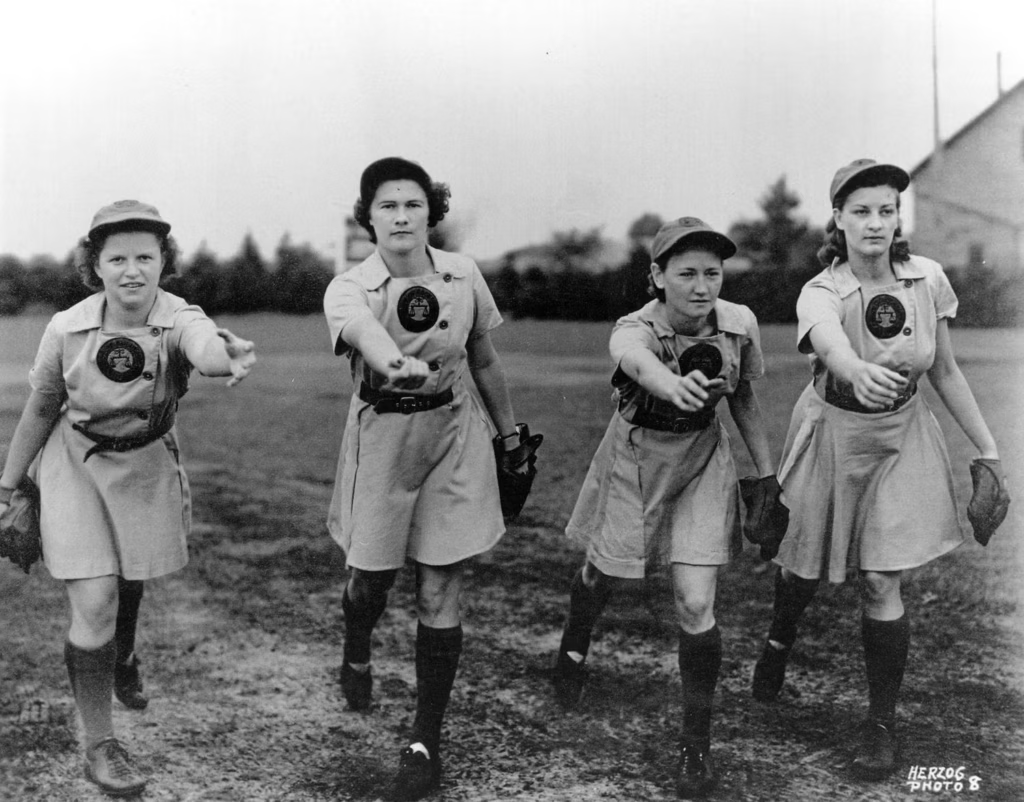
The real players wore short-skirted uniforms.

The basic design consisted of a one-piece, flared tunic inspired partly by women’s tennis, field-hockey and figure-skating clothing, worn with satin shorts underneath, knee-high socks and a baseball cap.

Each team had its own colors and insignia. From a branding perspective, the uniforms were brilliant. From the perspective of sliding into second base, they could be brutal.


The Famous “Strawberries”
The movie repeatedly shows the consequences. Players slide. Skin meets dirt. Thighs become covered in abrasions. The resulting injuries—often called “strawberries”—were very real. The uniform tells us almost everything we need to know about the contradiction built into the AAGPBL. The women were expected to play hard enough to entertain paying customers.

But management wanted to ensure they never appeared too masculine while doing it. Athleticism was acceptable. Masculinity was not.
That meant appearance became part of the league’s business model.

Femininity Was Policy
The league’s surviving Rules of Conduct are astonishingly explicit. Players were expected to appear in feminine attire whenever they were not practicing or playing. Slacks and shorts were prohibited in public. Certain short hairstyles were discouraged. Hair was expected to remain groomed. Lipstick was expected. Smoking and drinking in public were prohibited.
Players had to conform not merely to athletic regulations but to a carefully constructed image of respectable womanhood.
That image wasn’t incidental. It was marketing.


Wrigley and the league’s organizers understood that professional female athletes challenged conventional gender expectations. Their solution was not to challenge those expectations completely. Instead, they attempted to reassure audiences.
Yes, these women could play baseball. But don’t worry. They were still “ladies.”


Charm School Was Real
One of the funniest sequences in Marshall’s movie is also one of its most historically grounded. The players really did receive instruction in grooming, appearance and etiquette. Wrigley contracted with Helena Rubinstein’s beauty organization, and players received instruction in personal presentation.


The surviving charm-school materials reveal just how extensive this program could be. Players were advised on skin care. Hair. Teeth. Hands. Clothing. Speech. Etiquette. Makeup. Social behavior. Public relations. They were instructed to maintain their appearance after games and to remain courteous with fans.
The beauty kit included products such as lipstick, rouge, face powder, cleansing cream, hand lotion and deodorant.
Imagine the contradiction.


A woman could spend the afternoon diving for line drives, stealing bases and scraping skin off her thigh. Then she was expected to shower, fix her hair, apply makeup and present herself as a carefully groomed representative of respectable American femininity. The movie treats this contradiction comically.
History makes it considerably more revealing.


The Chaperones Were Real Too
The women traveled with chaperones. Again, this was about image and respectability. Many players were extremely young. Most were in their early twenties, while some were teenagers. Teams maintained curfews. Travel was closely regulated.
The chaperone functioned as supervisor, counselor and representative of the league’s behavioral standards.

The AAGPBL’s own charm-school guide described the chaperone as a player’s “friend,” counselor and guide while simultaneously emphasizing her responsibility to the player, family, club and league.
That relationship reflects another contradiction.

These were adult professional athletes—or young women doing adult professional work—who traveled around the country earning salaries and performing before thousands of spectators.
Yet they were supervised according to gendered assumptions that male professional athletes never encountered in comparable form.

A League of Their Own captures that absurdity extremely well. The women have professional responsibilities.
But they are treated as though their respectability must constantly be monitored.

VI. How Good Were These Players?
Very good.
This point needs emphasis because the sentimental reputation of A League of Their Own sometimes obscures the athletic history underneath it. The AAGPBL was not simply wartime entertainment featuring women pretending to play baseball until the men came home.
These were serious athletes.

Many had years of competitive softball experience before joining the league. The scouting process selected from some of the best female talent available in the United States and Canada.
And once selected, the players entered a demanding professional environment.


The Schedule Was Grueling
AAGPBL players didn’t show up for an occasional exhibition. They played extensive schedules while traveling from city to city. The Hall of Fame’s archival description notes a 108-game regular season during the league’s history.
Players frequently traveled by bus. They played through injuries. They competed in summer heat. And they had relatively little recovery time. The romantic image of women enjoying a wartime adventure becomes much less romantic when we consider the physical workload.
These were working athletes.
The Rules Kept Getting Harder
Perhaps the best evidence of their ability is the evolution of the sport itself.
Consider the progression.
In 1943:
12-inch ball.
40-foot pitching distance.
65-foot base paths.
Underhand pitching.
By 1948:
10⅜-inch ball.
50-foot pitching distance.
72-foot base paths.
Overhand pitching.
By 1954:
Regulation-size nine-inch baseball.
60-foot pitching distance.
85-foot base paths.

The women adapted. Pitchers who had developed their careers throwing underhand learned sidearm techniques. Then overhand. Hitters adjusted to smaller balls and changing pitching styles. Fielders adapted as the diamond expanded.
That is not a trivial athletic accomplishment.

Fans Came to Watch
Attendance provides another answer to the question of quality. The league reached approximately 910,000 paid spectators in 1948. In the years immediately following World War II, individual teams could regularly attract crowds numbering in the thousands. An estimated 10,000 spectators reportedly attended a July 4, 1946 doubleheader in South Bend.
Those numbers matter because the league could no longer rely on wartime necessity by then. The war was over.

Men’s baseball was fully operating. Fans still paid to watch women play. They weren’t buying tickets merely because the players wore skirts. They were watching competitive baseball.

The Movie Sometimes Makes Them Too Flashy
Interestingly, former players have suggested that the film occasionally exaggerates the theatricality of their on-field behavior. Marshall’s players perform crowd-pleasing tricks and increasingly flamboyant plays as the league searches for publicity.
That makes cinematic sense. The film needs to show audiences becoming excited.

But the real women generally regarded themselves as serious ballplayers rather than entertainers performing stunts. The AAGPBL Players Association notes that flashy behavior like that depicted in the film would have been comparatively unusual.
That distinction is important.

The movie sometimes implies:
The women saved the league by becoming entertaining.
History suggests something slightly different:
The women earned respect because they were excellent players.
The spectacle helped sell tickets. The baseball kept people watching.

VII. What A League of Their Own Leaves Out
No historical movie can include everything. But omissions matter.
And one of A League of Their Own‘s most important limitations involves the boundaries of the opportunity it celebrates. The AAGPBL created extraordinary opportunities for women.
But not all women.

Race and Segregation
The league was segregated. Black women were excluded.
This reality complicates any simple narrative about the AAGPBL as a universally progressive institution. It broke one barrier while preserving another. White women were invited onto professional diamonds while Black women remained excluded from the opportunity. The movie acknowledges that reality in one brief but memorable moment.
A foul ball travels toward a group of Black spectators. A Black woman picks it up. Dottie gestures for the ball. The woman fires it back with remarkable strength and accuracy. Dottie catches it. The two exchange a look. Nothing is said. Nothing needs to be.
For a few seconds, the film reveals the boundary surrounding its own story.


Here is another woman who can clearly play. But she isn’t wearing the uniform.
That scene has become one of the film’s most discussed historical moments precisely because it opens a door the narrative never walks through.
The Women Outside the League
Black women did play professional baseball. They simply had to find opportunities elsewhere.
The history of Toni Stone, Connie Morgan and Mamie “Peanut” Johnson demonstrates how incomplete the popular narrative of women’s baseball becomes if we stop with the AAGPBL.
Stone played professionally in the Negro Leagues.


Morgan followed. Johnson became a professional pitcher. Johnson’s story is particularly revealing. In 1953, she went to an AAGPBL tryout with another Black woman. They were effectively ignored. Johnson understood the message.
She was not wanted.

She later found an opportunity with the Indianapolis Clowns of the Negro American League. The contradiction could hardly be clearer. The AAGPBL demonstrated that women could play professional baseball. Yet Black women still had to seek opportunities elsewhere because the supposedly “All-American” league did not include them.

A League of Their Own hints at this history. It does not explore it.
For a movie released in 1992, the acknowledgment is meaningful. From a modern historical perspective, however, the omission remains significant.

Gender Conformity
Race wasn’t the only boundary.
The league also enforced a narrow definition of acceptable femininity. Players could challenge one gender convention—women couldn’t play professional baseball—but were expected to conform to many others.

Longer hair. Makeup. Skirts. Public decorum. Heteronormative respectability. Charm. Modesty. No behavior management considered excessively masculine. That tension deserves more attention than the movie gives it.
The league did not simply prove women could play baseball.

It demonstrated how institutions sometimes allow women into traditionally male spaces only after establishing rules ensuring that those women remain recognizable within conventional gender expectations.
You could be strong. But you still had to be feminine. You could be competitive. But you still had to be gracious. You could slide aggressively into second.
But afterward, you had better fix your lipstick.

Sexuality and the Limits of the 1992 Film
A League of Their Own also largely avoids questions of sexuality.

That omission is understandable within the commercial and cultural context of a mainstream studio movie released in 1992. But it leaves another part of women’s sports history unexplored. The intense regulation of players’ clothing, hairstyles, dating behavior and public appearance wasn’t simply about aesthetics. It helped reassure audiences that female athleticism did not necessarily mean rejecting conventional heterosexual femininity.

The film shows the rules. It shows their absurdity. But it doesn’t fully interrogate what those rules were designed to police. That creates an interesting historical gap. Marshall’s film is progressive in insisting that women belong on the baseball field. But it largely remains inside the public-relations framework created by the league itself.
The women are allowed to challenge gender expectations. Only so far.

VIII. The Ending: When Fiction Meets Historical Memory
The most powerful historical moment in A League of Their Own doesn’t happen during the 1943 season.
It happens decades later. An elderly Dottie arrives at the Baseball Hall of Fame in Cooperstown. She walks through an exhibition honoring the women who played professional baseball. Former teammates reunite. Old photographs come alive. Memories return.


And the women sing their league song together.
The sequence works emotionally because the audience has spent the previous two hours with fictional characters. But its historical power comes from something else.
Real AAGPBL players appear in the sequence.
The boundary between Hollywood reconstruction and lived history begins to collapse. The women whose experiences inspired the movie are suddenly present inside the movie that has reconstructed their past.
It is an extraordinary act of historical remembrance. And it was based on something real.
Cooperstown Came Before Hollywood
The film makes the Hall of Fame exhibit feel like the culmination of Dottie’s personal journey. Historically, however, the exhibit helped produce the movie.


Former AAGPBL players had begun organizing reunions during the 1980s. They wanted their contribution to baseball history remembered. Their efforts helped generate artifacts, documentation and institutional recognition.
On November 5, 1988, the National Baseball Hall of Fame opened its Women in Baseball exhibit.
More than 150 former AAGPBL players reportedly attended. It was deeply emotional.
These women had spent decades watching baseball history move forward while their own accomplishments received relatively little national attention. Now they were inside Cooperstown. Penny Marshall became fascinated by that history.

The Hall of Fame later recalled that Marshall visited, interviewed staff and drew upon the exhibit’s emotional power while developing the movie.

That changes how we should understand A League of Their Own. The movie didn’t single-handedly rediscover the league.
The women were already rediscovering themselves.

They held reunions. They preserved artifacts. They organized. They pushed baseball institutions to recognize what they had accomplished.
Marshall then took that recovery movement and gave it a mass audience.

The Movie That Made America Remember
That is why the title of this week’s feature matters. A League of Their Own didn’t create AAGPBL history. It didn’t initiate every effort to preserve it. But it became the mechanism through which millions of Americans encountered that history.

Former players described people suddenly believing their stories because they had seen the movie. Children approached them. Fans recognized their uniforms. Schools discussed the league. Museums saw renewed interest. A professional women’s baseball league that had once drawn hundreds of thousands of spectators had returned to the cultural imagination.

Hollywood had done what Hollywood occasionally does remarkably well. It took forgotten history and transformed it into popular memory.

REEL VS. REAL: WHAT DID A LEAGUE OF THEIR OWN GET RIGHT?
The answer depends on what kind of accuracy we’re measuring.
If we judge the movie according to whether its protagonists literally existed, the score falls quickly.
Dottie? Fictional. Kit? Fictional. Jimmy? Fictional composite. Mae? Fictional. Doris? Fictional. The central sibling conflict? Fictional. But if we ask whether the movie accurately reconstructs the world inhabited by AAGPBL players, the answer changes dramatically.

The teams were real. The league was real. The wartime circumstances were real. The recruiting was real. The uniforms were real. The charm school was real. The chaperones were real. The beauty expectations were real. The exhausting schedules were real. The athletic quality was real. The struggle for legitimacy was real.
And the decades-long struggle to be remembered was very real.

That makes A League of Their Own an excellent example of the difference between factual accuracy and historical authenticity.
The factual narrative is largely invented. The historical ecosystem is remarkably faithful.

MoviesToHistory Accuracy Meter

| Category | Score | MoviesToHistory Assessment |
|---|---|---|
| AAGPBL Historical Context | 90% | Strong reconstruction of the league’s wartime origins and broader purpose, although the film simplifies institutional history. |
| League Culture | 90% | Charm school, chaperones, travel, publicity concerns and strict behavioral expectations are strongly grounded in history. |
| Characters | 60% | The major characters are fictional or composites, though they embody genuine player experiences and recognizable historical personalities. |
| Wartime America | 85% | Effectively connects women’s changing social roles with wartime labor and entertainment, though broader wartime complexities remain background material. |
| Uniforms & Gender Expectations | 95% | Among the film’s strongest historical elements: skirts, grooming requirements, femininity standards and behavioral regulations are extensively documented. |
| Baseball | 90% | The film convincingly communicates the players’ athletic ability and professionalism, although some crowd-pleasing theatrics are exaggerated. |
| OVERALL HISTORICAL ACCURACY | 85% | Highly authentic historical world built around deliberately fictional protagonists. |
MoviesToHistory Verdict
A League of Their Own fictionalizes its central characters but preserves something arguably more important: the world in which the real women of professional baseball played.

That distinction is what separates the film from many historical dramas. Some movies take real people and distort the world around them. Penny Marshall largely does the opposite.
She invents people and places them inside a world recognizable to the people who actually lived it.

The Rockford Peaches were real. The Racine Belles were real. The Kenosha Comets were real. The South Bend Blue Sox were real.
The skirts were real. The bruises were real. The charm school was real. The chaperones were real. The exhausting travel was real. The rules governing femininity were real. The spectators were real. The championships were real. And the baseball was absolutely real. Dottie and Kit allow us into that world. They give the history a dramatic structure.
Jimmy gives skepticism a human face. Mae and Doris give the clubhouse humor and personality.
Marshall takes the hundreds of women who passed through the league and constructs a handful of fictional characters capable of carrying pieces of their collective experience.

There is historical loss in that choice. Individual players whose accomplishments deserve wider recognition disappear behind fictional counterparts. Race receives only fleeting acknowledgment. Sexuality and gender nonconformity remain largely outside the frame. The AAGPBL’s postwar history is compressed by the movie’s focus on its wartime creation.
And the complexity of women’s baseball beyond the AAGPBL receives almost no attention. Those limitations matter.

But so does what happened because millions of people watched the film. A generation learned that the Rockford Peaches had existed. Children learned that women had once played professional baseball.
Former players who had spent decades explaining an almost forgotten chapter of their lives suddenly found audiences who knew what they were talking about.

The National Baseball Hall of Fame’s Women in Baseball exhibit preceded the film and helped inspire Marshall’s recreation of the Cooperstown reunion. After the movie became a cultural phenomenon, however, public awareness expanded dramatically.
The movie became part of the history it was depicting. That is the unusual legacy of A League of Their Own.
It isn’t simply a movie about historical memory. It created historical memory.

And that becomes particularly meaningful in September 2026.
More than eight decades after Philip Wrigley’s league began play in the Midwest—and more than three decades after Penny Marshall introduced that history to millions of moviegoers—the conversation about women and professional baseball is no longer confined to museum cases, archival photographs and Hollywood nostalgia.
A new generation can look backward at Dottie Hinson and ask who inspired her.

They can discover Helen Callaghan. Marge Callaghan. Dottie Kamenshek. Sophie Kurys. The hundreds of women whose names never became famous outside their hometowns.

And they can look beyond the league’s segregated boundaries to Toni Stone, Connie Morgan, Mamie Johnson and the Black women whose baseball careers developed outside an institution that denied them access.
That is where historical filmmaking can become valuable even when its protagonists never existed.


Dottie Hinson isn’t history. She is a doorway into history. Walk through it, and an extraordinary world appears. Women crossing North America for tryouts.
Professional contracts. Packed ballparks. Long bus rides. Overhand fastballs. Stolen bases. Championship races. Skinned thighs. Lipstick. Curfews. Gender restrictions. Segregation. Opportunity. Contradiction.


And hundreds of women insisting—sometimes simply by stepping onto the diamond—that baseball belonged to them too.
Perhaps that is why A League of Their Own has endured. Jimmy Dugan’s line became the quotation everyone remembers.
But the film’s most important message was never really about whether there is crying in baseball.
It was about something much larger:
There were women in baseball.
They played professionally. They played exceptionally well.
America forgot. And A League of Their Own helped America remember.
A League of Their Own is available now with a subscription to Netflix…

Discover more from Movies To History.com
Subscribe to get the latest posts sent to your email.
Related Posts

My Top Ten Thanksgiving Movies:
Welcome to The Top Ten List! To commemorate the Featured Film Blog for the month of November, The Godfather, I have gathered My Top Ten Thanksgiving Movies! If you're looking for the best classic Holiday…
My Top Ten At Sea Movies:
To commemorate the Featured Film Blog of the month for February, The Perfect Storm, I have gathered My Top Ten At Sea Movies! If you're looking for the best film to watch featuring the cast…
‘The Trial of the Chicago 7’ – Official Trailer:
The Chicago Streets had Enough... The Trial of the Chicago 7 (2020) is an American historical legal drama written and directed by Aaron Sorkin. The film dramatizes the infamous trial of the Chicago Seven — a…