Skip to content
CONNECT WITH US
https://moviestohistory.com/wp-content/uploads/2022/03/cropped-d3d0f4de5c874cf7a06b2f50e0bc7820-2-10.png

Movies To History.com

  • Home
  • About
  • Featured Film Blog
    • Film Critiques
    • Film Reviews
    • FIlm Recommendations
    • Video
  • Featured Television Blog
    • Television Critiques:
    • Television Reviews:
    • Television Recommendations:
    • Image
    • Video
  • Blog Posts
  • Contact Us
  • Subscribe
  • Oscar History
  • Top Ten List
Close Button

Television Critiques:

DECEMBER 2022:

Genre: Drama, Created by Danny Strong, Based on "Dopesick: Dealers, Doctors, and the Drug Company that Addicted America" by Beth Macy, Starring: Michael Keaton, Peter Sarsgaard, Michael Stuhlbarg, Will Poulter, John Hoogenakker, Kaitlyn Dever, Rosario Dawson, Composer: Lorne Balfe, Country of origin: United States, Original language: English, No. of episodes: 8, Executive producers: Danny Strong, John Goldwyn, Warren Littlefield, Karen Rosenfelt, Barry Levinson, Beth Macy, Michael Keaton, with Cinematography by Checco Varese, and Editors Douglas Crise, C. Chi-Yoon Chung, and Matthew Barber, Running time: 57–65 minutes, Production companies: Danny Strong Productions, John Goldwyn Productions, The Littlefield Company, and 20th Television, Original Network: Hulu. (2021)
Dopesick (2021)

Evil Has A Name, And It’s Sackler…

The Sackler family is an American family who founded and owned the pharmaceutical companies Purdue Pharma and Mundipharma. Arthur, Mortimer, and Raymond Sackler, the three children of Jewish immigrants from Galicia and Poland, grew up in Brooklyn in the 1930s. All three of the siblings went to medical school and worked together at the Creedmoor Psychiatric Center in Queens. They were often cited as early pioneers in medical techniques that ended the common practice of lobotomies. They were also regarded as the first to fight for the racial integration of blood banks. Arthur Sackler was widely regarded as the patriarch of the family. In 1952, the brothers bought a small pharmaceutical company, Purdue-Fredrick. Raymond and Mortimer ran Purdue Pharma, while Arthur, the oldest brother, became a pioneer in medical advertising. He devised campaigns appealing directly to doctors and enlisted prominent physicians to endorse Purdue Pharma’s products. Arthur is considered one of the foremost art collectors of his generation, he also donated the majority of his collections to museums all over the world. After his death in 1987, his option on one-third of Purdue-Fredrick was sold by his estate to his two brothers who turned it into Purdue Pharma. In 1996, Purdue Pharma introduced OxyContin, a reformulated version of oxycodone in a slow-release form. Oxycodone was first invented in 1916 and sold as Eukodal but had been withdrawn from the market in 1990 due to addiction issues. Raymond and Mortimer Sackler played significant roles in the company’s operations and marketing strategies.

(L from the top)

David Sackler, Richard Sackler, Jonathan Sackler, Beverly Sackler, and Raymond Sackler

(R from the top)

Jacqueline Sackler, Ilene Sackler Lefcourt, Kathe Sackler, Mortimer D.A. Sackler, Mortimer Sackler, and Theresa Sackler

Photo Credit: Google Images
In this photo illustration, Purdue Pharma L.P. logo is seen on a smartphone and on a pc screen. Photo Illustration Credit: Pavlo Gonchar/SOPA Images/LightRocket via Getty Images
Purdue Pharma headquarters stands in downtown Stamford, April 2, 2019 in Stamford, Connecticut. Purdue Pharma, the maker of OxyContin, and its owners, the Sackler family, are facing hundreds of lawsuits across the country for the company's alleged role in the opioid epidemic that has killed more than 200,000 Americans over the past 20 years. 

Photo Credit: Drew Angerer/Getty Images
Mundipharma International Limited is a British multinational research-based pharmaceutical company owned by members of the Sackler family with locations in United Kingdom, Canada, Germany, and Singapore. In Germany, Mundipharma is a subsidiary of Mundipharma International Limited and Mundipharma AG. Its global headquarters located at the Cambridge Science Park of Cambridge, England.

Photo Credit: Google Images
Mundipharma research modern high-tech businesses located in Cambridge Science park, Cambridge, England founded by Trinity College in 1970, is the oldest science park in the United Kingdom.. 

Photo Credit: Geography Photos/Universal Images Group via Getty Images
(L to R) Mortimer, Raymond and Mortimer Arthur Sackler at Purdue Frederick.

Photo Credit: Google Images
Arthur Mitchell Sackler (August 22, 1913 – May 26, 1987) was an American psychiatrist and marketer of pharmaceuticals whose fortune originated in medical advertising and trade publications. He was also a philanthropist and art collector. He was one of the three patriarchs of the controversial Sackler family pharmaceutical dynasty.

Sackler amassed the largest personal Chinese art collection in the world, which he donated to the Smithsonian. He provided the funds needed to build numerous art galleries and schools of medicine. Sackler's estate was estimated at $140 million.

Since his death, Sackler's reputation has been tarnished due to his company Purdue Pharma's central role in the opioid crisis. Many of the museums and galleries that Sackler donated to have distanced themselves from him and his family in the wake of the opioid crisis and the Sackler family's resulting reputational fall. On December 9, 2021, the Metropolitan Museum of Art in New York City officially removed the Sackler family name from galleries which had been named after them.
Mortimer David Sackler KBE (December 7, 1916 – March 24, 2010) was an American-born British psychiatrist and entrepreneur who was a co-owner, with his brother Raymond, of Purdue Pharma. During his lifetime, Sackler's philanthropy included donations to the Metropolitan Museum of Art, the Tate Gallery, the Royal College of Art, the Louvre and Berlin's Jewish Museum.

After Sackler's death, his family's company became embroiled in a scandal about its role in the opioid crisis, including the aggressive marketing of highly addictive opioids. Many of the museums and galleries that Sackler donated to have distanced themselves from Sackler and his family in the wake of this, and the Sackler family's reputational fall. On December 9, 2021, the Metropolitan Museum of Art in New York City officially removed the Sackler family name in dedicated galleries.

Photo Credit: google Images
Raymond Sackler KBE (February 16, 1920 – July 17, 2017) was an American physician and businessman. He acquired Purdue Pharma together with his brothers Arthur M. Sackler and Mortimer Sackler. Purdue Pharma is the developer of OxyContin, the drug at the center of the opioid epidemic in the United States.

Sackler and his family have been linked to the rise of direct pharmaceutical marketing and the opioid crisis. The Sackler family's philanthropy has been characterized as reputation laundering from profits acquired from the selling of opiates

Photo Credit: Google Images
View from the Lion Mountain to the historic center in Lviv.

Photo Credit: Wikipedia Commons
Dark-Green) Poland.  (Light-Green) The rest of the European Union (EU).  (Dark-gray) The rest of Europe.  (Light-gray) The surrounding region. See also: Category:SVG locator maps of countries in European Union (gray and green scheme) Category:SVG locator maps of countries of Europe (gray and green scheme)

Photo Credit: Wikipedia Commons
1930S New York City Brooklyn Bridge And The Skyline Of Lower Manhattan Across The East River  

Photo Credit: Charles Phelps Cushing/ClassicStock/Getty Images
Creedmoor Psychiatric Center is a psychiatric hospital at 79-26 Winchester Boulevard in Queens Village, Queens, New York, United States. It provides inpatient, outpatient and residential services for severely mentally ill patients. The hospital occupies more than 300 acres (1.2 km2) and includes more than 50 buildings.

The site was named after the Creed family, which farmed on the site. It later was used as a firing range from the 1870s until 1892. The Farm Colony of Brooklyn State Hospital was opened on the site in 1912, with 32 patients. By 1959, the hospital housed 7,000 inpatients. The hospital's census declined by the early 1960s, and unused portions were sold off and developed into the Queens County Farm Museum, a school campus, and a children's psychiatric center.

Photo Credit: Wikipedia Commons
The borough of Queens in New York City, looking toward Manhattan, 1952. 

Photo Credit: Bob Henriques/Pix/Michael Ochs Archives/Getty Images
A guard at Vacaville State Prison prepares a prisoner for a lobotomy in 1961. The warden of Vacaville at that time was Dr. William Keating, a psychiatrist who was convinced that "criminality" was lodged in certain areas of the brain, and so lobotomies at Vacaville became routine. 

Photo byCredit: © Ted Streshinsky/CORBIS/Corbis via Getty Images
Black people were once banned form donating blood to blood banks under Jim Crow laws, a Sackler changed that surprisingly. 

Photo Credit: Google Images
Sackler family patriarch. Arthur Sackler.

Photo Credit: Google Images
Arthur Sackler had donated all of his work to collection houses allover the world by the time he died. 

Photo Credit: Google Images
Arthur Sackler write up in the Harvard Crimson, where he has a building named after him for donations of money and art to the institution. 

Photo Credit: Google Images
The Sackler family through most of Arthur's art, have their name on buildings internationally.

Photo Credit: Google Images
A picture of the Black Box Warning and Purdue Pharma name on their addictive opioid marketed to treat pain without habit forming side effects, OxyContin. Photo Credit: Google Images
OxyContin was introduced by Purdue Pharma in 1996.

Photo Credit: Google Images
A bag of evidence containing the synthetic opioid fentanyl disguised as Oxycodone is shown during a 2020 news conference at the Fresno County Sheriff's Office in Fresno, California. 

Photo Credit: Craig Kohlruss/The Fresno Bee/Tribune News Service via Getty Images
Oxycodone was first introduced in 1916 as an alternative to Opeum. 

Photo Credit: Google Images
When Oxycodone was first introduced it was called Eukodal. 

Photo Credit: Google Images
Raymond and Mortimer Sackler were in charge of operations and marketing strategies at Purdue Pharma. 

Photo Credit: Google Images

Richard Sackler, played by Michael Stuhlbarg in Dopesick, is the son of Raymond and is a Sackler billionaire and physician who was chairman and president of Purdue Pharma and was connected to the development of OxyContin and the opioid epidemic in the United States and has been the subject of multiple lawsuits and fines as a result. Richard was born in Roslyn, New York in 1945 and he received a bachelor’s degree from Colombia University, and followed that by joining his father and uncles by becoming a doctor and attending medical school for his MD degree from the New York University School of Medicine. Sackler joined Purdue Pharma in 1971, as an assistant to his father. His father was the company’s president. Richard became head of research and development and head of marketing, where he was a key figure in the development of OxyContin being the moving force behind Purdue Pharma’s research around 1990 that pushed OxyContin to replace MS Contin that was about to have a generic competition.

Richard Stephen Sackler (born March 10, 1945) is an American billionaire businessman and physician who was the chairman and president of Purdue Pharma, a company best known as the developer of OxyContin, whose connection to the opioid epidemic in the United States was the subject of multiple lawsuits and fines.

Photo Credit: Google Images
Michael Stahlbarg as Perdue Pharma CEO and creator of OxyContin, Richard Sackler in the Hulu Original limited series "Dopesick" (2021) Photo Credit: Hulu/20th Television
Raymond Sackler and his wife Beverly Sackler.

Photo Credit: The New York Times
Dopesick -- "The People vs. Purdue Pharma" - Episode 108 -- Rick and Randy’s criminal investigation now threatens Richard Sackler’s empire, activists take action against Purdue, and Finnix tries to heal his beloved community that’s been ravaged by addiction. Richard (Michael Stuhlbarg), shown. 

Photo Credit: Gene Page/Hulu
In this photo illustration the OxyContin painkiller drug produced by pharmaceutical company owned by the Sackler family and believed the blame for the United States' opioid crisis, Purdue Pharma, logo seen displayed on a smartphone with an economic stock exchange index graph in the background. 

Photo Credit: Budrul Chukrut/SOPA Images/LightRocket via Getty Images
Rep. Ted Lieu, D-Calif., reads the Washington Post during the House Judiciary Committee markup of the "Humanitarian Standards for Individuals in Customs and Border Protection Custody Act," in Rayburn Building titled on Wednesday, July 17, 2019. 

Photo Credit: Tom Williams/CQ Roll Call
The lawsuits against Richard Sackler and Purdue Pharma are nationwide through states.

Photo Credit: Google Images
Main Street and Old Northern Boulevard in Downtown Roslyn, looking southeast. The famous Ellen Ward Clock Tower is at right.

Photo Credit: Wikipedia Commons
In this photo illustration, a Columbia University logo seen displayed on a tablet. 

Photo Credit: Igor Golovniov/SOPA Images/LightRocket via Getty Images
New York University School of Medicine logo.

Photo Credit: New York University School of Medicine
Michael Stahlbarg as Perdue Pharma CEO and creator of OxyContin, Richard Sackler in the Hulu Original limited series "Dopesick" (2021)

Photo Credit: Hulu/20th Television
A picture of the Black Box Warning and Purdue Pharma name on their addictive opioid marketed to treat pain without habit forming side effects, OxyContin. Photo Credit: Google Images
MS Contin was replaced with OxyContin in a matter of time based on the development practices and marketing strategies of Richard Sackler and Purdue Pharma. 

Photo Credit: Google Images

Richard also was integral in getting Russell Portenoy and J. David Haddox into working within the medical community to push a new narrative claiming that opioids were not highly addictive. In pushing this narrative of OxyContin through the Food and Drug Administration (FDA) in 1995, Sackler managed to get the FDA to approve a claim that OxyContin was less addictive than other painkillers, although there had been no studies at the time on how addictive it was or how likely it was to be abused, and no studies of the sort were conducted as part of the approval process. This is quite alarming since the addictive nature of opiates has been known for several decades. Richard became president of Purdue Pharma in 1999, and in 2001 he sent out an email to employees of the company urging them to push the narrative that addiction to OxyContin was caused by the “criminal” addicts who had the addiction and was not caused by the drug itself. Sackler also urged pharmaceutical representatives to urge doctors to prescribe as high a dose as possible to increase the company’s profits.

Purdue Pharma's Richard Sackler. Photo Credit: Google Images
Dr. Portenoy is Chairman of the Department of Pain Medicine and Palliative Care at Beth Israel Medical Center, the first of its kind in the United States. He is Professor of Neurology at the Albert Einstein College of Medicine, for which Beth Israel serves as The Manhattan Campus. Photo Credit: Google Images
J. David Haddox Vice President, Health Policy, Purdue Pharma L.P. (primary employment) Adjunct Associate Professor, Department of Public Health & Community Medicine, School of Medicine, Tufts University, Boston, MA Photo Credit: Google Images
In this photo illustration, a medicine pill is seen in a hand dressed in a medical glove with the U.S. Food and Drug Administration (FDA) logo in the background. Photo Illustration Credit: Pavlo Gonchar/SOPA Images/LightRocket via Getty Images
Oxycontin pills. oxycodone hydrochloride. prescription only pain medication. Photo Credit: Lawrence K. Ho/Los Angeles Times via Getty Images
In this photo illustration, the American pharmaceutical company Purdue logo seen on an Android mobile device screen with the currency of the United States dollar icon, $ icon symbol in the background. 

Photo ICredit: Budrul Chukrut/SOPA Images/LightRocket via Getty Images
Purdue Pharma Company profit estimates in 1996, when OxyCOntin was put on the market all the way to 2002, three years after Richard Sackler became president of Purdue Pharma and pushed the narrative of less addictive and pushed doctors to prescribe as a high a dose a possible for company profit. Photo Credit: Google Images
Opioids spread across money for addiction for profit. Photo Credit: Google Images

Richard Sackler was made co-chairman of Purdue Pharma in 2003. Sackler was in charge of the research department that developed OxyContin, and as president, he approved the targeted marketing schemes to promote sales of OxyContin to doctors, pharmacists, nurses, academics, and others. In 2008, Sackler, along with Mortimer and Jonathan Sackler’s support, made Purdue Pharma measure its performance in proportion to not only the number of pills being sold but also the strength of the doses it sold, despite allegedly knowing that sustained high doses of the drug risked serious side effects, including addiction.

In this photo illustration a pharmaceutical company owned by Sackler family and the blamed for the United States' opioid crisis, Purdue Pharma, logo is seen on an android mobile device with a growth chart in the background. Photo Credit: Budrul Chukrut/SOPA Images/LightRocket via Getty Images

In 2015, Sackler was deposed in Louisville, Kentucky by four lawyers investigating the concern over the development and marketing of OxyContin, and how this affected him and his family financially. All of the Sackler family were and are active board members of their private company, Purdue Pharma. The marketing and prescribing of OxyContin in Pike County, Kentucky, was of particular interest to the four lawyers. Before the case went to trial and before the deposition was made a matter of public record, Purdue Pharma settled for $24 million, but admitted no liability and had the deposition sealed from the public, and required Kentucky prosecutors to destroy or return to Purdue Pharma the millions of pages of internal documents obtained from the company during the discovery process. A medical news website called STAT News sued under the 1967 Freedom of Information Act to unseal Richard Sackler’s deposition. A state judge ruled in its favor and Purdue Pharma appealed but the deposition was later made public.

Richard Sackler being deposed in Louisville, Kentucky for a lawsuit filed by the state against his family and company Purdue Pharma for their part in the Opioid epidemic. 

Photo Credit: Google Images
Kentucky Takes Purdue Pharma to Court over OxyContin Addictions. 

Photo Credit: Google Images
A list of all the Sackler family who are on the board for Purdue Pharma and benefited by the company profit of the drug OxyContin. 

Photo Credit: Google Images
Pike County, Kentucky was most affected by the Opioid Crisis and epidemic in relation to OxyContin. 

Photo Credit: Google Images
Governor Matt Bevin's response to the settlement by Kentucky with Purdue Pharma over the OxyContin addictions and Opioid Epidemic.

Photo Credit: Google Images
STAT News logo

Photo Credit: STAT News
The Freedom of Information Act, 5 U.S.C. § 552, is the United States federal freedom of information law that requires the full or partial disclosure of previously unreleased or uncirculated information and documents controlled by the U.S. government, state, or other public authority upon request. The act defines agency records subject to disclosure, outlines mandatory disclosure procedures, and includes nine exemptions that define categories of information not subject to disclosure. The act was intended to make U.S. government agencies' functions more transparent so that the American public could more easily identify problems in government functioning and put pressure on Congress, agency officials, and the president to address them. The FOIA has been changed repeatedly by both the legislative and executive branches.

The FOIA is commonly known for being invoked by news organizations for reporting purposes, though such uses make up less than 10% of all requests—which are more frequently made by businesses, law firms, and individuals.

Photo Credit: Google Images

In 2018, the State of Massachusetts sued Richard Sackler, Purdue Pharma, and 15 other Purdue Pharma executives and Sackler family members alleging that they had misled doctors and patients about the risks involved with taking its opioid-based pain medications for the sole purpose of boosting sales and to keep patients from safer alternatives. In response to the Massachusetts court filing. Richard sent an email that said:

Richard Sackler's internal e-mail regarding the Massachusetts court filing in 2019.

Photo Credit: Google Images

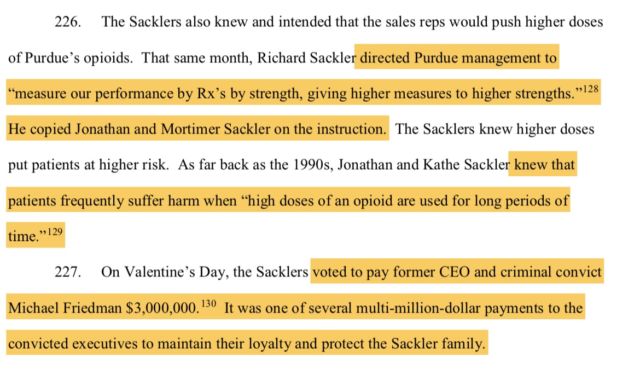
Purdue Pharma has faced numerous allegations of misconduct regarding OxyContin since the Massachusetts court filing. Not only did the drug’s development and testing process come under scrutiny, with accusations that Purdue downplayed the addictive nature of OxyContin and misrepresented its potential for abuse. The company allegedly conducted misleading marketing campaigns, exaggerating the drug’s effectiveness and minimizing the risks associated with its use in January 2019, The New York Times confirmed that Richard Sackler had told company officials back in 2008 to “measure our performance by Rx’s by strength giving higher measures to higher strengths.” This quote was verified again in legally obtained documents tied to another lawsuit, which was filed in June 2019 by the Massachusetts attorney general, Maura Healey, and the lawsuit also revealed that Purdue Pharma and members of the Sackler family knew that putting patients on high dosages of OxyContin for long periods of time increased the risk for serious side effects that included most of all, the likelihood of addiction.

Purdue Pharma headquarters stands in downtown Stamford, April 2, 2019 in Stamford, Connecticut. Purdue Pharma, the maker of OxyContin, and its owners, the Sackler family, are facing hundreds of lawsuits across the country for the company's alleged role in the opioid epidemic that has killed more than 200,000 Americans over the past 20 years. Photo Credit: Drew Angerer/Getty Images
In this photo illustration a pharmaceutical company owned by Sackler family and the blamed for the United States' opioid crisis, Purdue Pharma, logo is seen on an Android mobile device with a graph showing sharp losses in the background. Photo Credit: Budrul Chukrut/SOPA Images/LightRocket via Getty Images
The 48 states and Washington D.C. differences in settlement over lawsuits with Purdue Pharma. Photo Credit: Associated Press
The January 2019 article in The New York Times confirming the quote by Richard Sackler to judge the sale of OxyContin on prescription performance and not side effects or addiction possibilities. Photo Credit:The New York Times
AG Maura Healey discusses Purdue Pharma bankruptcy filing during a press conference on September 16, 2019 in Boston, MA. Photo Credit: Nancy Lane/MediaNews Group/Boston Herald
Massachusetts Details Sackler Family's Role In OxyContin Marketing in a lawsuit filed in Massachusetts by Attorney General Maura Healey.

Photo Credit: Google Images
You can read the full article by The New York Times in January 2019 above by clicking on the photo link.
You can read the full article by The New York Times in January 2019 above by clicking on the photo link above.

Nonetheless, Purdue Pharma promoted the high dosage because stronger pain pills brought the company and the Sacklers the most profit, as charged in the lawsuit. AG Healey also released unredacted documents on February 1, 2019, that showed the Sacklers were directing doctors to overprescribe the drug and even encouraged a medicating strategy under the code name “Region Zero”, that detailed the list of doctors who prescribed inordinately large amounts of OxyContin for no true medical reason, but rather for the directly related profit of the Sackler family.

Signage for Purdue Pharma headquarters stands in downtown Stamford, April 2, 2019 in Stamford, Connecticut. Purdue Pharma, the maker of OxyContin, and its owners, the Sackler family, are facing hundreds of lawsuits across the country for the company's alleged role in the opioid epidemic that has killed more than 200,000 Americans over the past 20 years. 

Photo by Drew Angerer/Getty Images
Eight members of the billionaire Sackler family are being sued by multiple American cities, counties and states, including Richard, Jonathan, Mortimer, Kathe, David, Beverly and Theresa Pictured (left to right): Dr. Thomas Lynch, Richard Sackler, Jonathan Sackler, and Dean Robert Alpern; Seated: Mr. and Mrs. Raymond and Beverly Sackler

Photo Credit: Smilow Cancer Hospital/Facebook
AG Maura Healey discusses Purdue Pharma bankruptcy filing during a press conference on September 16, 2019 in Boston, MA.   

Photo by Nancy Lane/MediaNews Group/Boston Herald via Getty Images
AG Maura Healey's lawsuit detailing the marketing strategy of "Region Zero"

Photo Credit: Google Images
Oxy Dollars and prescription bottles of OxyContin seen dropped outside the courthouse. Members of P.A.I.N. (Prescription Addiction Intervention Now), Truth Pharm, and a coalition of survivors and advocacy groups working in response to the overdose crisis held a demonstration outside of The United States Bankruptcy Court in White Plains to call out the United States justice system for allowing the billionaire Sackler Family to walk away unscathed after igniting one of the worst public health care scandals in the history of the nation. 

Photo Credit: Erik McGregor/LightRocket via Getty Images
Eight members of the billionaire Sackler family are being sued by multiple American cities, counties and states, including Richard, Jonathan, Mortimer, Kathe, David, Beverly and Theresa Pictured (left to right): Dr. Thomas Lynch, Richard Sackler, Jonathan Sackler, and Dean Robert Alpern; Seated: Mr. and Mrs. Raymond and Beverly Sackler

Photo Credit: Smilow Cancer Hospital/Facebook

Further lawsuits would allege conflicts of interest that extended to regulatory bodies such as the Food and Drug Administration (FDA) and the United States Department of Justice (DOJ). Critics claimed that Purdue Pharma had close ties to these agencies, potentially influencing their decisions and actions regarding OxyContin. It was suggested that the company’s influence might have led to the FDA approving OxyContin despite concerns about its addictive properties. Their hiring practices also supported this, Purdue Pharma would often hire ex-employees of the FDA who then retire from their federal job on the promise of giving them a heavy salary and bonuses to come to work for them, but that would only occur if they did Purdue Pharma a solid while still employed by the FDA.

McKinsey Never Told the FDA It Was Working for Opioid Makers While Also Working for the Agency. The consulting giant was helping Purdue Pharma and Johnson & Johnson fend off FDA regulations even as it helped shape FDA drug policy.

Photo Credit: Propublica

The first legal case against Purdue Pharma and the Sackler family gained significant attention. It resulted in multiple lawsuits filed by states, cities, and individuals, accusing the company of fueling the opioid crisis through aggressive marketing and contributing to the addiction epidemic. In 2020, Purdue Pharma reached a settlement agreement with the DOJ, admitting responsibility for unlawful conduct and agreeing to pay billions of dollars in fines. At least one legal case also involved allegations of the Sackler’s transferring funds from Purdue Pharma to offshore accounts, potentially to shield their wealth from litigation. This led to further legal actions and discussions regarding the family’s responsibility and accountability in the opioid crisis. Overall, the Sackler family‘s association with Purdue Pharma, the alleged conflicts of interest with regulatory bodies, and the legal case against the company shed light on the devastating impact of OxyContin and the broader opioid crisis in the United States.

You can watch the full Press Conference from the Department of Justice in 2020 on the Purdue Pharma Settlement from C-SPAN by clicking on the picture link above.

The Sackler family once seen as innovators and pioneers in the medical field of practice are now considered to be the “most evil family in America” as well as “the worst drug dealers in history” making Pablo Escobar look like a chump in the drug dealing game. The Sackler family has since been profiled in various media, including the documentary The Crime of the Century on HBO, the book Empire of Pain by Patrick Radden Keefe, the 2022 Oscar-nominated documentary All the Beauty and the Bloodshed, the book Dopesick: Dealers, Doctors and the Drug Company that Addicted America by Beth Macy, and the 2021 Hulu limited series adapted from Macy’s book, Dopesick starring Michael Keaton and Kaitlyn Dever.

The Sackler family is relinquishing ownership of Purdue Pharma, liquidating their international pharmaceutical holdings, and paying $4,325 billion as pat of Purdue's bankruptcy settlement. 

Photo Credit: Purdue Pharma, Bill Cunningham/The New York Times/Redux, Ronda Churchill/Bloomberg
Pablo Escobar in Colombia in 1983. 

Photo Credit: Eric VANDEVILLE/Gamma-Rapho via Getty Images
Written and directed by Alex Gibney, Country of origin: United States, Original language: English, Producers: Alex Gibney, Sarah Dowland, Tina Nguyen ,Svetlana Zill, with Cinematography by Brett Wiley, Editor Andy Grieve, Running time: 231 minutes, Production companies: HBO Documentary Films, The Washington Post, Jigsaw Productions, Storied Media Group (2021)
NEW YORK TIMES BESTSELLER • A NEW YORK TIMES NOTABLE BOOK OF THE YEAR • A grand, devastating portrait of three generations of the Sackler family, famed for their philanthropy, whose fortune was built by Valium and whose reputation was destroyed by OxyContin. From the prize-winning and bestselling author of Say Nothing.

"A real-life version of the HBO series Succession with a lethal sting in its tail…a masterful work of narrative reportage.” – Laura Miller, Slate

The history of the Sackler dynasty is rife with drama—baroque personal lives; bitter disputes over estates; fistfights in boardrooms; glittering art collections; Machiavellian courtroom maneuvers; and the calculated use of money to burnish reputations and crush the less powerful. The Sackler name has adorned the walls of many storied institutions—Harvard, the Metropolitan Museum of Art, Oxford, the Louvre. They are one of the richest families in the world, but the source of the family fortune was vague—until it emerged that the Sacklers were responsible for making and marketing a blockbuster painkiller that was the catalyst for the opioid crisis.

Empire of Pain is the saga of three generations of a single family and the mark they would leave on the world, a tale that moves from the bustling streets of early twentieth-century Brooklyn to the seaside palaces of Greenwich, Connecticut, and Cap d’Antibes to the corridors of power in Washington, D.C. It follows the family’s early success with Valium to the much more potent OxyContin, marketed with a ruthless technique of co-opting doctors, influencing the FDA, downplaying the drug’s addictiveness. Empire of Pain chronicles the multiple investigations of the Sacklers and their company, and the scorched-earth legal tactics that the family has used to evade accountability.

A masterpiece of narrative reporting, Empire of Pain is a ferociously compelling portrait of America’s second Gilded Age, a study of impunity among the super-elite and a relentless investigation of the naked greed that built one of the world’s great fortunes. Published on April 13, 2021

Photo Credit: The Berkshire Edge
The 95th Academy Awards Oscar nominees for Best Documentary Feature Film are: - "All That Breathes" - "All the Beauty and the Bloodshed" - "Fire of Love" - "A House Made of Splinters" - "Nalvany" Photo Credit: The Academy of Motion Pictures Arts and Sciences Twitter
Directed by Laura Poitras, Produced by Laura Poitras, Nan Goldin, Yoni Golijov, Clare Carter, and John Lyons, Starring: Nan Goldin, with Cinematography by Nan Goldin (credited as Photography and Slideshows), Clare Carter, Robert Kolodny, Alexander W. Lewis, Laura Poitras, Sean Vegezzi, and Thom Pavia, Edited by Amy Foote, Joe Bini, Brian A. Kates, with Music by Soundwalk Collective, Dawn Sutter Madell, Production companies: Praxis Films Participant, HBO Documentary Films, Distributed by Neon. (2022)
A Hulu limited series inspired by the New York Times bestselling book by Beth Macy. Journalist Beth Macy's definitive account of America's opioid epidemic "masterfully interlaces stories of communities in crisis with dark histories of corporate greed and regulatory indifference" (New York Times) -- from the boardroom to the courtroom and into the living rooms of Americans. In this extraordinary work, Beth Macy takes us into the epicenter of a national drama that has unfolded over two decades. From the labs and marketing departments of big pharma to local doctor's offices; wealthy suburbs to distressed small communities in Central Appalachia; from distant cities to once-idyllic farm towns; the spread of opioid addiction follows a tortuous trajectory that illustrates how this crisis has persisted for so long and become so firmly entrenched. Beginning with a single dealer who lands in a small Virginia town and sets about turning high school football stars into heroin overdose statistics, Macy sets out to answer a grieving mother's question-why her only son died-and comes away with a gripping, unputdownable story of greed and need. From the introduction of OxyContin in 1996, Macy investigates the powerful forces that led America's doctors and patients to embrace a medical culture where overtreatment with painkillers became the norm. In some of the same communities featured in her bestselling book Factory Man, the unemployed use painkillers both to numb the pain of joblessness and pay their bills, while privileged teens trade pills in cul-de-sacs, and even high school standouts fall prey to prostitution, jail, and death. Through unsparing, compelling, and unforgettably humane portraits of families and first responders determined to ameliorate this epidemic, each facet of the crisis comes into focus. In these politically fragmented times, Beth Macy shows that one thing uniting Americans across geographic, partisan, and class lines is opioid drug abuse. But even in the midst of twin crises in drug abuse and healthcare, Macy finds reason to hope and ample signs of the spirit and tenacity that are helping the countless ordinary people ensnared by addiction build a better future for themselves, their families, and their communities. "An impressive feat of journalism, monumental in scope and urgent in its implications." -- Jennifer Latson, The Boston Globe Published August 7, 2018 Photo Credit: Google Images
Beth Macy attends Hulu's "Dopesick" New York premiere at The Museum of Modern Art on October 04, 2021 in New York City. 

Photo Credit: Roy Rochlin/WireImage
Hulu Streaming Subscription Service
(L-R) Larry Arancio and Beth Macy attend the premiere for Hulu's "Dopesick" at Museum of Modern Art on October 04, 2021 in New York City.  

Photo Credit: Michael Loccisano/Getty Images
Genre: Drama, Created by Danny Strong, Based on "Dopesick: Dealers, Doctors, and the Drug Company that Addicted America" by Beth Macy, Starring: Michael Keaton, Peter Sarsgaard, Michael Stuhlbarg, Will Poulter, John Hoogenakker, Kaitlyn Dever, Rosario Dawson, Composer: Lorne Balfe, Country of origin: United States, Original language: English, No. of episodes: 8, Executive producers: Danny Strong, John Goldwyn, Warren Littlefield, Karen Rosenfelt, Barry Levinson, Beth Macy, Michael Keaton, with Cinematography by Checco Varese, and Editors Douglas Crise, C. Chi-Yoon Chung, and Matthew Barber, Running time: 57–65 minutes, Production companies: Danny Strong Productions, John Goldwyn Productions, The Littlefield Company, and 20th Television, Original Network: Hulu. (2021)

Oxford University removed the Sackler name from its buildings following a review of its relationship and admitted regret from its role in the US opioid epidemic, the Sackler Gallery and its sister institution, the Freer Gallery of Art were also rebranded although the Smithsonian Institution was keen to point out that neither gallery will have an official name change and simply be called the National Museum of Asian Art. While some institutions and galleries, including the Metropolitan Museum of Art in New York City, still carry the Sackler name, protests by Americans and families of those affected by the opioid epidemic eventually result in the removal of the Sackler name after they deem these institutions and galleries supporting rather than rejecting the Sacklers for the roles they played in addicting America to Opioids. The court of public opinion will never be out on erasing the Sackler name from prestige, while demanding responsibility, and accountability regardless of the recent legal court ruling removing the Sacklers from personal liability in relation to the Opioid epidemic and legal cases against them and their company Purdue Pharma.

Tufts employee Gabe Ryan removes letters from signage featuring the Sackler family name at the Tufts building at 145 Harrison Ave. in Boston on Dec. 5, 2019. Tufts University on Thursday became the first major university to strip the Sackler name from buildings and programs, after months-long conversations and a report that censured the school for its relationship with the family behind OxyContin, an opioid blamed for hundreds of thousands of deaths nationwide. The Sackler family gave Tufts $15 million over nearly 40 years and got its name prominently displayed throughout the universitys Boston health sciences campus - on the graduate school of biomedical sciences, on the center for medical education, and on laboratories and research funds. While there is no evidence that the financial relationship, which ended in 2016, materially affected academics, there was an appearance of too close a relationship between Purdue, the Sacklers, and Tufts, the outside report by former US attorney Donald K. Stern found. And the company was successful in exercising influence, whether directly or indirectly. 

Photo Credit: David L. Ryan/The Boston Globe via Getty Images
(L to R) The Sackler Library in Oxford (pictured), as well as a number of galleries and staff posts at the Ashmolean Museum in the city, will be renamed as the university cuts ties with the controversial family, OxyContin is a painkiller linked to multiple lawsuits relating to the US opioid crisis, Sackler Courtyard at the V & A.

Photo Credit: Daily Mail
A sign welcomes visitors to the Sackler Wing at the Metropolitan Museum of Art on March 28, 2019 in New York City. Joining a growing list of state and local governments alleging that the drug maker Purdue Pharma and the Sackler family sparked the nation’s opioid crisis, New York Attorney General Letitia James announced on Thursday that it is suing members of the billionaire family.  

Photo Credit: Spencer Platt/Getty Images
The Smithsonians National Museum of Asian Art, the Freer Gallery of Art and the Arthur M. Sackler Gallery preserve is closed in an effort to limit large gatherings of people, as the number of COVID-19 cases in the Washington, D.C., Maryland, Virginia increase.  Washington, D.C. Saturday March 14, 2020.  

Photo Credit: Aurora Samperio/NurPhoto via Getty Images
A sign for the Arthur M. Sackler Gallery in Washington, DC is seen on March 26, 2019. - Large museums are rejecting funds from the Sackler family, underscoring the growing unease with the main source of the philanthropic dynasty's riches: the painkiller at the center of the US opioid crisis. With net worth estimated at more than $13 billion, the Sacklers are among the world's richest families, according to Forbes. And they have used their wealth to become significant funders of the arts and education.

Photo Credit:  Mandel Ngan/AFP via Getty Images
An entrance to the Arthur M. Sackler Gallery is seen in Washington, DC on March 26, 2019. - Large museums are rejecting funds from the Sackler family, underscoring the growing unease with the main source of the philanthropic dynasty's riches: the painkiller at the center of the US opioid crisis. With net worth estimated at more than $13 billion, the Sacklers are among the world's richest families, according to Forbes. And they have used their wealth to become significant funders of the arts and education. 


Photo Credit:  Mandel Ngan/AFP via Getty Image
A sign welcomes visitors to the Sackler Wing at the Metropolitan Museum of Art on March 28, 2019 in New York City. Joining a growing list of state and local governments alleging that the drug maker Purdue Pharma and the Sackler family sparked the nation’s opioid crisis, New York Attorney General Letitia James announced on Thursday that it is suing members of the billionaire family.  

Photo Credit: Spencer Platt/Getty Images
Friends and family members of people who have died during the opioid epidemic protest against a bankruptcy deal with Purdue Pharmaceuticals that allows the Sackler family to avoid criminal prosecution and to keep billions of dollars in private wealth, on August 9, 2021 outside the Federal courthouse in White Plains, New York. For decades the Sackler family, which owned Purdue, knowingly marketed highly addictive painkillers, including Oxycontin. 

Photo Credit: Andrew Lichtenstein/Corbis via Getty Images
Nancy Goldin (C), photographer and founder of P.A.I.N. (Prescription Addiction Intervention Now) association - created to respond to the opioid crisis - and Fred Bladou (L), mission head of French NGO Aides, take part in a protest on July 1, 2019 in front of the Louvre museum in Paris, to condemn the museum's ties with the Sackler family, billionaire donors accused of pushing to sell a highly addictive painkiller blamed for tens of thousands of deaths. - The Sacklers have been high-profile philanthropists to cultural institutions such as the Tate in London and the Guggenheim in New York, but museums and galleries have recently been rebuffing their donations because of the opioid crisis fallout. The most recent museum to cut ties with the Sackler family is New York's Metropolitan Museum, which announced earlier this month that it will cease accepting gifts from the family. 

Photo by Stephane De Sakutin/AFP via Getty Images
The opioid addiction support group Truth Pharm builds a memorial for people who have overdosed from opioids to mark International Overdose Awareness Day on August 21, 2021 in Binghamton, New York. Family members of the dead gathered to grieve their lost loved ones and to call for drug reform policies and the prosecution of the Sackler family which manufactured and marketed Oxycontin. 

Photo Credit: Andrew Lichtenstein/Corbis via Getty Images
Susan Stevens carries her daughter Toria's ashes around her neck since she died of an opioid overdose in 2018. People from across the United States, who lost loved ones due to the opioid epidemic, rallied at the Department of Justice in Washington DC, calling on Attorney General Merrick Garland and Deputy AG Lisa Monaco to bring criminal charges against members of the Sackler family. The Sackler's company, Purdue Pharma, pleaded guilty in October of 2020, to three criminal charges related to its marketing of the drug OxyContin but have only faced monetary penalties of around $8.3 billion. 

Photo Credit: Michael Nigro/Pacific Press/LightRocket via Getty Images
Activists of P.A.I.N. (Prescription Addiction Intervention Now) association - created to respond to the opioid crisis - and of French NGO Aides hold a banner reading "Take down the Sackler name" in front of the Pyramid of the Louvre museum (Pyramide du Louvre), on July 1, 2019 in Paris, during a protest to condemn the museum's ties with the Sackler family, billionaire donors accused of pushing to sell a highly addictive painkiller blamed for tens of thousands of deaths. - The Sacklers have been high-profile philanthropists to cultural institutions such as the Tate in London and the Guggenheim in New York, but museums and galleries have recently been rebuffing their donations because of the opioid crisis fallout. The most recent museum to cut ties with the Sackler family is New York's Metropolitan Museum, which announced earlier this month that it will cease accepting gifts from the family. 

The Louvre Pyramid was designed by Chinese-born US architect Ieoh Ming Pei.      

Photo Credit: should read Stephane De Sakutin/AFP via Getty Images
Frank Huntley has been trying to raise awareness of opiate addiction with his sculpture "Pill Man". People from across the United States, who lost loved ones due to the opioid epidemic, rallied at the Department of Justice in Washington DC, calling on Attorney General Merrick Garland and Deputy AG Lisa Monaco to bring criminal charges against members of the Sackler family. The Sackler's company, Purdue Pharma, pleaded guilty in October of 2020, to three criminal charges related to its marketing of the drug OxyContin but have only faced monetary penalties of around $8.3 billion. 

Photo Credit: Michael Nigro/Pacific Press/LightRocket via Getty Images
A federal judge has approved Purdue Pharma's bankruptcy settlement, which grants sweeping "releases" from liability for any harm caused by the drug OxyContin to members of the Sackler family, hundreds of their associates, as well as their remaining empire of companies and trusts.

In return, the family — who admit no wrongdoing — has agreed to pay roughly $4.3 billion and forfeit ownership of the company. 

By their own reckoning, the Sacklers earned more than $10 billion from opioid sales. They will remain one of the wealthiest families in the world.

Photo Credit: NPR
Genre: Drama, Created by Danny Strong, Based on "Dopesick: Dealers, Doctors, and the Drug Company that Addicted America" by Beth Macy, Starring: Michael Keaton, Peter Sarsgaard, Michael Stuhlbarg, Will Poulter, John Hoogenakker, Kaitlyn Dever, Rosario Dawson, Composer: Lorne Balfe, Country of origin: United States, Original language: English, No. of episodes: 8, Executive producers: Danny Strong, John Goldwyn, Warren Littlefield, Karen Rosenfelt, Barry Levinson, Beth Macy, Michael Keaton, with Cinematography by Checco Varese, and Editors Douglas Crise, C. Chi-Yoon Chung, and Matthew Barber, Running time: 57–65 minutes, Production companies: Danny Strong Productions, John Goldwyn Productions, The Littlefield Company, and 20th Television, Original Network: Hulu. (2021)

You can watch the full limited series Dopesick on Hulu with a paid subscription to the streaming service.

You can help end the overdose crisis by visiting Drugfree.org to find out how you can help. Photo Credit: Hulu/20th Television

Share this:

  • Share on X (Opens in new window) X
  • Share on Facebook (Opens in new window) Facebook
  • Share on LinkedIn (Opens in new window) LinkedIn

Like this:

Like Loading…
Pages: 1 2 3 4 5 6 7 8 9 10 11 12 13 14 15 16 17 18

Leave a ReplyCancel reply

Archives

  • May 2026
  • April 2026
  • March 2026
  • February 2026
  • January 2026
  • December 2025
  • November 2025
  • October 2025
  • September 2025
  • August 2025
  • July 2025
  • June 2025
  • May 2025
  • April 2025
  • March 2025
  • February 2025
  • January 2025
  • December 2024
  • November 2024
  • October 2024
  • September 2024
  • August 2024
  • July 2024
  • June 2024
  • May 2024
  • April 2024
  • March 2024
  • February 2024
  • January 2024
  • December 2023
  • November 2023
  • October 2023
  • September 2023
  • August 2023
  • July 2023
  • June 2023
  • May 2023
  • April 2023
  • March 2023
  • February 2023
  • January 2023
  • December 2022
  • November 2022
  • October 2022
  • September 2022
  • August 2022
  • July 2022
  • June 2022
  • May 2022
  • April 2022
  • March 2022

Categories

  • Blog Posts
  • Critics Choice Awards
  • Emmy Awards
  • Featured Blog
  • Golden Globe Awards
  • In Memoriam
  • Oscar History
  • SAG Awards
  • Screen Actors Guild Awards
  • Television
  • The Actor Awards
  • Top Ten List

ABOUT US

PRIVACY POLICY

TERMS & CONDITIONS

DISCLAIMER

All Rights Reserved © Copyright 2021, MoviestoHistory.com By Themespride

Manage Cookie Consent
To provide the best experiences, we use technologies like cookies to store and/or access device information. Consenting to these technologies will allow us to process data such as browsing behavior or unique IDs on this site. Not consenting or withdrawing consent, may adversely affect certain features and functions.
Functional Always active
The technical storage or access is strictly necessary for the legitimate purpose of enabling the use of a specific service explicitly requested by the subscriber or user, or for the sole purpose of carrying out the transmission of a communication over an electronic communications network.
Preferences
The technical storage or access is necessary for the legitimate purpose of storing preferences that are not requested by the subscriber or user.
Statistics
The technical storage or access that is used exclusively for statistical purposes. The technical storage or access that is used exclusively for anonymous statistical purposes. Without a subpoena, voluntary compliance on the part of your Internet Service Provider, or additional records from a third party, information stored or retrieved for this purpose alone cannot usually be used to identify you.
Marketing
The technical storage or access is required to create user profiles to send advertising, or to track the user on a website or across several websites for similar marketing purposes.
  • Manage options
  • Manage services
  • Manage {vendor_count} vendors
  • Read more about these purposes
View preferences
  • {title}
  • {title}
  • {title}

Loading Comments...

    %d