

History remembers the Nuremberg Trials as one of the defining moments of the twentieth century: the moment when surviving leaders of Nazi Germany were brought before an international tribunal and forced to answer for crimes that had transformed humanity’s understanding of war, genocide, and individual responsibility. But before the judges delivered their verdicts—and before the courtroom became a symbol of international justice—another, quieter confrontation was taking place behind the prison walls.
What happens when you sit across from the architects of atrocity and attempt to understand how their minds work?

That unsettling question lies at the center of James Vanderbilt’s 2025 historical drama Nuremberg, our Featured Film of the Month at MoviesToHistory.com.

Based on Jack El-Hai’s 2013 nonfiction book The Nazi and the Psychiatrist, the film approaches the familiar history of the Nuremberg Trials from a less frequently dramatized perspective. Rather than concentrating exclusively on the courtroom proceedings, Vanderbilt turns his attention toward U.S. Army psychiatrist Douglas Kelley, played by Rami Malek, who was assigned to evaluate the mental condition of prominent Nazi prisoners awaiting trial.
Among those prisoners was Hermann Göring.


Played with imposing confidence by Russell Crowe, Göring had been one of the most powerful figures in Adolf Hitler’s regime. A former commander of the Luftwaffe and one of the highest-ranking surviving members of the Nazi leadership, Göring arrived at Nuremberg not merely as a defendant but as a man accustomed to wielding enormous political authority. His imprisonment created an extraordinary psychological confrontation: an American psychiatrist attempting to study a man who had helped sustain one of history’s most murderous regimes—and a prisoner intelligent and manipulative enough to recognize that he was being studied.
The official trailer places that relationship at the center of the film.


What initially appears to be a clinical psychiatric evaluation gradually becomes something closer to psychological combat. Kelley wants to understand Göring. Göring, however, seems equally interested in understanding Kelley.
That distinction matters.

Because underneath the courtroom drama, military uniforms, prison cells, and reconstructed postwar Germany lies one of the most disturbing questions surrounding the history of Nazi Germany: Were the people responsible for its crimes fundamentally different from everyone else?
Were they psychologically abnormal? Were they monsters?
Or were they human beings capable of making choices whose consequences became monstrous?
Those questions haunted psychologists, historians, philosophers, survivors, and subsequent generations long after the defendants left the courtroom.
And Nuremberg enters directly into that debate.


History Becomes a Psychological Thriller
The decision to frame this story partly as a psychological thriller immediately distinguishes Nuremberg from many earlier cinematic portrayals of the trials.
The historical importance of Nuremberg is enormous. Beginning in November 1945, the International Military Tribunal prosecuted major figures from the defeated Nazi regime for crimes including war crimes and crimes against humanity. The proceedings helped establish principles of international criminal responsibility that would reverberate through subsequent debates about genocide, human rights, warfare, and international law.
Yet the trials were also populated by individual human beings.


Behind the legal terminology were defendants who had participated in a political system responsible for persecution, aggressive warfare, mass murder, and the Holocaust. Understanding how those individuals rationalized their actions became a question extending beyond criminal guilt.
Psychiatrists and psychologists were given extraordinary access to the prisoners.
Douglas Kelley was among them.


His interactions with Göring provide Vanderbilt with the foundation for something more intimate than a conventional courtroom drama. The historical spectacle of Nuremberg becomes a battle between observation and manipulation, certainty and doubt, justice and explanation.
The trailer repeatedly emphasizes this tension.
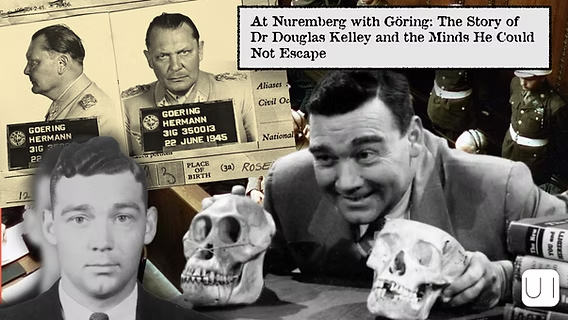
Kelley enters the prison believing that studying the Nazi leadership might reveal something identifiable—perhaps even clinically measurable—about the personalities capable of committing or facilitating extraordinary evil. Göring complicates that expectation because he does not necessarily conform to the comforting image of an irrational monster.
Instead, he can appear intelligent, charismatic, calculating, articulate, and disturbingly human.
That may be considerably more frightening.
Rami Malek and Russell Crowe Face Each Other Across History
The dramatic center of Nuremberg rests heavily upon the performances of Rami Malek as Douglas Kelley and Russell Crowe as Hermann Göring.
The trailer makes their relationship feel almost like an interrogation conducted in both directions.

Malek’s Kelley observes Göring professionally, searching for psychological explanations behind the man sitting across from him. Crowe’s Göring, meanwhile, appears keenly aware of the psychiatrist’s curiosity and increasingly willing to exploit it.
Who is examining whom?
It is precisely the kind of question that makes their relationship so dramatically potent.


Crowe’s performance became one of the most widely praised elements of the film following its 2025 release, and the trailer makes clear why Göring represents such a formidable acting challenge. Portraying a historical figure responsible for helping sustain the Nazi regime requires avoiding two equally dangerous extremes: transforming him into an almost supernatural embodiment of evil or making his intelligence and charisma so compelling that the historical reality of his actions disappears behind the performance.
That balance is one of the issues we will examine throughout our coverage of Nuremberg this month.

Malek faces a different challenge as Kelley. The psychiatrist functions partly as the audience’s entrance into this disturbing environment. Through his encounters with the imprisoned Nazi leadership, the film can ask questions that extend far beyond one historical personality.
What creates a dictator? What allows ordinary institutions to participate in extraordinary crimes? Can psychiatry explain ideological fanaticism?
And perhaps most importantly: What happens when the search for psychological explanations begins to blur the distinction between understanding evil and excusing it?
Those are not merely questions about 1945. They are questions about how we interpret history.

From Toronto to the Historical Drama Conversation
Nuremberg premiered as part of the Gala Presentations program at the Toronto International Film Festival on September 7, 2025, before Sony Pictures Classics released the film theatrically in the United States on November 7.

Critical reaction was generally positive but notably divided over how effectively Vanderbilt’s traditional prestige-drama approach handled such complicated historical material.


Russell Crowe’s performance received particular praise, while some critics questioned the film’s characterization of Kelley, its conventional dramatic structure, and whether its measured approach fully confronted the complexity of its subject.
That division makes Nuremberg particularly interesting for MoviesToHistory.
Historical films do not need to function as documentaries.


But when filmmakers dramatize events as consequential as the Nuremberg Trials, every creative decision matters. Characters can be simplified. Chronologies can be compressed. Conversations can be reconstructed. Motivations can be clarified for audiences even when the historical record itself remains ambiguous.
The result may produce compelling cinema while simultaneously reshaping how viewers understand the past.
And that is where our investigation begins.

Nuremberg as Our Featured Film of the Month
Throughout August, MoviesToHistory.com will move beyond the courtroom and examine the history underneath Vanderbilt’s film.

We will explore the extraordinary true story of Douglas Kelley and his encounters with Hermann Göring; investigate what psychiatrists and psychologists actually discovered while examining imprisoned Nazi leaders; compare the film’s characterization of Göring with the historical record; examine the origins, structure, and legacy of the Nuremberg Trials; and separate documented history from the dramatic license necessary to transform these events into a psychological thriller.
We will also confront the larger ethical question hovering over the entire story:
Can attempting to understand evil accidentally humanize it—or is understanding precisely what history requires of us?


The Nuremberg Trials were designed to establish responsibility. The psychiatric examinations occurring behind the scenes pursued a different objective. They sought explanation.
More than eighty years later, the distinction between those two goals remains deeply uncomfortable—and profoundly important.
So before we begin separating Reel from Real, watch the official trailer for Nuremberg below.

Pay particular attention to the exchanges between Kelley and Göring. Listen to the language surrounding sanity, responsibility, power, and persuasion. Consider how the trailer presents Göring—not simply as a defeated Nazi official awaiting judgment, but as a psychological adversary capable of influencing the very people attempting to understand him.
Then ask yourself the question that will guide our Featured Film coverage throughout the month:
If the architects of history’s worst atrocities were not monsters in a clinical sense, what does that tell us about the human capacity to commit them?

Watch the official trailer for Nuremberg below, and then join MoviesToHistory.com throughout August as we investigate the history behind the film, the real people inside the courtroom and prison cells, and the difficult boundary between understanding the past and explaining the people who created it.
The trial judged their crimes. The psychiatrists studied their minds. Now we examine how Hollywood tells their story.
Nuremberg is available now with a subscription to Netflix…

Discover more from Movies To History.com
Subscribe to get the latest posts sent to your email.
Related Posts

‘Winning Time’ – Interview:
IT’S SHOWTIME FOR BASKETBALL… This six-minute and 42-second interview is provided by HBO and is called, Winning Time: The Forum, its name is an homage to the former arena home of the Los Angeles Lakers…

‘Operation Dumbo Drop’ – Official Trailer:
An Elephant War Pact.... Operation Dumbo Drop is a 1995 American action comedy war film directed by Simon Wincer. The screenplay was written by Gene Quintano and Jim Kouf, based on a true story by United States Army major Jim Morris. The film stars Danny Glover and Ray Liotta as Green…

‘Titanic’ – Official Trailer:
THEY CALLED HER THE SHIP OF DREAMS, AND SHE WAS... Titanic is a 1997 film that was directed, written, produced, and co-edited by James Cameron, the film incorporated both historical and fictionalized aspects to tell a story based on the…