

There is an inherent problem facing any filmmaker who attempts to dramatize the Nuremberg Trials: the real story is simultaneously too large and too intimate for a single film.

The International Military Tribunal was not merely a courtroom proceeding. It was an unprecedented attempt to decide how law should respond to crimes so enormous that existing legal vocabulary seemed inadequate to describe them. It brought together four victorious Allied powers whose wartime alliance was already beginning to fracture. It required prosecutors to transform millions of pages of captured German records, photographs, films, orders, memoranda, military documents, and eyewitness testimony into a legal case against individual human beings. And it forced judges to confront questions that continue to shape international law: Can national leaders be held personally responsible for aggressive war? Does following orders excuse participation in atrocities? Can crimes committed by a government against civilians—including its own citizens—be prosecuted internationally?


James Vanderbilt’s Nuremberg approaches that enormous history through something much smaller: two men talking.
![James Platten Vanderbilt (born November 17, 1975) is an American film director, screenwriter, and producer.[2][3] He is best known for writing the films Zodiac (2007),[4] The Amazing Spider-Man (2012) and its sequel The Amazing Spider-Man 2 (2014), and Independence Day: Resurgence (2016). He co-wrote, produced, and co-storied Scream (2022), Scream VI (2023) and Scream 7 (2026). Vanderbilt produced several films, including The House with a Clock in Its Walls (2018), Ready or Not (2019) and Ready or Not 2: Here I Come (2026).](https://i0.wp.com/moviestohistory.com/wp-content/uploads/2026/08/IMG_2063.jpeg?ssl=1)

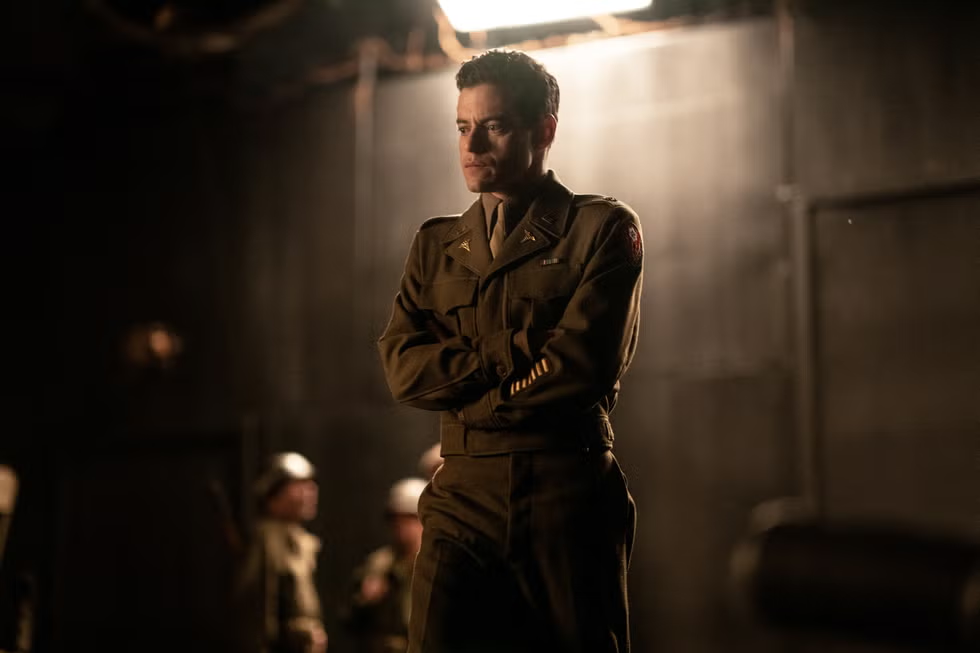
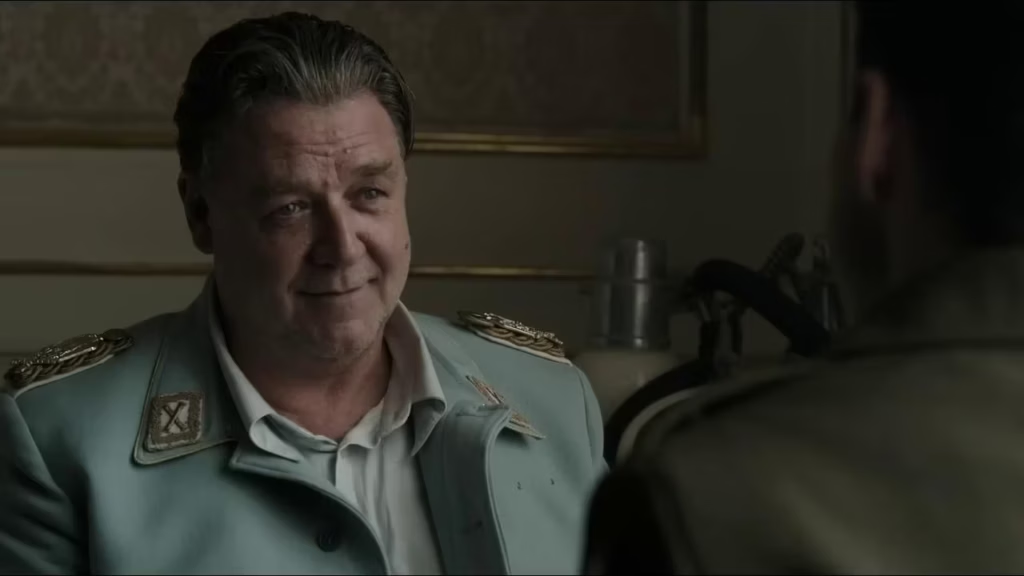
One is U.S. Army psychiatrist Douglas M. Kelley, played by Rami Malek. The other is Reichsmarschall Hermann Göring, played by Russell Crowe, the highest-ranking surviving member of Adolf Hitler’s regime to stand trial before the International Military Tribunal.


Their conversations become the film’s doorway into a much larger question.
What kind of person could participate in a regime responsible for the Holocaust, aggressive war, mass murder, forced labor, persecution, plunder, and the destruction of much of Europe?
More disturbingly: would such a person necessarily look insane?

That question makes Nuremberg more than another courtroom drama about Nazis. Vanderbilt, adapting Jack El-Hai’s 2013 nonfiction book The Nazi and the Psychiatrist, constructs a psychological thriller around Kelley’s encounters with Göring and the other imprisoned Nazi leaders. Vanderbilt has described the relationship between Kelley and Göring as the core that first attracted him to the story. His goal was not simply to reproduce a history lesson but to create a thriller capable of introducing the trials to viewers who might know almost nothing about them.


That choice inevitably produces historical compression.
Kelley did examine Göring.
He did administer psychological tests.

Göring really was extraordinarily intelligent, charismatic, narcissistic, manipulative, and determined to dominate the other prisoners.

Robert H. Jackson really did struggle with Göring during cross-examination.

The prosecution really did introduce captured Nazi documents and devastating film footage into evidence.

And Kelley really did reach one of the most unsettling conclusions to emerge from the psychological examinations at Nuremberg: the men responsible for Nazi Germany were not simply a collection of clinically insane monsters.

But Vanderbilt also keeps Kelley at the center of events longer than history permits, combines and compresses incidents, invents private conversations, and reshapes relationships to produce a cleaner dramatic arc.
The result is a film that is not literally accurate in every scene but is remarkably faithful to many of the larger historical, psychological, and moral truths surrounding Nuremberg. For MoviesToHistory’s August Featured Film, the question therefore is not simply whether Nuremberg gets every conversation right.
It is whether the film gives us an accurate understanding of what happened—and why what happened in that courtroom still matters.
The answer is largely yes.
But the most interesting inaccuracies reveal exactly where history ends and historical drama begins.

Why the Nuremberg Trials Still Matter…
When Nazi Germany surrendered unconditionally in May 1945, Europe had been devastated by six years of war.

Cities lay in ruins. Tens of millions of people were dead. Millions more were displaced. Allied armies entering Nazi concentration camps had encountered evidence of systematic imprisonment, starvation, torture, forced labor, mass execution, and genocide.

The question facing the victorious Allies was no longer whether Nazi crimes had occurred. The question was what to do with the surviving leaders responsible for them. The answer was not predetermined.

Some Allied leaders had contemplated summary execution for major Nazi figures. The idea was understandable in the immediate aftermath of a war of unprecedented destruction: identify the principal architects of the regime, declare them responsible, and execute them.

But the United States increasingly advocated a different approach. A trial would force the Allies to prove their accusations. It would create a documentary record. It would allow defendants legal representation and an opportunity to respond. Most importantly, it would establish that the Nazi leaders were being punished not merely because Germany had lost a war, but because individuals—including heads of state and senior government officials—could be held accountable under law.

The United States Holocaust Memorial Museum notes that while Winston Churchill and Joseph Stalin at times favored summary execution, the United States pushed for judicial proceedings. U.S. Secretary of State Cordell Hull argued that a legal condemnation would better withstand the “judgment of history” and prevent Germans from later claiming that admissions of guilt had simply been forced from defeated prisoners.
![The United States Holocaust Memorial Museum (USHMM) is the United States' official memorial and museum dedicated to the history and legacy of the Holocaust. Opened in Washington, D.C. in 1993, the museum explores the Holocaust through permanent and traveling exhibitions, educational programs, survivor testimonies and archival collections. The USHMM was created with the stated purpose of helping leaders and citizens of the world confront hatred, prevent genocide, promote human dignity, and strengthen democracy.[2] The museum sits between 14th and 15th streets SW in Washington, D.C. with the portion of 15th street renamed Raoul Wallenberg Place. This address is in memory of Raoul Wallenberg who was a Swedish architect, businessman, diplomat, and humanitarian.](https://i0.wp.com/moviestohistory.com/wp-content/uploads/2026/08/holocaust-museum.jpg-1024x814.webp?ssl=1)

![Joseph Stalin[e][f] (born Ioseb Besarionis dze Jughashvili;[g] 18 December 1878 – 5 March 1953) was a Soviet politician and revolutionary who ruled the Soviet Union from the mid-1920s until his death in 1953, holding the titles of General Secretary of the Communist Party of the Soviet Union from 1922 to 1952 and the nation's Premier from 1941 to 1953. Initially presiding over an oligarchic one-party system that governed by plurality, he became the de facto dictator of the Soviet Union by the 1930s. Ideologically committed to the Leninist interpretation of Marxism, Stalin helped to formalise these ideas as Marxism–Leninism, while his own policies became known as Stalinism.](https://i0.wp.com/moviestohistory.com/wp-content/uploads/2026/08/GettyImages-515207888-3251930-e1721903246488.jpg?ssl=1)

That distinction is fundamental to understanding Nuremberg. The Allies had won the military war. Now they needed to demonstrate that justice could be something more than vengeance.

On August 8, 1945, the United States, United Kingdom, France, and Soviet Union signed the London Agreement and Charter. The agreement created the International Military Tribunal, or IMT, and established its jurisdiction over three major categories of offenses: crimes against peace, war crimes, and crimes against humanity. The defendants were also prosecuted under a conspiracy charge connected to those crimes.

The trial of the major Nazi war criminals opened on November 20, 1945.
Twenty-two defendants were ultimately tried before the IMT. Nineteen were convicted and three acquitted. Twelve received death sentences, while others received prison terms ranging from ten years to life.
But the legacy of Nuremberg extends far beyond those verdicts.

The tribunal helped establish one of the defining principles of modern international criminal law: government officials cannot necessarily hide behind their offices, their governments, or orders from superiors when participating in international crimes.

The principles embodied in the Nuremberg Charter and judgment were subsequently affirmed by the United Nations and became foundational to the development of international criminal law. That is one reason audiences continue returning to the Nuremberg story nearly eighty years later.

Another is more uncomfortable. We want history to tell us that the people who committed extraordinary crimes were extraordinary monsters. Nuremberg repeatedly frustrates that desire.
And nobody in Vanderbilt’s film embodies that problem more powerfully than Douglas Kelley.

Who Was Douglas Kelley?
Rami Malek’s Douglas Kelley initially seems like an unusual protagonist for a film about one of history’s most famous trials. He was not a prosecutor. He was not a judge. He was not a Holocaust survivor giving testimony. He was not one of the defendants. He was a psychiatrist. That outsider status is precisely what makes Kelley so useful dramatically.

The Army Psychiatrist
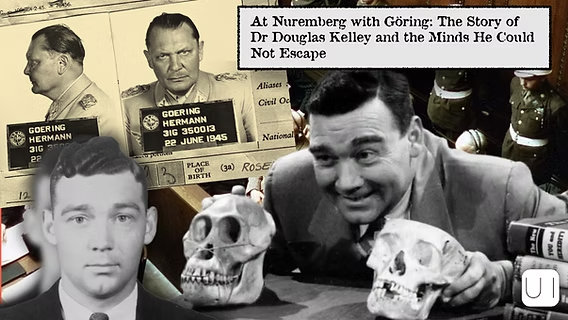
Douglas McGlashan Kelley was born in California in 1912 and trained as a physician and psychiatrist. Before his Nuremberg assignment, he had already developed expertise in psychiatric diagnosis and psychological testing, including work involving the Rorschach technique.

During World War II, Kelley served in the U.S. Army and worked with American soldiers experiencing combat-related psychiatric problems. Then came a radically different assignment. Instead of examining American servicemen, Kelley was ordered to evaluate captured leaders of Nazi Germany. His immediate task was practical.

Were these men mentally competent to stand trial? Could they understand the proceedings against them? Were they capable of participating in their defense? Would any suffer psychiatric breakdowns once the trials began?

The assignment placed Kelley in direct contact with some of the most notorious surviving officials of the Third Reich.
Among them were Rudolf Hess, Joachim von Ribbentrop, Julius Streicher, Wilhelm Keitel, Alfred Rosenberg, and Hermann Göring.

Kelley examined 22 Nazi officials and spent roughly 80 to 90 hours interacting with the prisoners during his time at Nuremberg. But Kelley’s curiosity quickly expanded beyond competency. He wanted to know what made these men psychologically different.
If anything did.
Searching for a “Nazi Personality”
The question reflected assumptions common after the war.
Surely, many thought, men capable of creating and operating such a system must be psychologically abnormal. Perhaps there was a recognizable authoritarian pathology. Perhaps Nazism had attracted a distinctive personality type.
Perhaps men like Göring could be diagnosed in a way that would explain what they had done.

Kelley investigated through interviews and psychological testing. He and psychologist Gustave Gilbert used tools that included the Rorschach inkblot test, Thematic Apperception Test, and a German-language version of the Wechsler-Bellevue intelligence test.


![The Thematic Apperception Test (TAT) is a projective psychological test developed during the 1930s by Henry A. Murray and Christiana D. Morgan at Harvard University. Proponents of the technique assert that subjects' responses, in the narratives they make up about ambiguous pictures of people, reveal their underlying motives, concerns, and the way they see the social world.[1] Historically, the test has been among the most widely researched, taught, and used of such techniques.](https://i0.wp.com/moviestohistory.com/wp-content/uploads/2026/08/Thimatic-apperception-test-3-2048.jpg-1024x576.webp?ssl=1)
![The Wechsler Adult Intelligence Scale (WAIS) is an IQ test designed to measure intelligence and cognitive ability in adults and older adolescents.[1] For children between the ages of 6 and 16, Wechsler Intelligence Scale for Children (WISC) is commonly used. The original WAIS (Form I) was published in February 1955 by David Wechsler, Chief Psychologist at Bellevue Hospital (1932–1967) in New York City, as a revision of the Wechsler–Bellevue Intelligence Scale released in 1939.[2] It is currently in its fifth edition (WAIS-5), released in 2024 by Pearson. It is the most widely used IQ test, for both adults and older adolescents, in the world](https://i0.wp.com/moviestohistory.com/wp-content/uploads/2026/08/images.png?ssl=1)
The film is therefore on strong historical ground when it depicts psychology as an important part of the prisoners’ evaluation. Even some of the more colorful details have historical foundations. Kelley was interested in magic and performed tricks. According to Jack El-Hai, he used magic with prisoners as a way of building confidence and rapport during interviews. That detail could easily feel like a screenwriter’s invention—a convenient metaphor for manipulation, illusion, and misdirection.
It was not.
Vanderbilt has said that discovering Kelley’s interest in magic helped him unlock the screenplay. He began to see the story as a series of people attempting to manipulate one another: Kelley trying to get Göring to reveal himself, Göring attempting to control Kelley’s perception of him, and Jackson trying to maneuver four Allied governments into supporting an unprecedented international trial.
It is an elegant dramatic metaphor. It is also rooted in Kelley’s actual personality.

Kelley’s Disturbing Conclusion
The most historically significant aspect of Kelley’s work was not a diagnosis. It was the absence of one.
Kelley did not discover a unique psychiatric disorder that could explain Nazism. He concluded that the defendants, with notable exceptions and individual psychological problems, were not simply insane men detached from reality.
The implication was terrifying. If Nazi leaders were not clinically insane, then psychiatry could not safely place them in a separate category of humanity.
Kelley later emphasized that the defendants had counterparts elsewhere in society. Speaking after Nuremberg, he stressed that—with the exception of Robert Ley—he had not encountered a room full of insane men or incomprehensible geniuses.
Kelley ultimately interpreted Nazism less as evidence of a special mental disease than as evidence of what ruthless, ambitious people could become within particular social and political environments.

That idea is central to Nuremberg. It is also why the film’s psychological story remains relevant. The reassuring interpretation of Nazi history is that the perpetrators were monsters. Kelley’s interpretation removes some of that reassurance.
If they were recognizably human, then the warning of Nuremberg cannot be restricted to Germany between 1933 and 1945.
It becomes a warning about institutions, ambition, conformity, obedience, propaganda, political violence, authoritarianism, and the capacity of people to rationalize participation in systems that reward cruelty.
That is much harder to dismiss.

How Accurate Is Rami Malek as Douglas Kelley?
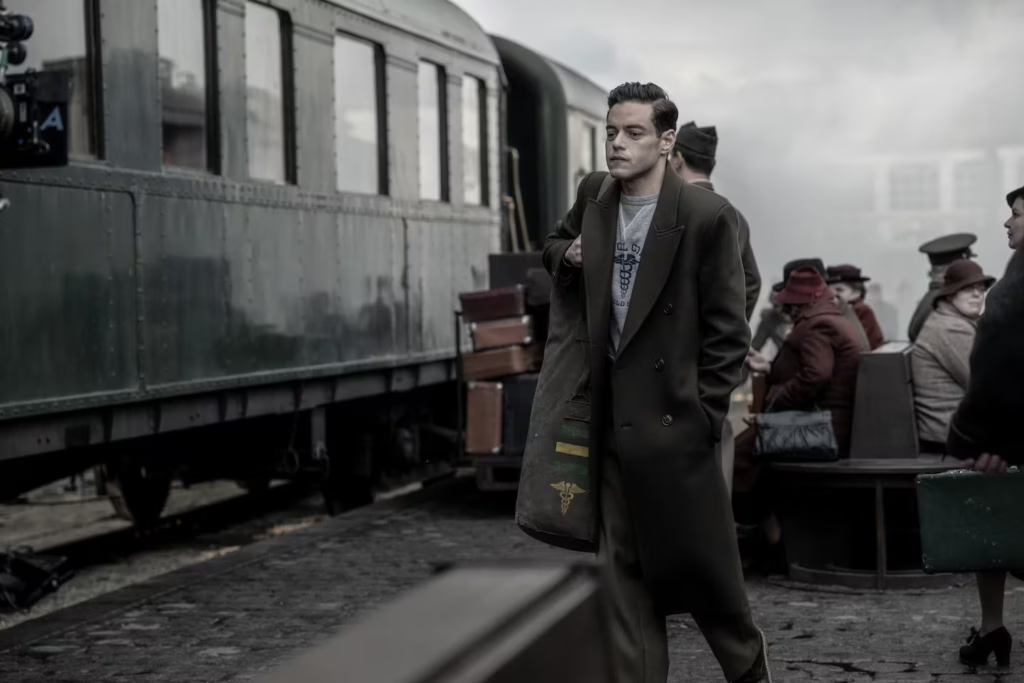
Rami Malek plays Kelley as brilliant, curious, ambitious, somewhat theatrical, and increasingly fascinated by the man he is supposed to study.
Broadly, that characterization works.

The real Kelley was ambitious and intellectually confident. His interest in magic, psychological experimentation, criminal behavior, and public presentation gives Vanderbilt considerable historical material from which to construct Malek’s eccentric, sometimes self-assured psychiatrist. The film also correctly captures the methodological dilemma at the heart of Kelley’s assignment.
A psychiatrist must establish enough rapport with a subject to obtain useful information.

But what happens when rapport becomes fascination? What happens when understanding a perpetrator begins to look like sympathizing with him? And what happens when the subject understands the psychiatrist well enough to begin conducting his own psychological experiment?
Those questions are particularly important with Göring.

Kelley could not simply interview a passive patient. He was dealing with a sophisticated political operator who had spent decades performing power. The relationship therefore becomes a contest over interpretation.
Who is studying whom? That dynamic is dramatized, but its foundation is historically credible.

Where the film departs most clearly from history is chronology.
Kelley did not remain at Nuremberg through all of the dramatic courtroom events Vanderbilt assigns to him. Historical specialists discussing the film have noted that Kelley left Germany before Göring’s famous testimony and cross-examination in March 1946. PBS’s discussion of the film specifically identifies this as one of Vanderbilt’s significant but understandable dramatic liberties.
This matters.
![PBS NewsHour is an American evening television news program broadcast on over 350 PBS member stations. It airs seven nights a week, and is known for its in-depth coverage of issues and current events. Since January 2, 2023, the one-hour weekday editions have been anchored by Amna Nawaz and Geoff Bennett. The 30-minute weekend editions, branded as PBS News Weekend, have been anchored by John Yang since December 31, 2022. The broadcasts are produced by PBS member station WETA-TV in Washington, D.C., and originates from its studio facilities in Arlington County, Virginia. Since 2019, news updates inserted into the weekday broadcasts targeted for viewers in the Western United States, online, and late at night have been anchored by Stephanie Sy, originating from the Walter Cronkite School of Journalism and Mass Communication at Arizona State University. Additional production facilities for the program are based in San Francisco and Denver.[2] The program is a collaboration between WETA-TV and PBS member station WNET in New York City, along with KQED in San Francisco, KETC in St. Louis, and WTTW in Chicago. The program debuted in 1975 as The Robert MacNeil Report before being renamed The MacNeil/Lehrer Report one year later. It was anchored by Robert MacNeil from WNET's studios and Jim Lehrer from WETA's studios. In 1983, the show was rebranded as The MacNeil/Lehrer NewsHour, and then The NewsHour with Jim Lehrer following MacNeil's departure in 1995. It was then renamed to its current PBS NewsHour title in 2009, two years before Lehrer left in 2011. Originally, the program only aired on weekdays before weekend editions began in 2013. Production of the weekend broadcasts were solely produced by WNET, before the New York City station transferred all of its PBS NewsHour involvement to WETA in April 2022.](https://i0.wp.com/moviestohistory.com/wp-content/uploads/2024/02/PBS-NewsHour.png?resize=238%2C212&ssl=1)
Vanderbilt effectively extends Kelley’s historical presence because the film needs its protagonist to witness the culmination of the psychological conflict it has spent so much time establishing.
Historically inaccurate? Yes. Dramatically understandable? Also yes.
But viewers should know the difference.
Character Accuracy: 85%.
Malek captures the intellectual curiosity, ambition, theatricality, and dangerous fascination surrounding Kelley remarkably well. The major distortion is not primarily personality. It is chronology.

Hermann Göring: The Most Dangerous Defendant…
If Kelley is Nuremberg’s investigator, Hermann Göring is its gravitational center. Russell Crowe’s performance depends upon an uncomfortable contradiction.
Göring must be horrifying without behaving like a horror-movie villain.

He must be charismatic. Funny at times. Intelligent. Proud. Manipulative. Capable of warmth. And completely implicated in a murderous regime. That contradiction is not Vanderbilt softening history.
It is one of the most historically important things the film gets right.

From Fighter Pilot to Hitler’s Inner Circle
Hermann Göring had been one of the most powerful men in Nazi Germany.

A decorated fighter pilot during World War I, he became an early supporter of Adolf Hitler and participated in the Nazi movement long before it controlled Germany. After Hitler became chancellor in 1933, Göring accumulated extraordinary political power.
He played a central role in consolidating Nazi authority. He became commander-in-chief of the Luftwaffe.


He was deeply involved in Germany’s rearmament and economic preparations for war. He accumulated enormous wealth and prestige. He participated in the persecution of political enemies and Jews. He was connected to the machinery that enabled Nazi aggression, plunder, forced labor, and genocide.
At Nuremberg, prosecutors charged Göring on all four counts presented before the tribunal: conspiracy, crimes against peace, war crimes, and crimes against humanity.
He was convicted on all four. The tribunal sentenced him to death.

But understanding Göring’s importance at Nuremberg requires more than listing his crimes. By 1945, Hitler, Heinrich Himmler, and Joseph Goebbels were dead. Göring was therefore the most prominent surviving representative of Hitler’s leadership circle sitting in the defendants’ dock.
He understood that. And he behaved accordingly.


Göring the Prison Politician…
The Third Reich had collapsed. Göring’s titles were meaningless. His Luftwaffe no longer existed. His government had been destroyed. He was a prisoner awaiting trial. Yet power remained central to his identity. Within the prison, Göring attempted to assert leadership among the defendants.
That is one of the reasons Russell Crowe’s physical and psychological presence works so effectively.

Göring did not suddenly become meek because Germany had lost. He could be charming, theatrical, boastful, humorous, intelligent, and dominating. Kelley’s psychological evaluation described an intensely egocentric man driven by powerful emotions.
Kelley also observed that Göring’s psychological testing did not reveal the kind of fundamental mental abnormality that many might have expected.

Gustave Gilbert (played by Colin Hanks) took a harsher interpretation, regarding Göring as an aggressive psychopath characterized by an extraordinary appetite for power, status, and self-aggrandizement. The disagreement is important. Kelley and Gilbert were examining many of the same people. They did not always reach the same conclusions.
That itself undermines the idea that psychological testing could provide one simple scientific explanation for Nazism.


Russell Crowe vs. the Historical Göring…
Crowe’s performance is one of the film’s greatest historical strengths precisely because it refuses to make Göring psychologically simple. The temptation would be obvious. Make him visibly evil from his first appearance. Give him sinister mannerisms. Strip away humor. Turn every conversation into a threat.
But that would actually make the character less historically useful.

Göring’s charm mattered. His intelligence mattered. His confidence mattered. His ability to dominate conversations mattered. Those qualities helped him acquire and exercise power. Crowe therefore portrays something more disturbing than a conventional villain: a man who can behave pleasantly while remaining morally responsible for monstrous crimes.
The contrast also fascinated Kelley.
How could someone display affection toward his own family while remaining indifferent to the suffering created by the regime he helped lead?


The contradiction is not evidence that Göring possessed a hidden good side capable of balancing his crimes. It demonstrates the limitations of assuming that perpetrators of mass violence must be incapable of ordinary human attachment. A person can love his family and participate in atrocities against someone else’s. That is precisely what makes the history frightening.
Crowe understands this.
Character accuracy for Göring: very high.
The dialogue is necessarily dramatized. The essential personality is not.
How Accurate Are the Psychological Interviews?
This is where Nuremberg is strongest. The film takes liberties with individual encounters, chronology, and dialogue, but the underlying psychological investigation is real. Kelley and Gilbert did administer tests. They did interview the defendants. They did attempt to understand their personalities. They did disagree over what the results meant.
And Göring really did perform extraordinarily well on intelligence testing.


The IQ Tests
Perhaps the most famous number associated with Göring’s psychological evaluation is:
138.
That was his reported IQ score.

And that number matters less because it tells us something extraordinary about Göring than because it destroys an easy assumption. Intelligence is not morality. A high IQ does not produce empathy. Education does not automatically create ethical judgment. Cognitive ability does not immunize someone against fanaticism, narcissism, prejudice, authoritarianism, or criminal behavior.
The Nazi defendants generally scored at average or above-average levels, with several scoring extremely highly.

Göring reportedly enjoyed the intellectual competition surrounding the testing. The idea that he cared about how his intelligence compared with the other prisoners fits his documented vanity and competitiveness.
Psychologically, the number 138 becomes another battlefield. Even in captivity, Göring wants to win.

The Rorschach Tests
The film’s use of Rorschach inkblots is also historically grounded. Kelley had professional experience with the Rorschach technique, and both Kelley and Gilbert used projective psychological testing while examining the Nazi defendants. The Rorschach test asks subjects to interpret ambiguous inkblot images.
At the time, clinicians hoped that patterns in those interpretations might provide insight into personality organization, emotional processes, internal conflicts, and psychological disturbance.


But there is an important historical caution. The Nuremberg Rorschachs did not reveal a scientifically definitive “Nazi personality.” Psychologists have debated their meaning for decades. The American Psychological Association notes that the Nazi Rorschach responses have generated long-running controversy, including disagreement about what conclusions—if any—can reliably be drawn from them. That makes the film’s psychological tension stronger, not weaker.

Kelley wants an answer. The tests refuse to give him a satisfying one. Göring’s Rorschach results did not expose a secret psychiatric monster hidden beneath a normal exterior. Kelley saw evidence of egocentricity and strong emotional drives but not the kind of severe abnormality that would explain away Göring’s behavior as madness.
And that leads directly back to the film’s central question.
What if there is no inkblot that explains evil?

Interviews and Prison Conversations
The private dialogue between Malek and Crowe obviously cannot be treated like courtroom transcript. Vanderbilt is constructing scenes. The conversations are composites of documented interactions, historical observations, ideas found in Kelley’s work and El-Hai’s research, and invented dialogue designed to create a coherent cinematic relationship.
This is a normal mechanism of historical drama. It is also where viewers should exercise the most caution. A line can express something historically plausible without having been spoken. A scene can accurately represent a relationship while inventing the specific encounter. A conversation can communicate a documented psychological idea while relocating it in time.
Nuremberg frequently operates in that territory.
The psychological content is often highly accurate. The dramatic delivery system is frequently reconstructed. That distinction earns the film a strong but not perfect score.
Psychological Research Accuracy: 90%.

Kelley vs. Gilbert: An Important Complication
Colin Hanks plays psychologist Gustave Gilbert, another key figure in the psychological study of the Nazi defendants. Gilbert is important because his presence prevents Nuremberg from presenting Kelley’s conclusions as uncontested scientific fact.
The two men disagreed.
Kelley increasingly emphasized that the Nazi defendants did not possess some unique psychiatric abnormality separating them from everyone else. Gilbert was more inclined to identify severe personality pathology, particularly in Göring. Their professional relationship became strained. The film dramatizes that conflict considerably—including a physical confrontation that did not actually occur. This is a clear example of cinematic exaggeration.

But beneath the invented fight lies a genuine intellectual dispute.
Were the Nazis psychologically abnormal? Or were they disturbingly recognizable human beings whose personalities interacted with ideology, institutions, ambition, opportunity, and social conditions?
That debate did not end at Nuremberg.
It became part of a much larger postwar effort to understand authoritarianism, obedience, conformity, genocide, and mass participation in political violence. So although Vanderbilt amplifies Kelley and Gilbert’s interpersonal conflict, the disagreement itself is historically significant.

Inside the Nuremberg Courtroom
Eventually the film must leave the prison cells. When it does, its scale changes dramatically. The psychological thriller becomes a legal drama. Here, Nuremberg confronts another adaptation problem: the actual International Military Tribunal lasted almost a year.
A feature film cannot reproduce it. So Vanderbilt condenses. Aggressively.
But the institutional framework remains impressively accurate.

The Judges
The International Military Tribunal was genuinely international. Each of the four principal Allied powers—the United States, United Kingdom, France, and Soviet Union—provided a judge and an alternate.
British judge Lord Justice Geoffrey Lawrence served as president of the tribunal. The American judge was Francis Biddle, a former U.S. attorney general. France appointed Henri Donnedieu de Vabres. The Soviet Union appointed Major General Iona Nikitchenko.
The multinational structure mattered.
This was not simply an American military court imposing American law. The Allies were attempting to construct an international judicial mechanism for crimes that transcended national borders.


Robert H. Jackson and the Prosecution
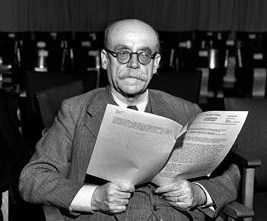
Michael Shannon portrays Robert H. Jackson, one of the most consequential figures in the real history of Nuremberg. Jackson was a justice of the U.S. Supreme Court when President Harry Truman appointed him chief U.S. prosecutor. His challenge was enormous.


He had to help create the legal framework for the trials while simultaneously preparing a case against the surviving leaders of Nazi Germany. And he had to do it alongside Britain, France, and the Soviet Union—nations with different legal traditions, political priorities, and visions of postwar justice.

The four principal prosecution teams were led by Jackson for the United States, Sir Hartley Shawcross for Britain, François de Menthon and later Auguste Champetier de Ribes for France, and Roman Rudenko for the Soviet Union. Jackson believed documentary evidence should form the foundation of the prosecution.


![Auguste Champetier de Ribes (French pronunciation: [oɡyst ʃɑ̃ptje də ʁib]; 30 July 1882 – 6 March 1947) was a French politician and jurist. A devout Catholic, he was an early follower of Albert de Mun and social Christianity. Wounded in the First World War, he was elected to the Chamber of Deputies from the Basses-Pyrénées as a Christian Democrat (PDP) from 1924 to 1934.[1] He was Senator from 1934 to 1940. He served as a junior minister or minister in various governments led by André Tardieu, Édouard Daladier, Paul Reynaud, and Pierre Laval. In 1940, he was among the 80 parliamentarians who refused to give Pétain full powers (see The Vichy 80) and served in the Combat resistance movement.[2] An early supporter of Charles de Gaulle, he was named by the Provisional Government of the French Republic as the French representative during the Nuremberg Trials, during which he delivered the closing statement from the French Prosecution.[3] Upon his return, he was elected President of the Council of the Republic (now known as the French Senate) by the benefit of age. He had tied Communist Georges Marrane, but was elected because he was older than Marrane. Two days later, he was the defeated MRP candidate in the 1947 French presidential election. His health prevented him from assuming his role as President of the Council and he died in office.](https://i0.wp.com/moviestohistory.com/wp-content/uploads/2026/08/Auguste_Champetier_de_Ribes-736x1024.png?ssl=1)

That decision proved enormously important. Instead of relying entirely upon survivor testimony, prosecutors could confront Nazi leaders with their own government’s records. Orders. Reports. Minutes. Correspondence. Statistics. Photographs. Films. Documents produced by the regime itself. The Nazis had created an enormous bureaucracy. That bureaucracy left evidence. Tens of thousands of German documents were ultimately introduced alongside photographs, films, and witness testimony.
The courtroom therefore became more than the location of a trial. It became an archive of the regime’s crimes.

The Films That Changed the Courtroom
One of Nuremberg’s most powerful sequences involves the showing of concentration-camp footage. Vanderbilt made a crucial creative decision here. He used authentic historical footage rather than recreating it.
He has explained that the production did not reshoot the images or place dramatic music beneath them. The sequence uses genuine material connected to what was shown during the proceedings, though the film necessarily presents only a fraction of the much longer historical presentation.

This choice matters ethically as much as historically. Recreating atrocities for dramatic effect can introduce a dangerous aesthetic distance. Real footage does something different. It interrupts the movie.
The audience is no longer simply watching Russell Crowe playing Hermann Göring or Rami Malek playing Douglas Kelley.

For those moments, historical drama collides with historical evidence. That collision echoes what prosecutors were attempting in 1945. The courtroom could debate legal definitions. Defendants could deny responsibility. Lawyers could challenge evidence. But the images made abstraction more difficult.
The physical consequences of Nazi policy were placed before the court.
Nuremberg deserves considerable credit for understanding that some historical material should not be “improved” by cinematic recreation.


Göring Takes the Stand
The courtroom conflict between Robert Jackson and Hermann Göring is one of the most famous episodes of the trial. It also demonstrates why Göring was such a formidable defendant. He understood performance. He understood audiences. He understood rhetoric.
And he understood that the courtroom was one of the last stages upon which he would ever appear.

During his testimony in March 1946, Göring used opportunities to explain, justify, minimize, redefine, and defend the Nazi regime. Jackson’s initial cross-examination did not go as planned. Göring exploited broad questions and attempted to transform the proceedings into a political argument rather than a straightforward interrogation.
Historical accounts describe Jackson struggling to control him. The confrontation was widely regarded as a difficult moment for the American prosecution.
That makes the scene almost irresistible to filmmakers. There is only one problem for Nuremberg. Douglas Kelley was no longer there. By the time Göring took the stand, Kelley had left Nuremberg. Vanderbilt nevertheless keeps him connected to the courtroom climax because the screenplay has built its emotional architecture around Kelley and Göring.
This is arguably the film’s most important chronological distortion. Without it, the protagonist would leave before the climax. With it, the film sacrifices literal chronology for narrative closure.
MoviesToHistory viewers should mark that distinction clearly:
Göring’s courtroom confrontation is historical. Kelley’s dramatic proximity to all of it is not.


What Nuremberg Changes
For a film with an overall historical accuracy score of 90%, Nuremberg changes quite a bit.
That is not contradictory. Historical accuracy is not measured simply by counting invented lines. The more important question is whether alterations fundamentally misrepresent the history. Most of Vanderbilt’s changes are structural rather than ideological.
They help transform an enormous historical event into a comprehensible feature-film narrative.

1. Kelley Remains Central Longer Than He Did Historically
This is the biggest alteration. The film needs Kelley and Göring’s relationship to lead directly into the courtroom drama. History refuses to cooperate. Kelley left before some of the most famous courtroom confrontations involving Göring. Vanderbilt solves the problem by bending chronology. It works dramatically.
But it should not be mistaken for documentary precision.

2. Conversations Are Reconstructed
No historical film can know every word spoken privately between two people. Nuremberg uses invented dialogue to represent documented attitudes and relationships. That means viewers should distinguish between:
“This conversation happened exactly as shown.”
and
“This scene dramatizes something historically supported.”
The second description applies far more often.

3. Events Are Compressed
The real trial opened in November 1945 and continued until judgments were delivered in October 1946.
A feature film cannot communicate the full scale of those proceedings in real time. Arguments are shortened. Evidence is selectively presented. Relationships develop more rapidly. Important legal questions are reduced to their essential dramatic components. Weeks and months can feel like days. This is substantial compression.
But the alternative would require a miniseries rather than a feature film.

4. Psychological Conflict Is Intensified
The disagreement between Kelley and Gilbert was real. The film makes it more cinematic. Their physical fight, for example, is invented. That is dramatic license in its clearest form: a genuine professional and intellectual conflict converted into physical action.
Does the scene communicate tension?
Yes.
Did it literally happen?
No.
5. Kelley and Göring Become a Near-Perfect Two-Hander
The historical Kelley examined many defendants. The film understands that audiences need a central relationship. So Göring becomes the embodiment of Kelley’s entire intellectual problem. This simplifies the scope of Kelley’s work.
But it also reflects the extraordinary amount of attention Göring received and the fascination he clearly exerted upon those studying him.
Vanderbilt has acknowledged that El-Hai’s book provided the foundation for this relationship-centered approach.


Why These Changes Mostly Work
Historical dramas should not receive automatic permission to invent whatever makes a better story. Compression can distort. Composite characters can erase real people. Invented dialogue can place beliefs into historical figures’ mouths that they never expressed. Rearranged chronology can falsely imply causation. Those are legitimate concerns.
But there is an important difference between simplifying history and changing its meaning.

Nuremberg usually does the first. It rarely does the second. Vanderbilt’s film condenses the legal process without pretending the trials were simple. It dramatizes Kelley and Göring’s conversations without fundamentally reversing their historical relationship.
It heightens Kelley and Gilbert’s conflict without inventing their underlying disagreement.
It moves Kelley through chronology in ways the real Kelley did not experience, but largely preserves the psychological questions generated by his work. Even Jack El-Hai has characterized the adaptation as largely factual while acknowledging inaccuracies introduced for dramatic purposes.
That is a useful way to understand the entire film. It is not a transcript. It is an interpretation.
A remarkably well-researched one.

The Question Nuremberg Gets Most Right
For all its courtroom detail, psychological testing, military uniforms, reconstructed prison cells, and historical personalities, Nuremberg’s greatest achievement is conceptual.
The film understands that the most frightening question posed by Kelley’s work was never:
“What mental illness made the Nazis evil?”
It was:
“What if mental illness does not explain them?”
That distinction changes everything.

Calling perpetrators monsters can function as moral condemnation. But it can also create distance. Monsters belong somewhere else. Monsters are fundamentally different from us. Monsters can be recognized before they gain power. History is rarely so convenient.
The Nuremberg defendants included intelligent men. Educated men. Ambitious men. Bureaucrats. Military officers. Lawyers. Politicians. Administrators.
Men capable of joking, competing, loving their families, worrying about their reputations, resenting colleagues, rationalizing decisions, and imagining themselves as historical figures.

None of those human characteristics absolves them. The opposite. Their humanity makes their choices morally consequential. Kelley’s findings challenged the comforting idea that extraordinary crimes require supernatural villains.
That lesson is one of the reasons the Nuremberg Trials continue to matter.

Why We Keep Returning to Nazi Germany on Screen
Cinema has returned to Nazi Germany for generations. Judgment at Nuremberg. Schindler’s List. The Pianist. Conspiracy. Downfall. The Zone of Interest.
And now Nuremberg.
At first glance, another Nazi drama might seem unnecessary. How many times can cinema revisit the same period?


![Directed by Oliver Hirschbiegel Screenplay by Bernd Eichinger Based on Inside Hitler's Bunker by Joachim Fest Until the Final Hour by Traudl Junge Melissa Müller Produced by Bernd Eichinger Starring Bruno Ganz Alexandra Maria Lara Corinna Harfouch Ulrich Matthes Juliane Köhler Heino Ferch Christian Berkel Alexander Held Matthias Habich Thomas Kretschmann Cinematography Rainer Klausmann[1] Edited by Hans Funck[1] Music by Stephan Zacharias[1] Production company Constantin Film[1] Distributed by Constantin Film (Germany and Austria) 01 Distribution (Italy)](https://i0.wp.com/moviestohistory.com/wp-content/uploads/2026/08/MV5BMTU0NTU5NTAyMl5BMl5BanBnXkFtZTYwNzYwMDg2._V1_FMjpg_UX1000_-698x1024.jpg?ssl=1)

But these films are not actually asking the same questions. Some focus on victims. Some examine perpetrators. Some investigate bystanders. Some examine resistance. Some study bureaucracy. Some reconstruct the Holocaust. Some analyze memory.





Nuremberg is primarily interested in accountability and psychology. How does civilization prosecute leaders after civilization itself has been violated? How do you judge people responsible for crimes on a scale that existing courts were never designed to confront? How do you understand perpetrators without excusing them? And how do democratic societies recognize the conditions that allow people like them to gain power?
Those questions have no expiration date.

The distance between 1945 and the present does not make Nuremberg less relevant. In some ways, distance makes historical precision more important. As living memory of World War II recedes, films increasingly become one of the primary ways later generations encounter that history. That gives filmmakers tremendous power.
And tremendous responsibility.

The MoviesToHistory Accuracy Meter – Nuremberg (2025)

Historical Context — 95%
The film presents the postwar environment, creation of the International Military Tribunal, Allied legal project, Nazi defendants, and broad significance of the proceedings with exceptional fidelity.
Some geopolitical and legal complexities are necessarily reduced. But the fundamental historical framework is accurate.
Score: 95%.
Psychological Research — 90%
Kelley’s psychiatric role is real. The interviews are real. The intelligence testing is real. The Rorschach examinations are real. The attempt to identify psychological abnormalities among Nazi leaders is real. Kelley’s conclusion that the defendants could not simply be explained as insane is central to his historical significance.
Specific conversations and confrontations are reconstructed, and the film occasionally makes psychological interpretation cleaner than the historical debate actually was.
Score: 90%.

Character Accuracy — 85%
Russell Crowe’s Göring is especially strong. The intelligence, charisma, narcissism, theatricality, competitiveness, political instincts, and manipulative behavior all have historical foundations.
Rami Malek’s Kelley similarly captures the psychiatrist’s ambition, curiosity, theatrical tendencies, and fascination with his subjects. But the screenplay extends Kelley’s presence beyond the historical chronology and intensifies several relationships.
Score: 85%.
Courtroom Procedures — 90%
The film accurately communicates the international nature of the tribunal, the central role of Robert Jackson, the importance of documentary evidence, the confrontation with Göring, and the unprecedented legal questions being addressed.
Its principal problem is compression. Months of proceedings must become manageable dramatic sequences. The result captures the structure and meaning of the courtroom more accurately than its precise chronology.
Score: 90%.

Dramatic License — Moderate
The major liberties include:
- extending Kelley’s presence through events he did not personally witness;
- reconstructing private conversations;
- compressing the trial chronology;
- intensifying interpersonal conflicts;
- simplifying complex legal arguments;
- and reshaping historical relationships around Kelley and Göring to create a conventional dramatic arc.
These are meaningful changes.
But most do not fundamentally alter the historical conclusions audiences should draw from the story.
Overall Historical Accuracy: 90%
█████████░ 90%
Nuremberg is not a documentary. It is not a courtroom transcript.
It is not a substitute for Jack El-Hai’s The Nazi and the Psychiatrist, Kelley’s 22 Cells in Nuremberg, Gilbert’s Nuremberg Diary, the International Military Tribunal records, or the enormous scholarship surrounding the trials and Holocaust.
But as historical drama, it succeeds remarkably well.
Its greatest inaccuracies come from chronology and narrative construction rather than from wholesale distortion of the historical record. That distinction matters. Vanderbilt does not invent Kelley’s fascination with Göring. He intensifies it. He does not invent the psychological testing. He dramatizes it.
He does not invent Göring’s intelligence and manipulative charisma. He concentrates those qualities into scenes. He does not invent Jackson’s courtroom difficulties with Göring. He compresses them. And he does not invent the fundamental question at the center of Kelley’s research.
He makes it the organizing principle of the movie.
Final Verdict: History Condensed, Not Rewritten
There is a moment in almost every historically ambitious film when the viewer has to decide what kind of accuracy matters most. Literal accuracy matters. Dates matter. Who was present matters. Words matter. Legal procedures matter. Historical dramas should be held accountable when they change those things.
Nuremberg changes them too.
Douglas Kelley’s cinematic journey extends beyond his actual presence at the trial. Conversations are reconstructed. Conflicts are heightened. Months of courtroom proceedings are condensed into a narrative that must maintain momentum. The film places its psychiatrist closer to Göring’s courtroom climax than history allows.
Those are not trivial alterations.
They are precisely why Nuremberg receives a 90% rather than a 100% on the MoviesToHistory Accuracy Meter. But there is another form of historical accuracy. It involves understanding what an event meant.
And here, Vanderbilt’s film is exceptionally strong.

The International Military Tribunal represented an attempt to replace vengeance with law. It insisted that even after a war of catastrophic brutality, accusations should be documented, evidence should be presented, defendants should receive counsel, and judgment should be rendered through a legal process.
The prosecution preserved evidence of Nazi crimes on an extraordinary scale. Tens of thousands of captured records, photographs, films, and testimony helped establish a historical record that could survive long after the courtroom closed.


And within that courtroom stood Hermann Göring. Not a raving madman. Not an unintelligent thug. Not a supernatural embodiment of evil. A highly intelligent, charismatic, narcissistic, ruthless political leader who understood how to manipulate people and audiences.

Across from him, for part of the Nuremberg story, stood Douglas Kelley. Kelley wanted psychiatry to explain the men in those cells. Instead, he confronted a possibility far more disturbing. There might be no psychiatric category capable of containing them.
No unique disease.
No simple psychological boundary separating “them” from everyone else. The crimes remained extraordinary. The perpetrators remained human. That is the historical tension Nuremberg understands better than almost anything else. And it is why Russell Crowe’s Göring cannot simply snarl his way through the film.
He has to charm us.
It is why Rami Malek’s Kelley has to become fascinated before he becomes frightened by what that fascination means. It is why the psychological tests cannot deliver a satisfying diagnosis. And it is why the courtroom matters. Nuremberg was never merely an attempt to determine whether these men were evil.
Their actions had already answered that question.
The greater challenge was determining whether civilization could define their crimes, document them, assign individual responsibility, and punish them through law.
The tribunal was imperfect. Its legal innovations have been debated ever since. Its Allied participants carried their own political contradictions. Its procedures cannot be separated entirely from the reality that the victors were judging the defeated. Yet the alternative—the summary execution of captured leaders without trial—would have created a very different historical legacy.
Instead, the defendants were brought into a courtroom. They heard the charges. They received attorneys. They challenged evidence. They presented defenses. They testified. Some were convicted. Some were sentenced to prison. Some were sentenced to death. And three were acquitted.
That last fact is particularly significant.
A tribunal created by the victorious powers was still capable of finding that prosecutors had failed to establish guilt against particular defendants to the required standard.
That distinction helped separate judicial accountability from simple retaliation. The principles established at Nuremberg subsequently became foundational to the evolving system of international criminal law. That is the larger history operating behind Vanderbilt’s psychological thriller.
And perhaps that explains why Nuremberg works as well as it does.

The film does not treat history as a museum exhibit. It treats Nuremberg as an unresolved warning. The danger is not merely that history might someday produce another Hermann Göring who looks exactly like Hermann Göring.
History does not repeat itself that neatly.
The danger is believing that destructive political systems announce themselves only through obviously insane people. They do not. Intelligence offers no guarantee of morality. Charm offers no guarantee of empathy. Education offers no guarantee of ethical courage. Professional status offers no guarantee of resistance to authoritarian power. And psychological normality offers no guarantee of goodness. That is a profoundly uncomfortable conclusion. It was uncomfortable in 1945.
It remains uncomfortable now.

Nearly eighty years after the defendants entered the courtroom at Nuremberg, the enduring question is therefore not simply how men like Göring could have existed.
It is how societies create conditions in which ambition, prejudice, obedience, bureaucracy, propaganda, opportunism, and political violence can become mutually reinforcing—and how institutions can stop that process before atrocities become normalized.
James Vanderbilt changes history to tell that story. He compresses it. Rearranges it. Dramatizes it. Occasionally invents around it. But he rarely loses sight of its meaning. For a Hollywood historical drama, that is an important distinction.
MoviesToHistory Final Verdict
Historical Context: 95%
Psychological Research: 90%
Character Accuracy: 85%
Courtroom Procedures: 90%
Dramatic License: Moderate
Overall Historical Accuracy: 90%
Nuremberg succeeds because its historical liberties generally serve compression rather than revisionism. The film simplifies one of the twentieth century’s most complicated legal proceedings, but it does not simplify the moral question at its center.
If anything, it makes that question harder. The defendants at Nuremberg were responsible for extraordinary crimes.
But Douglas Kelley’s encounters with them challenged the comforting assumption that extraordinary crimes can only be committed by psychologically extraordinary people.
That is where Nuremberg stops being merely a film about 1945. It becomes a warning about every generation that comes afterward.
History gives us the verdict. The film asks whether we have understood the warning.

Nuremberg is available now with a subscription to Netflix…

Discover more from Movies To History.com
Subscribe to get the latest posts sent to your email.
Related Posts
‘Good Night, and Good Luck.’ – Official Trailer:
See It Now... Good Night, and Good Luck (promoted as good night, and good luck.) is a 2005 historical drama film about American television news directed by George Clooney, with the movie starring David Strathairn, Patricia Clarkson, Jeff Daniels, Robert Downey Jr., and Frank Langella as well as…

The Real War Dogs: Arms Dealers, Scandals & Global Supply Chains:
In 2016, War Dogs exploded onto the screen with the swagger of a buddy comedy and the smirk of a dark political satire. Directed by Todd Phillips and starring Jonah Hill and Miles Teller, the film follows…

‘Monsters: The Lyle and Erik Menendez Story’ – Interview:
The Menendez Brothers... 2024TV-MADocumentary Serving life in prison for murdering their parents, Lyle and Erik Menendez speak out in this documentary examining the shocking crime and ensuing trials. https://youtu.be/xQaa4G0JZn8?si=6X9g9HUDtiTerzWu Monsters: The Lyle and Erik Menendez…