

Part I: A Film That Refused to Look Away
Few historical films have altered public conversations about the past as profoundly as 12 Years a Slave (2013). Directed by Steve McQueen and adapted by John Ridley from Solomon Northup’s 1853 memoir, the Academy Award-winning film did something Hollywood had rarely attempted with such uncompromising honesty: it portrayed American slavery not as a backdrop for heroism or romance, but as a brutal economic system built upon the systematic destruction of human lives.
![Directed by Steve McQueen Screenplay by John Ridley Based on Twelve Years a Slave by Solomon Northup Produced by Brad Pitt Dede Gardner Jeremy Kleiner Bill Pohlad Steve McQueen Arnon Milchan Anthony Katagas Starring Chiwetel Ejiofor Michael Fassbender Benedict Cumberbatch Paul Dano Paul Giamatti Lupita Nyong'o Sarah Paulson Brad Pitt Alfre Woodard Cinematography Sean Bobbitt Edited by Joe Walker Music by Hans Zimmer Production companies Regency Enterprises[1] River Road Entertainment[1] Plan B Entertainment[1] Film4[1] Distributed by Fox Searchlight Pictures (United States and Canada)[1] Entertainment One (United Kingdom)[2] Summit Entertainment (International)[3][2]](https://i0.wp.com/moviestohistory.com/wp-content/uploads/2025/07/12-Years-a-Slave--690x1024.jpg?ssl=1)


The film’s critical success was extraordinary. It won the Academy Award for Best Picture, making history as the first Best Picture produced by a Black filmmaker, Brad Pitt’s Plan B Entertainment having partnered with producer Dede Gardner and director Steve McQueen. John Ridley received the Oscar for Best Adapted Screenplay, while Lupita Nyong’o earned Best Supporting Actress for her devastating portrayal of Patsey. Chiwetel Ejiofor’s performance as Solomon Northup was widely celebrated as one of the finest dramatic performances of the decade.
Awards, however, tell only part of the story.


The film’s enduring significance lies in something much rarer: historians, museum professionals, educators, and descendants of enslaved Americans have consistently praised 12 Years a Slave for its remarkable historical authenticity. While every historical drama necessarily compresses events and reshapes dialogue, Steve McQueen approached Northup’s memoir with an unusual philosophy. Instead of asking how history could serve the story, he asked how cinema could serve history.
That distinction fundamentally shaped every aspect of the production.

From the locations where filming occurred to the language spoken by its characters, from costume construction to cinematography, 12 Years a Slave represents one of the most exhaustive efforts ever undertaken to recreate antebellum America with historical fidelity. Rather than soften the realities of slavery for modern audiences, McQueen deliberately chose to confront viewers with the violence, humiliation, uncertainty, and psychological terror that enslaved people endured every day.
The result is a film that often feels less like traditional Hollywood storytelling and more like historical witnessing.


For MoviesToHistory.com, historical accuracy has always involved more than simply counting factual errors. Accuracy also encompasses atmosphere, social relationships, institutional structures, economic realities, and emotional truth. A costume may be historically perfect, yet the worldview of the characters may still reflect modern assumptions. Likewise, a film may recreate every building correctly while fundamentally misunderstanding the people who inhabited them.
12 Years a Slave succeeds because it achieves authenticity on multiple levels simultaneously.

The Challenge of Adapting One of America’s Most Important Slave Narratives
The foundation of the film’s accuracy begins with its source material. Unlike many historical dramas that rely primarily on secondary biographies or fictionalized accounts, 12 Years a Slave draws directly from one of the most important first-person narratives ever written by a formerly enslaved American.
Published in 1853, Solomon Northup’s memoir appeared only months after his rescue from slavery.
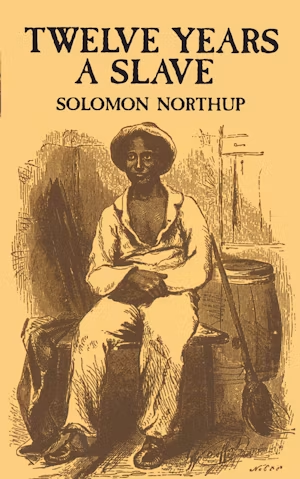
The account was prepared with editor David Wilson, who helped organize Northup’s recollections into a publishable narrative while preserving Solomon’s voice and experiences. The book quickly became a bestseller among abolitionists and offered Northern readers one of the clearest firsthand descriptions of the domestic slave trade operating within the United States.
Northup’s story differed from many other slave narratives in one important respect. He had been born free.

A skilled violinist living in Saratoga Springs, New York, Solomon enjoyed a stable family life with his wife Anne and their children. In 1841, two men approached him with what appeared to be an attractive employment opportunity performing music in Washington, D.C. Instead, they drugged him, stripped him of documentation proving his free status, and sold him into slavery.
That single act demonstrated one of slavery’s most disturbing realities. Freedom itself could be stolen.


For twelve years, Northup was forced to survive within a legal system specifically designed to erase his identity. Renamed “Platt,” denied the ability to reveal his true history, and subjected to repeated violence, he eventually found himself on plantations in central Louisiana before regaining his freedom through an extraordinary series of legal interventions.


Historians have long regarded Northup’s memoir as one of the most reliable firsthand accounts of American slavery ever published. Unlike many autobiographies written decades after emancipation, Northup recorded his experiences almost immediately after returning home, when memories remained vivid and supporting witnesses were still alive. Modern scholarship has repeatedly confirmed numerous details contained in the narrative, from plantation ownership records and census documents to court filings and newspaper accounts.

This abundance of documentary evidence provided filmmakers with something extraordinarily valuable: a primary source that could be independently verified. Rather than invent large portions of Solomon’s experience, Steve McQueen and screenwriter John Ridley could reconstruct events directly from the historical record.

Why Historical Accuracy Matters
Many films advertise themselves as “based on a true story.” That phrase can mean almost anything.

Some productions merely borrow names while inventing major events. Others compress decades into months, combine multiple historical figures into a single fictional character, or manufacture romances that never occurred. While dramatic license is often unavoidable, audiences frequently leave theaters believing these fictionalized narratives accurately represent history.
12 Years a Slave deliberately moved in the opposite direction.
![Directed by Steve McQueen Screenplay by John Ridley Based on Twelve Years a Slave by Solomon Northup Produced by Brad Pitt Dede Gardner Jeremy Kleiner Bill Pohlad Steve McQueen Arnon Milchan Anthony Katagas Starring Chiwetel Ejiofor Michael Fassbender Benedict Cumberbatch Paul Dano Paul Giamatti Lupita Nyong'o Sarah Paulson Brad Pitt Alfre Woodard Cinematography Sean Bobbitt Edited by Joe Walker Music by Hans Zimmer Production companies Regency Enterprises[1] River Road Entertainment[1] Plan B Entertainment[1] Film4[1] Distributed by Fox Searchlight Pictures (United States and Canada)[1] Entertainment One (United Kingdom)[2] Summit Entertainment (International)[3][2]](https://i0.wp.com/moviestohistory.com/wp-content/uploads/2026/06/MV5BMzM2YjJjOWUtYTVlNi00YzM5LTgyNGItZjAzNmI2NmQ2MzExXkEyXkFqcGc%40._V1_QL75_UX1050_.jpg?resize=525%2C219&ssl=1)
Instead of asking how history could become more entertaining, McQueen consistently asked how entertainment could become more truthful. The distinction is subtle but transformative.

For example, many previous Hollywood depictions of slavery emphasized exceptional acts of rescue or triumphant rebellion. Such narratives, while emotionally satisfying, often imply that escape represented a realistic possibility for most enslaved people.
Northup’s memoir reveals something different. Survival itself became resistance.


Every day required impossible calculations: whom to trust, when to remain silent, when to speak, how much emotion could safely be displayed, whether hope itself remained dangerous. The film preserves these dilemmas with remarkable patience, refusing to transform Solomon into a conventional action hero.
This commitment to historical reality extends beyond plot.

The film rarely offers audiences moments of emotional release. Violence frequently occurs without dramatic music. Death is abrupt. Justice is delayed. Even Solomon’s eventual rescue cannot erase twelve years of trauma.

This narrative structure reflects historical reality rather than Hollywood convention. Millions of enslaved Americans never experienced rescue. Many families remained permanently separated. Children disappeared into slave markets. Parents died without seeing loved ones again.

By refusing to impose artificial optimism upon these realities, 12 Years a Slave honors the experiences of countless people whose stories never received happy endings.

More Than Historical Detail
Perhaps the film’s greatest achievement lies in understanding that slavery functioned not simply as individual cruelty but as an entire economic and legal system.

Cruel overseers certainly existed. Sadistic plantation owners certainly existed. Yet the institution endured because ordinary citizens, merchants, judges, politicians, bankers, insurers, transport companies, auctioneers, and consumers collectively benefited from enslaved labor.
The film consistently reminds viewers that Solomon’s suffering did not result from isolated acts of evil. It resulted from institutions.

This perspective aligns closely with contemporary historical scholarship, which increasingly emphasizes slavery as the economic engine of the antebellum South rather than merely a moral failing of individual slaveholders. Cotton cultivation, international finance, insurance markets, shipping networks, and political power all depended upon maintaining human bondage.
McQueen visualizes this system without lengthy exposition. Auction houses. Plantation fields. Courtrooms. Whipping posts. Slave quarters. Cotton gins.

Every location becomes part of an interconnected machinery designed to transform human beings into property. The horror emerges precisely because so much of it appears routine. Slavery did not require extraordinary monsters. It required ordinary participation. That insight may be the film’s most historically important contribution.

Rather than reassuring audiences that slavery belonged to a distant, exceptional past populated only by villains, 12 Years a Slave demonstrates how ordinary institutions normalized extraordinary cruelty. It asks viewers not merely to condemn history, but to understand how societies become capable of sustaining injustice through law, commerce, and habit.
That uncomfortable lesson remains as relevant today as it was in 1853.

Part II — Steve McQueen’s Vision: Filming History Instead of Hollywood
When Steve McQueen first encountered Twelve Years a Slave, he immediately recognized that Solomon Northup’s memoir offered something almost unheard of in American cinema: an opportunity to portray slavery from the perspective of someone who had lived it rather than someone who merely observed it.


For decades, Hollywood had produced films that touched upon slavery, but few centered the lived experiences of enslaved people themselves. Earlier productions often filtered the institution through white protagonists, whether abolitionists, sympathetic plantation owners, Union soldiers, or journalists. Even critically acclaimed films frequently relied on familiar cinematic conventions—uplifting musical cues, heroic rescues, sentimental reconciliations, or clear moral victories—that softened the relentless reality of bondage.
![Directed by Kasi Lemmons Screenplay by Gregory Allen Howard Kasi Lemmons Story by Gregory Allen Howard Produced by Debra Martin Chase Daniela Taplin Lundberg Gregory Allen Howard Starring Cynthia Erivo Leslie Odom Jr. Joe Alwyn Janelle Monáe Cinematography John Toll Edited by Wyatt Smith Music by Terence Blanchard Production companies Perfect World Pictures New Balloon Stay Gold Features Distributed by Focus Features (United States) Universal Pictures[1] (International)](https://i0.wp.com/moviestohistory.com/wp-content/uploads/2026/03/MV5BMTVlNGQ0ZWQtZTkzZC00YmQxLTg5MzQtYjFhYjVhMTdmM2I3XkEyXkFqcGc@._V1_FMjpg_UX1000_-691x1024.jpg?ssl=1)

McQueen wanted none of that. Instead, he approached 12 Years a Slave with a philosophy more commonly associated with documentary filmmaking than historical drama. His goal was not to entertain audiences by making slavery more accessible. His goal was to immerse audiences in an experience they could never fully understand but could no longer comfortably ignore.

“I wanted that person to be everyone in the audience,”1 McQueen explained in numerous interviews surrounding the film’s release. That distinction shaped every creative decision throughout production. Witnesses are not passive observers. They cannot simply enjoy a story and leave unchanged. Witnesses bear responsibility for what they have seen.
The film therefore rejects many of the emotional safety nets that audiences unconsciously expect from historical dramas.

Refusing Traditional Hollywood Storytelling
One of the most striking aspects of 12 Years a Slave is what it deliberately refuses to do. Hollywood often structures historical films around triumph. Characters overcome impossible odds. Justice arrives in spectacular fashion. Villains receive satisfying punishment. Audiences leave emotionally reassured. History rarely works that way.
Northup’s memoir certainly did not.

For twelve years, Solomon experienced repeated losses that no dramatic reversal could erase. His freedom eventually returned, but his stolen years remained stolen. Families he encountered remained enslaved. Friends disappeared forever. Children continued to be sold away from their parents. The institution itself continued for years after his rescue.

McQueen resisted every temptation to reshape these realities into a conventional inspirational narrative. Instead of emphasizing escape, the film emphasizes endurance. Instead of celebrating heroic confrontation, it highlights impossible compromises. Instead of portraying slavery as a series of extraordinary acts of cruelty, it presents violence as ordinary, bureaucratic, and deeply embedded within everyday life. That approach reflects the historical record. Most enslaved people did not experience dramatic escapes.
Most never overpowered overseers.

Most survived by carefully navigating an environment in which every decision carried enormous risk. The film’s quiet moments often prove more devastating than its scenes of violence because they reveal how slavery infiltrated ordinary existence. Preparing meals. Harvesting cotton. Repairing fences. Playing music. Walking through fields. Sleeping.
Every ordinary activity occurred under constant surveillance. Freedom did not disappear only during moments of punishment.
It disappeared every hour of every day.

Long Takes That Refuse Escape
Perhaps no aspect of McQueen’s direction generated more discussion than his use of extended, unbroken shots. Many modern films rely on rapid editing to heighten excitement or soften disturbing imagery. Editors cut away from violence before audiences become overwhelmed. McQueen often does the opposite. He leaves the camera still. One of the film’s most discussed sequences illustrates this philosophy perfectly.

After Solomon is nearly lynched, he remains suspended from a tree with only the tips of his toes touching muddy ground. Unable to breathe comfortably, he struggles to remain alive for hours while plantation life continues around him.

Children play nearby. Workers carry on with daily routines. People glance toward him before looking away. No dramatic rescue occurs. No swelling orchestra instructs viewers how to feel. The camera simply remains. The audience is forced to inhabit time alongside Solomon. This scene exemplifies what historians often describe as the normalization of violence under slavery.

Punishment became so common that daily life continued around it. The horror lies not only in Solomon’s suffering but in the casual acceptance surrounding it. By refusing to shorten the sequence through editing, McQueen transforms viewers from spectators into reluctant participants. We experience discomfort because the camera denies us escape.
That discomfort is intentional. History itself offers no convenient cut to the next scene.

Silence as Historical Realism
Equally important is McQueen’s restrained use of music. Many historical dramas rely heavily upon orchestral scores to guide emotional reactions. When audiences should feel triumphant, the music swells. When sadness arrives, strings begin playing. When heroes emerge, themes become inspirational. 12 Years a Slave frequently removes those emotional cues altogether.

Natural sounds dominate the soundtrack. Wind moves through trees. Chains rattle. Footsteps crunch across dirt. Cotton rustles. Birds continue singing despite nearby suffering. The absence of continuous musical guidance creates an unsettling realism. Violence unfolds without cinematic punctuation. Moments that might become melodramatic instead feel disturbingly ordinary. This mirrors countless historical accounts written by formerly enslaved people. Many describe horrific events not with theatrical language but with startling simplicity. The horror required no embellishment.
Reality proved sufficient.

Humanizing Without Romanticizing
Another remarkable aspect of McQueen’s direction involves characterization. The film avoids reducing enslaved individuals to symbols. Each person retains emotional complexity, private fears, individual ambitions, and distinct personalities despite existing within a system designed to erase individuality.

Patsey is far more than a victim. Eliza is more than a grieving mother. Bass is neither a flawless savior nor a miraculous hero. Ford demonstrates moments of apparent kindness while remaining fully complicit in slavery. Epps embodies monstrous cruelty while believing himself justified by scripture and law.


History rarely divides neatly between heroes and villains. Institutions shape behavior in complicated ways. McQueen recognizes this complexity without allowing nuance to excuse moral responsibility. Ford may appear more humane than Epps. He still owns human beings. That fact never disappears.

Likewise, Bass eventually helps Solomon communicate with the outside world, yet the film avoids portraying him as the central hero. This remains Solomon’s story. The narrative never shifts away from the lived experience of the enslaved.

John Ridley’s Adaptation: Respecting the Memoir
If Steve McQueen established the film’s philosophical foundation, screenwriter John Ridley provided its historical architecture. Ridley’s challenge was extraordinary.

Northup’s memoir contains detailed descriptions of plantation life, legal proceedings, conversations, travel, labor practices, religious gatherings, agricultural methods, and personal observations. Compressing twelve years into a feature-length screenplay required difficult choices about pacing and emphasis.

Rather than invent dramatic subplots, Ridley generally chose subtraction instead of addition. He removed material that could not fit while preserving the memoir’s emotional and historical structure. Many of the film’s most memorable scenes come directly from Northup’s own words.

His kidnapping. His sale in New Orleans. His friendship with fellow captives. His ownership under William Ford. His conflict with John Tibeats. His transfer to Edwin Epps. His observations of Patsey’s suffering. His eventual encounter with Samuel Bass. His rescue. Even dialogue frequently echoes Northup’s published account.

Rather than modernizing nineteenth-century speech, Ridley preserved much of its formal cadence while making conversations accessible to contemporary audiences. The screenplay therefore feels rooted in its historical moment instead of sounding like twenty-first century dialogue wearing period costumes. This fidelity distinguishes 12 Years a Slave from many historical adaptations that freely invent conversations to create modern emotional resonance. Ridley trusted Northup’s voice.
That trust became one of the screenplay’s greatest strengths.

A Rare Respect for Primary Sources
Historians often encourage students to distinguish between primary and secondary sources. Primary sources originate from people who directly experienced historical events. Secondary sources interpret those experiences later.

Film adaptations frequently rely upon biographies written decades after events occurred, themselves based upon interviews, recollections, or interpretations. 12 Years a Slave benefits from something far rarer. Its central source is Solomon himself. His observations form the narrative backbone. His memories determine pacing.
His perspective shapes audience understanding.

While modern scholarship has expanded historians’ understanding of slavery enormously since 1853, Northup’s account remains one of the clearest firsthand windows into the domestic slave trade. McQueen and Ridley understood that inventing dramatic replacements for Solomon’s experiences would weaken rather than strengthen the story.

The memoir already possessed extraordinary dramatic power. Their responsibility was to translate it faithfully into cinema. The remarkable result is a screenplay that often feels less like an adaptation than a visual interpretation of a historical document. Few historical films demonstrate such sustained respect for the written record.
That respect is one of the principal reasons historians continue to cite 12 Years a Slave as a benchmark for historical filmmaking.
![Directed by Steve McQueen Screenplay by John Ridley Based on Twelve Years a Slave by Solomon Northup Produced by Brad Pitt Dede Gardner Jeremy Kleiner Bill Pohlad Steve McQueen Arnon Milchan Anthony Katagas Starring Chiwetel Ejiofor Michael Fassbender Benedict Cumberbatch Paul Dano Paul Giamatti Lupita Nyong'o Sarah Paulson Brad Pitt Alfre Woodard Cinematography Sean Bobbitt Edited by Joe Walker Music by Hans Zimmer Production companies Regency Enterprises[1] River Road Entertainment[1] Plan B Entertainment[1] Film4[1] Distributed by Fox Searchlight Pictures (United States and Canada)[1] Entertainment One (United Kingdom)[2] Summit Entertainment (International)[3][2]](https://i0.wp.com/moviestohistory.com/wp-content/uploads/2026/06/12-years-banner.jpg?resize=525%2C213&ssl=1)
Part III — Recreating 1840s Louisiana: How History Became Visible on Screen
If Steve McQueen’s directing philosophy provided the emotional authenticity of 12 Years a Slave, then the production design, historical research, and location work provided its physical authenticity. Every frame of the film reflects an extraordinary commitment to recreating the material world Solomon Northup inhabited between 1841 and 1853.

Many historical films rely heavily on studio backlots, digital enhancements, or reconstructed sets. While these techniques can produce visually impressive results, they often create environments that feel curated rather than lived in. McQueen wanted the opposite.
He wanted audiences to feel as though they had stepped into the Louisiana that Solomon Northup described in his memoir.

Achieving that level of authenticity required years of historical research, extensive consultation with historians and preservation specialists, and one of the most ambitious location shoots undertaken for an American historical drama in decades.
Rather than asking, “What looks historical?” the production continually asked, “What actually survived from the world Solomon knew?”
That question guided virtually every department.

The Importance of Filming in Louisiana
One of the production’s greatest strengths was its decision to shoot almost entirely in southern Louisiana rather than recreating the region elsewhere.

Principal photography began in the summer of 2012 in and around New Orleans. Unlike many productions that simply use Louisiana as a tax-friendly filming location while disguising its geography, 12 Years a Slave embraced the state’s preserved nineteenth-century landscape.

Louisiana possesses something few other regions can offer filmmakers: surviving plantation buildings, centuries-old oak alleys, original agricultural landscapes, and waterways that have changed remarkably little since the antebellum era.

For Solomon Northup, geography was not merely scenery. It determined every aspect of daily life. The humid climate dictated work schedules. The bayous shaped transportation. The rich alluvial soil supported cotton and sugar production. The isolation of plantations made escape extraordinarily difficult.
By filming within these actual landscapes, McQueen captured environmental realities that cannot easily be recreated on a soundstage.

The heat visible on actors’ faces was genuine. The oppressive humidity was real. The insects, dense vegetation, muddy roads, and towering live oaks all contributed to an atmosphere that audiences experience almost physically.
Historical authenticity, in this case, became environmental authenticity.

Magnolia Plantation: A Landscape That Mirrors Solomon Northup’s World
Among the production’s most historically significant locations was Magnolia Plantation in Louisiana.

Although historians cannot definitively identify every building Solomon Northup occupied during his twelve years in bondage, Magnolia Plantation bears remarkable similarities to the plantations described throughout his memoir. Established during the eighteenth century and expanded throughout the nineteenth, Magnolia preserves one of the most complete plantation landscapes remaining in the United States.

Unlike many plantation sites restored primarily to showcase grand manor houses, Magnolia retains substantial evidence of the enslaved community that sustained its agricultural economy. The preserved slave cabins, agricultural infrastructure, cotton fields, roads, and workspaces provide an unusually comprehensive picture of plantation life.
This mattered enormously to McQueen.

Rather than presenting slavery through the lens of elegant architecture, the film consistently centers the spaces occupied by enslaved people themselves. Audiences spend relatively little time inside the plantation owner’s home. Instead, they experience cabins. Fields. Workshops. Yards. Kitchen areas. Paths connecting labor sites. These were the places where Solomon actually lived.

Magnolia’s surviving landscape allowed the filmmakers to recreate those environments with extraordinary fidelity. When viewers watch Solomon walk beneath moss-covered oak trees or labor in expansive cotton fields, they are not looking at generic Southern scenery.
They are seeing a landscape remarkably similar to the one Northup described nearly 170 years earlier.

The Value of Preserved Plantation Landscapes
Modern audiences often associate plantations primarily with stately mansions. This perception reflects decades of tourism and popular culture that emphasized architectural beauty while minimizing the realities of enslaved labor. 12 Years a Slave deliberately reverses that emphasis. The plantation house becomes almost incidental. The true center of the plantation is labor. Every road leads toward work. Every building supports production.

Every human interaction reflects an economic system designed to extract profit from enslaved bodies. This perspective aligns closely with contemporary historical scholarship. Historians increasingly interpret plantations not simply as homes but as industrial agricultural enterprises. Cotton production required sophisticated management systems, transportation networks, accounting practices, blacksmith shops, carpentry operations, livestock management, food production, and hundreds of workers performing highly specialized labor.

McQueen visualizes this complexity without lengthy explanation. Audiences gradually understand that slavery functioned as an enormous economic machine.
The landscape itself tells the story.

Historical Consultants and Research
Producing an authentic historical film requires far more than beautiful locations. Every department must understand the historical period in remarkable detail.

For 12 Years a Slave, researchers consulted historians specializing in antebellum Louisiana, slavery, architecture, agriculture, clothing, and material culture. Museums, archives, preservation organizations, and surviving historical documents informed countless production decisions.

The production repeatedly returned to Solomon Northup’s memoir itself. His descriptions of distances, labor routines, housing, transportation, food, weather, and social interactions became practical guides for recreating plantation life.

Whenever possible, the filmmakers preferred documented historical evidence over dramatic convenience. This approach affected seemingly minor details. How cotton sacks were carried. Where tools were stored. How meals were distributed. The placement of cabins. Methods of transportation. Field organization. Even the spacing between workers reflected historical research. Few audience members consciously notice these elements.
Collectively, however, they create an environment that feels convincing because it is grounded in historical evidence rather than cinematic convention.

Costume Authenticity: Clothing as Historical Evidence
Costume designer Patricia Norris approached clothing not as decoration but as historical documentation. Antebellum Louisiana was a society in which clothing immediately communicated status, occupation, wealth, race, and legal identity.


Enslaved workers rarely possessed wardrobes in the modern sense. Garments were issued sparingly. Many items were repeatedly repaired. Fabric quality was poor. Shoes frequently wore out. Clothing became faded through constant agricultural labor.
Rather than presenting neatly dressed extras, Norris ensured that costumes reflected years of physical work.

Shirts appear sun-bleached. Trousers show repeated repairs. Hats exhibit heavy wear. Children wear clothing clearly handed down from older siblings. The cumulative effect is striking. Nothing appears freshly tailored. Nothing resembles a theatrical costume. Instead, clothing feels inhabited.

Plantation owners, meanwhile, display greater variety in fabrics, tailoring, and accessories, yet even their wardrobes avoid excessive glamour. The contrast between owners and the enslaved communicates social hierarchy without requiring exposition.
Costume becomes visual history.

Language That Sounds Like the Nineteenth Century
Dialogue represents one of the most overlooked components of historical authenticity. Many period films feature characters dressed in nineteenth-century clothing while speaking unmistakably modern English. McQueen and Ridley avoided this trap.

Drawing extensively from Solomon Northup’s memoir and contemporary documents, the screenplay preserves much of the formal vocabulary, sentence structure, and rhythm characteristic of mid-nineteenth-century speech. Equally important is the film’s willingness to include the racist language that permeated slaveholding society. The language is often shocking. It is also historically accurate.

Removing such terminology would falsely sanitize the historical record. Its inclusion reminds audiences that slavery depended not only upon physical violence but also upon language that continually reinforced dehumanization.

Words became instruments of power. Titles such as “Master” were not simply honorifics. They reflected legal ownership. Names carried similar significance. The repeated use of “Platt” instead of “Solomon” illustrates slavery’s assault upon personal identity.
A stolen name symbolized a stolen life.

Sean Bobbitt’s Cinematography: History Through the Camera
If any single artistic element elevates 12 Years a Slave beyond conventional historical filmmaking, it is Sean Bobbitt’s cinematography. Rather than romanticizing the antebellum South through golden sunsets and picturesque landscapes, Bobbitt photographs Louisiana with remarkable restraint.

Natural light dominates. Clouds frequently obscure the sun. Interiors appear dim rather than theatrically illuminated. Fields stretch endlessly toward the horizon. The landscape is undeniably beautiful. Yet that beauty never overwhelms the brutality occurring within it. This visual tension becomes one of the film’s defining achievements.

The same magnificent oak trees that tourists admire today also witnessed unimaginable suffering. The same fertile fields produced immense wealth precisely because enslaved people worked them. Bobbitt refuses to separate natural beauty from historical violence.
Instead, he allows both to exist simultaneously. The result is profoundly unsettling.

Long Shots That Restore Historical Time
Perhaps Bobbitt’s greatest contribution involves his treatment of time. Historical films often compress labor into quick montages. Cotton appears harvested almost instantly. Days pass within seconds. 12 Years a Slave deliberately slows time.

Cotton picking seems endless. Walking through fields feels exhausting. Waiting becomes almost unbearable. This pacing mirrors Solomon Northup’s memoir, in which repetitive labor dominates daily existence. Slavery was not defined solely by moments of spectacular violence.

It was equally defined by monotony. Sunrise. Labor. Counting cotton. Punishment. Sleep. Then the cycle repeated. By allowing scenes to breathe, Bobbitt and McQueen restore the rhythm of historical experience itself.
Audiences begin to feel—not merely understand—the relentless passage of time.

Historical Accuracy Beyond Facts
What ultimately distinguishes 12 Years a Slave is that authenticity extends far beyond factual correctness. Every creative decision serves the larger goal of historical immersion. Locations communicate economics. Costumes communicate class. Language communicates power. Cinematography communicates endurance.

The film recreates not simply what slavery looked like but what it felt like to exist within its oppressive structures. That achievement explains why historians so frequently cite the film as one of the most historically faithful ever produced.
It succeeds because every department pursued the same question:
How do we allow history—not Hollywood—to shape what audiences experience?
The answer can be seen in every frame.

Part IV — Behind the Scenes: Bringing Solomon Northup’s World to Life
By the time cameras began rolling in Louisiana during the summer of 2012, 12 Years a Slave had already become one of the most meticulously researched historical productions of the twenty-first century. Yet Steve McQueen understood that no amount of archival research, authentic locations, or historically accurate costumes would matter if the performances themselves failed to convince audiences that they were watching real people rather than actors portraying history.

Historical accuracy is often discussed in terms of dates, locations, and factual precision. Equally important, however, is emotional authenticity. Do the actors inhabit the psychology of people living in a completely different world? Do they understand the social structures, fears, and survival strategies that shaped everyday life? Can they portray individuals without imposing modern attitudes upon nineteenth-century experiences?
For McQueen, these questions were just as significant as finding the correct plantation or reproducing period clothing.

The production therefore became an extraordinary collaboration between historians, craftspeople, and performers—all working toward the same goal of honoring Solomon Northup’s testimony.

Chiwetel Ejiofor: Becoming Solomon Northup
From the moment Chiwetel Ejiofor accepted the role of Solomon Northup, he understood that he was portraying far more than a historical figure. He was becoming the cinematic voice of one of America’s most important primary historical sources.

Unlike fictional characters, Solomon left behind his own account of events. Readers know his observations, his language, his humor, his frustrations, and even the subtle ways he described people around him. That memoir became Ejiofor’s most valuable resource.

Rather than attempting to invent Solomon’s personality, he immersed himself in Northup’s writing repeatedly before filming began. The memoir revealed a man of remarkable intelligence. Northup was educated. He possessed technical knowledge. He was an accomplished violinist. He displayed careful observational skills.

Most importantly, he never surrendered his belief that he remained a free man despite every effort to strip him of that identity. Ejiofor recognized that preserving this inner dignity would be essential. Hollywood often portrays enslaved people as either entirely broken victims or extraordinary rebels. Solomon fit neither category.

He survived because he adapted. He observed. He calculated. He waited. His resilience lay not in dramatic speeches but in quiet endurance. That psychological complexity defines Ejiofor’s performance.

Throughout the film, audiences frequently witness Solomon thinking rather than speaking. His face becomes a battlefield between hope and despair. Every expression communicates calculations invisible to those around him. Can this person be trusted? Should he reveal his literacy? Will speaking invite punishment? Is silence safer?
These moments reflect the memoir’s central theme: survival demanded constant intellectual labor.

Physical Transformation
Ejiofor’s preparation extended well beyond reading historical documents. Filming in Louisiana during the height of summer exposed the cast to oppressive heat and humidity remarkably similar to what enslaved laborers experienced. Long days working in cotton fields under intense sunlight naturally altered posture, movement, and physical exhaustion.

McQueen deliberately embraced these conditions rather than attempting to eliminate them. Sweat visible on screen is genuine. Dust covering clothing accumulated naturally. The fatigue audiences observe during harvest scenes reflects real physical exertion. This commitment to environmental authenticity prevented performances from appearing theatrical.
Instead of acting exhausted, performers frequently were exhausted.

While no modern production can replicate the unimaginable suffering endured by enslaved people, allowing actors to experience some of the environment’s physical demands contributed significantly to the film’s realism.

Learning the Violin
One of Solomon Northup’s defining characteristics was his extraordinary musical ability. Before his kidnapping, he earned additional income performing violin throughout New York.

Music represented not merely a profession but an essential part of his identity. Ejiofor therefore worked extensively to portray violin performance convincingly. Rather than relying entirely on editing tricks or hand doubles, he practiced enough to reproduce authentic posture, movement, and bow technique. The goal was not virtuoso performance. It was historical credibility.

When audiences watch Solomon play, they should believe this man genuinely spent years mastering the instrument. The violin also serves an important symbolic purpose throughout the film. It represents Solomon’s humanity. His education. His artistry. His life before slavery. Repeatedly forcing him to perform music for enslavers illustrates one of slavery’s cruelest contradictions.
The very talent that once expressed freedom becomes another commodity owned by someone else.

Lupita Nyong’o and the Humanity of Patsey
Few performances in recent cinema have been as universally acclaimed as Lupita Nyong’o’s portrayal of Patsey. Before 12 Years a Slave, Nyong’o was largely unknown outside academic and independent film circles.

Her first feature film performance earned the Academy Award for Best Supporting Actress. The achievement was remarkable. The performance itself was unforgettable. Patsey existed in Solomon Northup’s memoir as one of the most tragic figures he encountered.


Renowned for extraordinary productivity in the cotton fields, she nevertheless endured relentless physical, sexual, and psychological abuse from Edwin Epps and jealousy from his wife. Rather than portraying Patsey solely as a victim, Nyong’o revealed her intelligence, humor, resilience, vulnerability, and profound loneliness. The character became fully human. That humanity matters historically. Too often, discussions of slavery reduce enslaved individuals to anonymous statistics.

Millions enslaved. Thousands sold. Hundreds whipped. Statistics explain scale. Stories restore individuality. Nyong’o’s performance reminds audiences that every historical number represented a person with dreams, fears, friendships, talents, and emotional lives.
Patsey becomes unforgettable precisely because she refuses to remain merely symbolic.

The Whipping Scene
Perhaps no sequence better illustrates the production’s commitment to historical honesty than Patsey’s whipping. The scene remains extraordinarily difficult to watch. Some critics initially questioned whether such graphic violence was necessary.
Historians generally responded differently.

Accounts remarkably similar to Patsey’s punishment appear throughout slave narratives, plantation records, abolitionist publications, and post-emancipation testimony. Corporal punishment formed a routine mechanism of control within slavery.

Previous films often abbreviated these events or softened their consequences. McQueen refused. The sequence unfolds with unbearable duration. No rapid editing offers relief. No dramatic score softens the experience. The camera simply observes. The audience becomes witness rather than consumer.

Nyong’o later spoke about the emotional demands of filming these scenes and the importance of creating a supportive environment among cast and crew. Despite the difficult subject matter, McQueen emphasized mutual trust and careful communication throughout production. Historical authenticity never justified emotional exploitation.
Professional care remained essential.

Michael Fassbender’s Edwin Epps
One reason 12 Years a Slave succeeds historically is its refusal to portray evil as theatrical. Michael Fassbender’s Edwin Epps is terrifying precisely because he believes himself morally justified.

Northup described Epps as deeply religious, volatile, frequently intoxicated, and extraordinarily cruel. The film preserves these contradictions.

Epps quotes Scripture. He prays. He attends religious gatherings. He simultaneously commits horrific acts of violence. This combination reflects an uncomfortable historical truth. Many slaveholders sincerely viewed slavery as compatible with Christianity.

Rather than inventing hypocrisy for dramatic effect, McQueen presents documented ideological contradictions that historians continue to examine today. Fassbender reportedly immersed himself in historical accounts of slaveholders, diaries, and contemporary writings to avoid creating a one-dimensional villain.

The result is deeply unsettling. Epps rarely appears insane. He appears normal within the moral universe slavery created. That realization proves far more disturbing.
Part V — Why Historical Discomfort Matters
History is not supposed to be comfortable. One of the greatest misconceptions surrounding historical films is that their primary responsibility is to entertain. While cinema is undoubtedly an artistic medium, films based on real events also shape public memory. For millions of people, a feature film becomes their first—and sometimes only—introduction to a historical subject.
That reality carries enormous responsibility.

When filmmakers soften historical atrocities to make audiences more comfortable, they do more than alter a story. They reshape collective memory. Steve McQueen understood this responsibility from the very beginning of 12 Years a Slave. Rather than creating a version of slavery that audiences could comfortably consume, he created one they would struggle to forget.
That choice explains why the film continues to provoke powerful emotional reactions more than a decade after its release. It does not ask viewers to admire history.
It asks them to confront it.

Refusing to Romanticize Slavery
Throughout much of Hollywood history, depictions of the antebellum South often emphasized sweeping plantations, grand architecture, elegant costumes, and nostalgic visions of Southern life while minimizing—or completely ignoring—the system of forced labor that made that wealth possible.

Films such as Gone with the Wind (1939) helped establish an enduring cinematic myth in which plantations became symbols of refinement and romance. Enslaved people were frequently relegated to the background, portrayed as loyal servants, comic relief, or passive observers rather than individuals living under constant coercion.


By the early twenty-first century, historians had spent decades dismantling these myths, but popular culture often lagged behind academic scholarship.

12 Years a Slave represents a decisive break from that tradition. The plantation house is never presented as an object of admiration. Its beauty cannot be separated from the suffering that sustains it. Cotton fields are not picturesque landscapes. They are workplaces of relentless labor. Live oak trees are not merely symbols of Southern charm. They are silent witnesses to generations of violence.


Even scenes of apparent tranquility carry an undercurrent of fear because audiences understand that slavery never truly pauses. This refusal to romanticize the past is one of the film’s greatest achievements. It reminds viewers that historical beauty and historical brutality often existed side by side. Ignoring either creates an incomplete picture of the past.

Slavery as a System, Not Simply Individual Cruelty
One of the film’s most important historical contributions is its depiction of slavery as an institution rather than merely a collection of cruel individuals.

Edwin Epps is undeniably monstrous. John Tibeats is vicious. Yet focusing exclusively on individual villains risks misunderstanding history. Slavery endured for more than two centuries in what became the United States because it was supported by law, politics, religion, economics, banking, transportation, insurance, and international trade. The system did not depend upon extraordinary evil.

It depended upon ordinary participation. Merchants financed plantations. Banks accepted enslaved people as collateral. Courts enforced slaveholders’ property claims. Politicians protected the institution through legislation. Churches often defended slavery through selective interpretations of Scripture. Consumers across the Atlantic purchased cotton harvested through forced labor. The institution functioned because countless individuals benefited from its existence.

12 Years a Slave quietly communicates this reality. Auctioneers conduct business with professional efficiency. Traders negotiate prices as though discussing livestock. Plantation owners balance financial concerns with crop production. Violence becomes administrative rather than exceptional. This perspective aligns closely with modern historical scholarship. The horror of slavery lies not only in its brutality but also in its normalization.
Why the Film Doesn’t Offer Emotional Escape
Many viewers leave 12 Years a Slave emotionally exhausted. That reaction is intentional. McQueen consistently refuses to provide the reassuring emotional rhythms common to historical dramas.

There are no triumphant battle sequences. No dramatic speeches that instantly transform society. No sweeping musical finales celebrating justice. Even Solomon’s rescue feels restrained. He returns home, but twelve years have disappeared forever. His children have grown. His family has lived an entire lifetime without him. Nothing can restore what slavery stole. This ending reflects a profound historical truth. Freedom did not erase trauma. Emancipation did not erase grief.

The abolition of slavery did not erase generations of economic inequality, family separation, or psychological wounds. History rarely concludes with tidy resolutions. By resisting sentimental closure, 12 Years a Slave respects that reality.

Why Discomfort Is Educational
Some critics argued upon the film’s release that its violence was excessive. Historians generally responded differently. The violence is disturbing because slavery was disturbing. Reducing its brutality for audience comfort would produce historical distortion. Museums dedicated to difficult history often face similar challenges.

How should they present genocide? War? Lynching? The Holocaust? Forced displacement? The goal is never shock for its own sake. Rather, discomfort can become an educational tool when it accurately reflects historical reality. 12 Years a Slave functions in much the same way. The film encourages viewers to sit with uncomfortable questions.

How could ordinary people participate in extraordinary cruelty? How did legal systems transform human beings into property? What responsibilities do later generations have in remembering these histories accurately? These questions matter precisely because they remain uncomfortable. History loses much of its power if it merely confirms what audiences already believe.

The Film’s Lasting Historical Legacy
More than a decade after its release, 12 Years a Slave continues to occupy a unique place in historical cinema.

It is frequently assigned in university history courses. Teachers use it alongside Solomon Northup’s memoir to discuss the challenges of adapting primary sources for the screen. Museums have incorporated scenes into educational programming about slavery and the antebellum South. Historians routinely reference the film when discussing public history because it demonstrates that rigorous scholarship and compelling filmmaking are not mutually exclusive. Its influence extends beyond academia.

The film helped reshape expectations for historical dramas by proving that audiences would embrace a work that refused easy emotional gratification in favor of historical honesty. It also opened conversations about whose stories receive cinematic attention. For generations, slavery had often been depicted through the perspectives of white protagonists. 12 Years a Slave restored agency to an individual whose own words survived.
That decision alone marked a significant shift in historical filmmaking.
MoviesToHistory Accuracy Meter – 12 Years a Slave (2013)
![Directed by Steve McQueen Screenplay by John Ridley Based on Twelve Years a Slave by Solomon Northup Produced by Brad Pitt Dede Gardner Jeremy Kleiner Bill Pohlad Steve McQueen Arnon Milchan Anthony Katagas Starring Chiwetel Ejiofor Michael Fassbender Benedict Cumberbatch Paul Dano Paul Giamatti Lupita Nyong'o Sarah Paulson Brad Pitt Alfre Woodard Cinematography Sean Bobbitt Edited by Joe Walker Music by Hans Zimmer Production companies Regency Enterprises[1] River Road Entertainment[1] Plan B Entertainment[1] Film4[1] Distributed by Fox Searchlight Pictures (United States and Canada)[1] Entertainment One (United Kingdom)[2] Summit Entertainment (International)[3][2]](https://i0.wp.com/moviestohistory.com/wp-content/uploads/2025/07/12-Years-a-Slave-.jpg?resize=525%2C779&ssl=1)
| Category | Rating | Analysis |
|---|---|---|
| Historical Events | ⭐⭐⭐⭐⭐ (10/10) | Closely follows Solomon Northup’s verified memoir with only minor compression of events. |
| Historical Figures | ⭐⭐⭐⭐⭐ (10/10) | Solomon, Edwin Epps, William Ford, Patsey, Bass, and other principal figures closely match historical documentation. |
| Material Culture | ⭐⭐⭐⭐⭐ (10/10) | Outstanding recreation of plantation architecture, agricultural practices, clothing, transportation, and tools. |
| Language & Social Customs | ⭐⭐⭐⭐⭐ (9.8/10) | Dialogue reflects nineteenth-century speech while remaining accessible to modern audiences. |
| Emotional & Psychological Authenticity | ⭐⭐⭐⭐⭐ (10/10) | One of the finest cinematic portrayals of the emotional realities of slavery ever produced. |
| Overall Historical Accuracy | ⭐⭐⭐⭐⭐ 9.9/10 | Among the most historically accurate feature films ever made. |
![Directed by Steve McQueen Screenplay by John Ridley Based on Twelve Years a Slave by Solomon Northup Produced by Brad Pitt Dede Gardner Jeremy Kleiner Bill Pohlad Steve McQueen Arnon Milchan Anthony Katagas Starring Chiwetel Ejiofor Michael Fassbender Benedict Cumberbatch Paul Dano Paul Giamatti Lupita Nyong'o Sarah Paulson Brad Pitt Alfre Woodard Cinematography Sean Bobbitt Edited by Joe Walker Music by Hans Zimmer Production companies Regency Enterprises[1] River Road Entertainment[1] Plan B Entertainment[1] Film4[1] Distributed by Fox Searchlight Pictures (United States and Canada)[1] Entertainment One (United Kingdom)[2] Summit Entertainment (International)[3][2]](https://i0.wp.com/moviestohistory.com/wp-content/uploads/2026/06/12yearsaslave_coverart_1600x686_67e18248.jpeg?resize=525%2C225&ssl=1)
Final Verdict
There are historically accurate films because they recreate costumes correctly. There are historically accurate films because they reproduce famous speeches. There are historically accurate films because they faithfully reconstruct battles or political events.
Then there is 12 Years a Slave. Steve McQueen’s film achieves something considerably rarer. It recreates an entire historical worldview.

Every department—from John Ridley’s screenplay to Sean Bobbitt’s cinematography, Patricia Norris’s costumes, Adam Stockhausen’s production design, Hans Zimmer’s restrained score, and the extraordinary performances of Chiwetel Ejiofor and Lupita Nyong’o—works toward the same purpose: allowing audiences to experience Solomon Northup’s world with honesty rather than nostalgia.


The film does not claim that every conversation occurred exactly as shown. It does not suggest that every scene unfolded precisely as depicted. Instead, it remains remarkably faithful to the spirit, chronology, documented events, and lived experience preserved in Northup’s memoir and corroborated by decades of historical scholarship.
That distinction is crucial. Historical films should not merely illustrate the past. They should deepen our understanding of it.
12 Years a Slave succeeds because it recognizes that historical accuracy is more than factual precision. It is the faithful recreation of systems, relationships, environments, and human experiences. By refusing to romanticize slavery, by grounding itself in one of the most important primary sources of the nineteenth century, and by trusting audiences to confront difficult truths without cinematic reassurance, the film establishes a benchmark against which future historical dramas will continue to be measured.
For MoviesToHistory.com, where historical storytelling is evaluated not only by what happened but by how faithfully cinema communicates the realities of the past, 12 Years a Slave stands among the very finest achievements ever brought to the screen.
Its greatest accomplishment is not that it tells an extraordinary story. It is that it tells an extraordinary true story with uncommon integrity.
Further Reading
- Solomon Northup, Twelve Years a Slave (1853)
- Sue Eakin & Joseph Logsdon (eds.), Twelve Years a Slave: Narrative of Solomon Northup (1968 scholarly edition)
- Edward E. Baptist, The Half Has Never Been Told: Slavery and the Making of American Capitalism
- Ira Berlin, Many Thousands Gone
- Stephanie E. Jones-Rogers, They Were Her Property
- Walter Johnson, River of Dark Dreams
- Annette Gordon-Reed, The Hemingses of Monticello


![Winner of the Pulitzer Prize Winner of the National Book Award New York Times Bestseller #1 on Esquire's List of the 50 Best Biographies of All Time "[A] commanding and important book." ―Jill Lepore, The New Yorker This epic work―named a best book of the year by the Washington Post, Time, the Los Angeles Times, Amazon, the San Francisco Chronicle, and a notable book by the New York Times―tells the story of the Hemingses, whose close blood ties to our third president had been systematically expunged from American history until very recently. Now, historian and legal scholar Annette Gordon-Reed traces the Hemings family from its origins in Virginia in the 1700s to the family’s dispersal after Jefferson’s death in 1826.](https://i0.wp.com/moviestohistory.com/wp-content/uploads/2026/07/714yY6rhGuL._AC_UF10001000_QL80_.jpg?ssl=1)
Discussion Question
Do you believe historical films have a responsibility to make audiences uncomfortable when the historical record itself is uncomfortable? Or should filmmakers balance historical truth with audience accessibility? Share your thoughts in the comments below and join the conversation at MoviesToHistory.com.
![Directed by Steve McQueen Screenplay by John Ridley Based on Twelve Years a Slave by Solomon Northup Produced by Brad Pitt Dede Gardner Jeremy Kleiner Bill Pohlad Steve McQueen Arnon Milchan Anthony Katagas Starring Chiwetel Ejiofor Michael Fassbender Benedict Cumberbatch Paul Dano Paul Giamatti Lupita Nyong'o Sarah Paulson Brad Pitt Alfre Woodard Cinematography Sean Bobbitt Edited by Joe Walker Music by Hans Zimmer Production companies Regency Enterprises[1] River Road Entertainment[1] Plan B Entertainment[1] Film4[1] Distributed by Fox Searchlight Pictures (United States and Canada)[1] Entertainment One (United Kingdom)[2] Summit Entertainment (International)[3][2]](https://i0.wp.com/moviestohistory.com/wp-content/uploads/2026/06/IMG_1285.jpg?resize=525%2C296&ssl=1)
12 Years a Slave is available now with a subscription to Hulu…

- Tony Maglio, ’12 Years a Slave’ Director Steve McQueen Wants Viewers to Experience Injustice (Video), thewrap.com, September 3, 2013, accessed June 20, 2026, https://www.google.com/url?sa=t&source=web&rct=j&opi=89978449&url=https://www.thewrap.com/12-years-a-slave-featurette-promises-a-testament-to-solomon-northup-video/&ved=2ahUKEwiG_-C51quVAxUVEVkFHQOVADQQFnoECCMQAQ&usg=AOvVaw0-_bcPQWU-MeqA4NpdJOqj ↩︎
Discover more from Movies To History.com
Subscribe to get the latest posts sent to your email.
Related Posts

My Top Ten At Sea Movies:
To commemorate the Featured Film Blog of the month for February, The Perfect Storm, I have gathered My Top Ten At Sea Movies! If you're looking for the best film to watch featuring the cast…

‘Mrs. America’ – Interview:
Cate Blanchett with Mrs America cast and creator Full Conversation... Cate Blanchett and the cast of Mrs. America, with creator Dahvi Waller sit down with editor-at-large for Variety Magazine, Kate Arthur to discuss the 2020…
My Top Ten Ryan Murphy Series:
Welcome to The Top Ten List! To commemorate the Featured TV Blog for the month of February, The Assassination of Gianni Versace: American Crime Story, I have gathered My Top Ten Ryan Murphy Series! If…