

How Historical Television Balances Storytelling, Truth, and Responsibility
When History Becomes Entertainment
Historical dramas occupy a unique position within popular culture. They are not documentaries, nor are they pure fiction. Instead, they exist somewhere between historical record and artistic interpretation, translating complex lives into emotionally engaging narratives that can reach audiences far larger than any academic biography.
For many viewers, television is their first encounter with history.

A successful historical series can revive forgotten stories, inspire curiosity, and encourage audiences to seek out books, interviews, and archival material. It can humanize distant figures and make history feel immediate.

But what happens when dramatic license crosses into invention? At what point does storytelling cease to illuminate history and instead reshape it?

These questions sit at the center of the debate surrounding Love Story: John F. Kennedy Jr. & Carolyn Bessette, Ryan Murphy’s romantic drama chronicling one of America’s most scrutinized couples.

![Ryan Patrick Murphy (born November 9, 1965) is an American television writer, director, and producer. He has created and produced a number of television series including Nip/Tuck (2003–2010), Glee (2009–2015), American Horror Story (2011–present), American Crime Story (2016–2021), Pose (2018–2021), 9-1-1 (2018–present), 9-1-1: Lone Star (2020–2025), Ratched (2020), American Horror Stories (2021–present), Monster (2022–present), The Watcher (2022–present), Grotesquerie (2024), Doctor Odyssey (2024–2025), and 9-1-1: Nashville (2025–present). Murphy has also directed the 2006 film adaptation of Augusten Burroughs' memoir Running with Scissors, the 2010 film adaptation of Elizabeth Gilbert's memoir Eat, Pray, Love, the 2014 film adaptation of Larry Kramer's play The Normal Heart, and the 2020 film adaptation of the musical The Prom. Murphy has received six Primetime Emmy Awards from 39 nominations, a Tony Award from two nominations, and two Grammy Award nominations. He has often been described as "the most powerful man" in modern television and signed the largest development deal in television history with Netflix.[1][2] Murphy is noted for having created a shift in inclusive storytelling that "brought marginalised characters to the masses"](https://i0.wp.com/moviestohistory.com/wp-content/uploads/2025/10/RYan-Murphy--1024x577.webp?ssl=1)

The series captures glamour, celebrity, and tragedy with cinematic flair, but it has also ignited criticism from historians, journalists, family friends, and viewers who argue that certain portrayals invent behavior, exaggerate conflict, and potentially damage the reputations of people who can no longer defend themselves.


The controversy surrounding the depiction of actress Daryl Hannah (Dree Hemingway) has become the clearest example of these ethical concerns.


It forces audiences to ask a larger question:
How much fiction is acceptable when telling someone else’s life story?

Historical Drama Has Always Changed History
Hollywood has never simply recreated events. Even acclaimed historical films routinely compress timelines, merge characters, invent dialogue, and rearrange chronology. Filmmakers argue that audiences expect compelling narratives rather than literal reconstructions. History is messy. Drama demands structure.

A two-hour film or eight-episode series must condense years into emotionally satisfying arcs. This practice has existed for decades.


Lincoln simplifies political negotiations. The Social Network compresses lawsuits. Apollo 13 heightens interpersonal conflict. The Crown openly fictionalizes private conversations.


Most viewers understand that scenes behind closed doors are imagined. The ethical dilemma emerges when those inventions fundamentally change how audiences perceive real people.


The Daryl Hannah Controversy
Perhaps no criticism of Love Story has generated more discussion than its portrayal of actress Daryl Hannah.

The series dramatizes aspects of her previous relationship with John F. Kennedy Jr., implying emotional behaviors and interpersonal dynamics that critics argue lack historical documentation. Because Kennedy and Hannah’s relationship largely occurred away from public view, much of what transpired remains private.

By filling those gaps with speculation, dramatization risks becoming perceived fact. Millions of viewers who never read biographies or contemporary reporting may leave believing these invented interactions actually occurred.

That creates a unique ethical problem. Unlike fictional characters, real individuals carry reputations that extend beyond the screen. Their families, careers, and public legacies remain affected by popular portrayals.

When dramatic invention assigns motives, jealousy, instability, or manipulation without evidence, audiences often remember fiction more vividly than documented history. The dramatized version can replace reality.

Fiction Can Rewrite Public Memory
Psychologists have long understood that repeated visual storytelling reinforces memory. Audiences frequently struggle to distinguish between factual events and fictional scenes when both are presented within realistic historical settings.

Television possesses enormous persuasive power. Costumes, authentic locations, period music, and recognizable historical figures create an illusion of authenticity. Even disclaimers stating that scenes are dramatized often fail to counteract emotional impressions created over multiple episodes.
Viewers remember stories. Not footnotes.

When millions watch the same fictional interaction, collective memory slowly shifts. Eventually audiences begin discussing invented moments as historical fact. This phenomenon has affected countless historical productions. Many people believe events occurred simply because they saw them dramatized.
The visual medium carries authority that written fiction rarely achieves.

The Responsibility of Prestige Television
Prestige historical dramas occupy a particularly influential space. Networks market them as meticulously researched. Production teams emphasize costume accuracy, archival consultation, and historical authenticity. These marketing strategies encourage audiences to trust what they see.


When production proudly advertises realism while quietly inventing interpersonal conflict, ethical tensions emerge. Viewers naturally assume dramatic scenes are grounded in evidence. They may not realize which conversations are documented and which originate entirely from a writer’s imagination.


Greater authenticity creates greater responsibility. The more realistic a production appears, the more carefully it should distinguish fact from invention.

Fabricated Behaviors and Reputational Harm
Inventing dialogue is one thing. Inventing behavior is another. Behavior communicates character.

When audiences repeatedly watch someone act cruelly, manipulative, unstable, vindictive, or selfish, those traits become associated with that historical figure regardless of documentary evidence.

For deceased individuals, there is no opportunity for rebuttal. Their public image becomes partially controlled by dramatists. Unlike satire or clearly fictional adaptations, prestige dramas often blur those distinctions intentionally.


The emotional impact depends upon audiences believing these people truly behaved this way. That creates ethical consequences extending far beyond entertainment. Historians work to reconstruct evidence.

Dramatists sometimes replace missing evidence with narrative convenience. The resulting portrayal may satisfy storytelling requirements while undermining historical integrity.

Composite Storytelling: A Legitimate Narrative Tool
Not all fictionalization is unethical. One of the most accepted techniques in historical filmmaking is the composite character. A composite combines multiple real individuals into one fictional figure representing broader historical realities.
This approach can simplify sprawling events while preserving essential truth.

Instead of introducing fifteen government officials, filmmakers may merge their functions into one advisor. Instead of portraying dozens of journalists, one composite reporter may represent collective media coverage. When used transparently, composites improve clarity without significantly altering historical understanding.
The ethical distinction lies in representation.

Composite characters usually symbolize institutional realities rather than assign fabricated actions to identifiable individuals.
They are narrative shorthand. Not reputational reinterpretation.

Composite Characters vs. Real Individuals
The ethical gap widens when productions retain real names while inventing fictional conduct. A fictional composite cannot defame someone who never existed. A real historical figure can experience posthumous reputational harm.
Audiences rarely separate documented history from dramatized embellishment.

Instead, they absorb the entire performance as biography. Creators therefore carry greater responsibility when using actual names. If significant invention becomes necessary, fictional composites may provide a more ethical solution. They preserve dramatic function while avoiding unsupported claims about real people.
History remains accessible without rewriting someone’s legacy.
![Tom Hanks As Carl Hanratty In 'Catch Me If You Can' Portrays Numerous Law Enforcement Officers In Catch Me If You Can, Frank Abagnale Jr. (played by Leonardo DiCaprio) undertakes a cat-and-mouse chase with FBI agent Carl Hanratty (Tom Hanks). As a con man from a young age, Abagnale carried out credit card schemes, wrote countless bad checks, and impersonated airline pilots before authorities finally caught up with him. The truth behind the 2002 movie remains controversial, but one thing is certain - Hanratty wasn't an actual person, but rather an amalgam of numerous law enforcement authorities who chased Abagnale over the years. One specific FBI agent, however, heavily influenced Hanratty's character - Joseph Shea. According to Abagnale, Shea was responsible for getting him out of jail and putting him to work with the FBI, just like Hanratty did in the movie: He persuaded the government that he felt that I would be a great asset to the government if they took me out of prison to basically not only help educate agents to think out of the box and to look at things not as black and white, but also to do undercover work for the Bureau because I could take on these roles as different people and get enough time doing it to get enough information. Shea and Abagnale entered into a decades-long friendship, again something represented in the movie. At first, Hanratty was supposed to be a purely supporting character in Catch Me If You Can. Once Hanks read the script, he decided to “crash" the movie: What happened was I read it and I knew that Leo was gonna be playing Frank Abagnale and when I read it, the character Carl Hanratty the FBI guy [stood out to me]. I called up and said, “Look, I'm not trying to crash anything and I'm not trying to stick my head in this, but you have a part in here that is the equal to Javert in Les Misérables. You can't have a movie called Catch Me If You Can without somebody who is constantly chasing him. I'd like to play who's constantly chasing him.” So I honed in on that all on my own. So there you have all those various permutations. And Leo gave the okay and Steven let me in. That's how that became the three-hander that it was. According to some sources, Hanks came up with the name 'Carl Hanratty" but the actor has never confirmed that to be true.](https://i0.wp.com/moviestohistory.com/wp-content/uploads/2026/06/Screenshot-2026-06-10-at-4.59.13-AM.png?resize=525%2C286&ssl=1)
Celebrity Culture Complicates Historical Accuracy
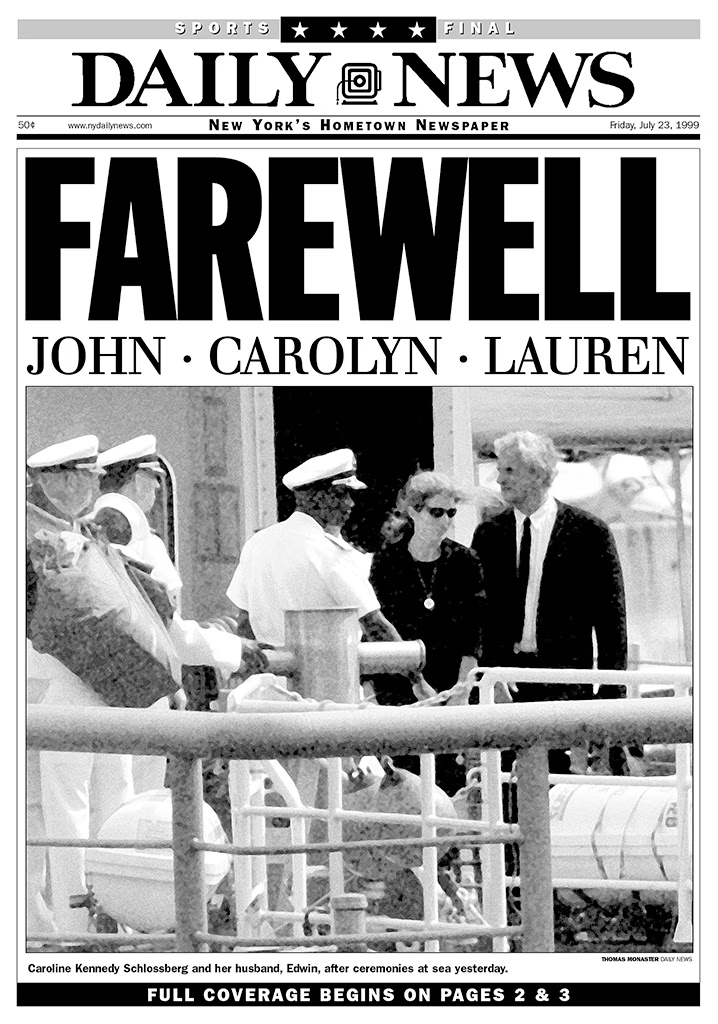
John F. Kennedy Jr. and Carolyn Bessette lived under extraordinary media scrutiny. Photographers documented nearly every public appearance. Tabloids speculated endlessly about their marriage. Rumors circulated constantly.
Many stories published during the 1990s remain impossible to verify.


Historical dramatization must therefore distinguish between documented fact and tabloid mythology. Repeating speculation without contextualization risks legitimizing gossip. The series explores celebrity obsession effectively, yet occasionally appears to rely upon the same speculative narratives it critiques.
Ironically, dramatization can perpetuate the myths it seeks to examine.


Narrative Responsibility
Historical storytellers inevitably make choices. Every omitted event and invented conversation shapes audience perception. Narrative responsibility requires asking not merely whether a scene is entertaining but whether it serves historical understanding.
Good dramatization clarifies truth. Poor dramatization obscures it.

The strongest historical dramas invent only where necessary while remaining faithful to documented character, context, and consequence. Their fictional moments illuminate reality rather than replace it. This distinction separates responsible adaptation from sensational reinterpretation.

Ethical Checklist for Historical Dramatization
1. Consent vs. Portrayal

Most historical subjects cannot approve their depiction. Many are deceased. Their families often possess little legal authority over dramatizations. Because consent is impossible, ethical responsibility increases. Creators should avoid unsupported portrayals that could substantially alter public perception.
Historical silence should not automatically become fictional certainty.
2. Fictionalization Disclosure

Simple opening disclaimers often prove inadequate. Audiences benefit from transparency regarding what has been invented. Companion documentaries, episode notes, production essays, and creator interviews explaining fictionalized elements encourage media literacy. The goal is not eliminating artistic freedom but making audiences aware of where fact ends and imagination begins.
Transparency builds trust.

3. Narrative Responsibility

Does fictionalization reveal deeper historical truth? Or merely create more exciting television? These questions should guide every adaptation. If invention clarifies emotional reality without contradicting established history, it may strengthen storytelling. If invention assigns unsupported motives or damaging behavior for dramatic effect alone, ethical concerns become much stronger.
Historical drama should challenge audiences to explore history—not replace it.

Why These Debates Matter
Some argue these discussions are unnecessary because viewers understand television is fiction. Research suggests otherwise. Popular media significantly shapes collective memory. For younger generations especially, streaming dramas often become foundational historical education.
The stories remembered decades later may owe more to screenwriters than historians.

This reality places extraordinary influence in the hands of creators. Historical entertainment contributes to cultural memory. With that influence comes responsibility. The goal should not be perfect accuracy—an impossible standard—but honest engagement with evidence. Creative freedom and ethical accountability need not be enemies.
The greatest historical dramas achieve both.

The MoviesToHistory Accuracy Meter – Love Story: John F. Kennedy Jr. & Carolyn Bessette (2026)

Historical Context
★★★★★ (5/5)
The series successfully recreates the media environment of the 1990s and captures the pressures surrounding America’s closest equivalent to royalty.

Production Design
★★★★★ (5/5)
Costuming, locations, atmosphere, and visual authenticity immerse viewers in the era.

Character Interpretation
★★★☆☆ (3/5)
Strong performances are occasionally undermined by speculative emotional narratives presented with excessive certainty.

Dramatic License
★★☆☆☆ (2/5)
Invented interpersonal conflicts and disputed portrayals create ethical concerns regarding historical representation.

Ethical Representation
★★★☆☆ (3/5)
While emotionally compelling, the series illustrates the challenges—and risks—of dramatizing private lives when documentary evidence is limited.

Overall Ethical Accuracy Score
78% — A beautifully produced historical drama that succeeds as emotional storytelling but raises important questions about where artistic interpretation ends and historical distortion begins.
Who Owns History?
Every generation retells history. Each adaptation reflects contemporary values as much as historical reality. The question is not whether dramatization should exist. It absolutely should.
Historical storytelling inspires curiosity, empathy, and cultural conversation.
The more important question is how responsibly creators wield that power. When dramatization fills evidentiary gaps with compassion and restraint, it enriches understanding. When invention reshapes reputations without support, it risks becoming distortion. The controversy surrounding Love Story reminds us that historical television does more than entertain.
It constructs memory.
And memory, once rewritten by popular culture, can endure longer than history itself. For viewers, the solution is not to avoid historical dramas but to engage with them critically. Watch the series. Enjoy the performances. Appreciate the artistry.
Then ask the essential MoviesToHistory question:
What really happened—and why does the difference matter?

Love Story: John F. Kennedy Jr. & Carolyn Bessette is available now with a subscription to Hulu…

Discover more from Movies To History.com
Subscribe to get the latest posts sent to your email.
Related Posts
‘The Hurricane’ – Official Trailer:
Rubin "Hurricane" Carter was an American-Canadian middleweight boxer, who at the height of his career and on the cusp of becoming "Champion of the World" in boxing, Carter was wrongfully convicted and imprisoned for murder…

Behind the Scenes Facts of ‘Secretariat’ (2010) – What the Movie Didn’t Show You:
When Secretariat galloped onto movie screens in 2010, audiences were swept up in the awe-inspiring true story of the 1973 Triple Crown winner and the woman behind his rise to greatness, Penny Chenery. While the…
My Top Ten Mark Wahlberg Movies:
To commemorate the Featured Film Blog of the month for September, Lone Survivor, I have gathered My Top Ten Mark Wahlberg Movies! If you're looking for the best film to watch starring Mark Wahlberg, you…