

How Wild Hearts Can’t Be Broken Explores Disability, Independence, and the Human Capacity to Adapt…
For decades, Hollywood has struggled to portray disability with nuance. Too often, disabled characters exist only to inspire others, serve as tragic figures, or demonstrate miraculous perseverance that borders on fantasy. Their stories become less about living with disability and more about restoring comfort to able-bodied audiences.

Disney’s 1991 film Wild Hearts Can’t Be Broken appears, at first glance, to follow that familiar formula. It tells the story of diving horse performer Sonora Webster, whose life changes forever after a catastrophic accident leaves her blind. The film culminates in a triumphant return to the diving platform, presenting blindness as another obstacle for a determined heroine to overcome.
Yet behind the cinematic sentimentality lies a far richer historical story.


The real Sonora Webster Carver did not simply “overcome” blindness. She adapted to it. She rebuilt her life through years of training, extraordinary resilience, and a willingness to redefine independence on her own terms. Her experience offers a fascinating lens through which to examine disability representation in early twentieth-century America and the ways Hollywood shapes public understanding of blindness.
Rather than asking whether disability can be conquered, Sonora’s life invites a more important question: what does it mean to live fully after losing sight?

Blindness in Early Twentieth-Century America
When Sonora Webster lost her vision in the 1930s, blindness carried enormous social stigma.
The United States had few legal protections for disabled individuals. There was no Americans with Disabilities Act, no guaranteed workplace accommodations, and little expectation that blind people could live independently.


Society often viewed blindness through one of two extremes. The first portrayed blind individuals as helpless dependents requiring lifelong care. The second romanticized them as possessing mystical wisdom or heightened perception.
Neither reflected reality.

Opportunities for employment were limited, educational resources varied dramatically, and accessibility infrastructure was virtually nonexistent. Navigating public spaces required creativity, confidence, and assistance from communities that were often poorly equipped to provide support.

Blind performers faced an even greater challenge.
Entertainment industries prized physical perfection and spectacle. A disabled performer was frequently viewed as unemployable.
Against this backdrop, Sonora Webster Carver’s determination to continue performing was extraordinary.
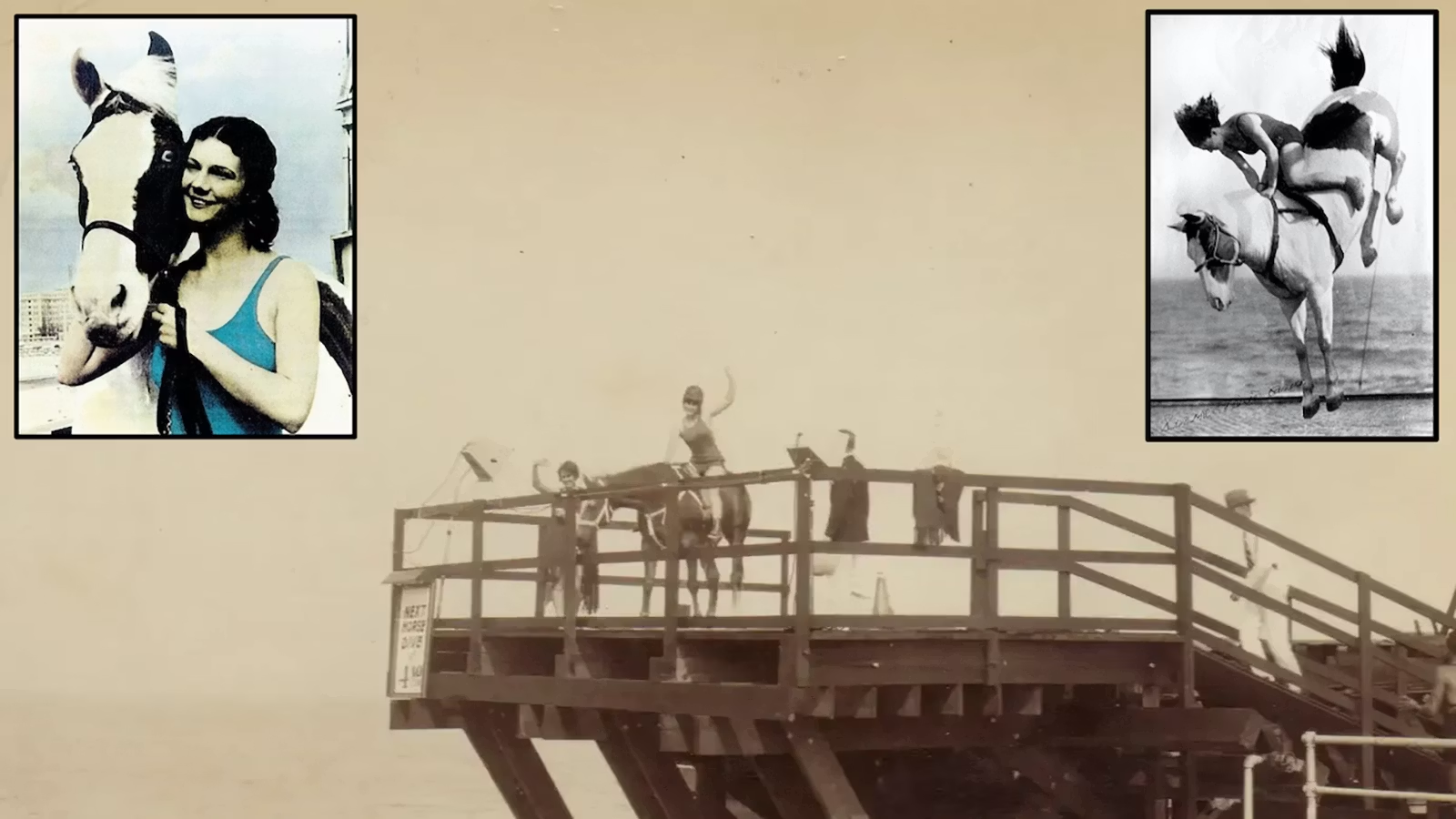
The Accident That Changed Everything
On a dive in Atlantic City, Sonora’s horse lost its balance approaching the platform. The animal entered the water at an improper angle. Instead of slicing cleanly into the pool, Sonora struck the water face-first with tremendous force.
The impact detached both retinas.

Medical treatment in the 1930s offered few options for repairing such catastrophic injuries. Despite multiple attempts to save her eyesight, Sonora became permanently blind.
For many performers, the accident would have marked the end of a career.
For Sonora, it became the beginning of an entirely different chapter.

Disney’s Version of Blindness
Wild Hearts Can’t Be Broken presents Sonora’s blindness through an emotional narrative focused on courage and determination. The audience watches her struggle with despair before reclaiming confidence and eventually returning to diving.

The emotional arc is satisfying. It is also compressed. Months of rehabilitation become minutes. Complex psychological adjustment becomes a montage.
Years of adaptation appear almost effortless.

The film understandably favors dramatic momentum over historical precision, but doing so risks simplifying the lived reality of permanent disability.
Blindness is not a single obstacle conquered through willpower. It is an ongoing process of adaptation that evolves every day.

The Reality of Learning to Live Without Sight
Historical accounts suggest Sonora spent considerable time learning new ways to navigate everyday life. Tasks that once required no thought suddenly demanded new techniques. Walking independently. Reading. Identifying objects. Managing household responsibilities. Maintaining confidence in unfamiliar environments. Rather than regaining her former life, she constructed a different one.

Modern disability scholars emphasize that adaptation is not a return to normal but the creation of a new normal. This distinction matters.

Hollywood often implies disability disappears through courage. Real resilience acknowledges disability while refusing to let it define identity.
Sonora’s experience aligns far more closely with the latter.
![After the breakup of his show Carver put together a smaller show, which featured trained animals and shooting exhibitions. His biographer wrote that Carver added the diving horse act to the show in Kansas City, Missouri, in August 1894.[4] Carver told several versions of a story describing an exciting escape from bandits, which inspired the diving horse act, but those who remembered him in Nebraska said he got the idea after plunging on horseback off a bank into a deep hole in Medicine Creek.[7] Over the next few years the other acts were eliminated, and the diving horse exhibition became Carver's primary endeavor. Included in the touring company were his son, Al, who helped train and take care of the horses, and his daughter, Lorena, said to be the first rider. By the time his future daughter-in-law, Sonora Webster, joined the show in 1924, Carver had two diving teams on the road, each performing in a different city.[](https://i0.wp.com/moviestohistory.com/wp-content/uploads/2026/05/4f3abade34479-image.jpg?resize=401%2C322&ssl=1)
Returning to the Diving Platform
Perhaps the most remarkable aspect of Sonora’s story is her decision to continue diving. Many viewers assume this was impossible. In reality, it required meticulous preparation.
Her horse understood the routine instinctively. Handlers provided auditory cues. The platform dimensions never changed.

Repeated practice allowed Sonora to memorize every movement. Success depended not on restoring vision but on trusting systems, routines, and relationships.
This illustrates a broader truth about disability adaptation.
Independence rarely means doing everything alone. It often means developing strategies that make autonomy possible.

Disability and Independence
Popular culture frequently defines independence as complete self-sufficiency. Disability studies challenge that assumption. Every person relies on networks of assistance. Families. Technology. Infrastructure. Communities.
Blind individuals simply make those systems more visible.
Sonora’s continued career depended upon collaboration between trainers, horses, assistants, and fellow performers. That dependence did not diminish her accomplishment.
It enabled it.
Recognizing interdependence provides a healthier understanding of disability than the myth of solitary heroism.

The Inspirational Trap
Films about disability often fall into what critics call “inspiration narratives.”

Disabled characters become symbols designed to motivate nondisabled audiences. Their personal struggles exist primarily to produce emotional catharsis. The individual disappears behind the lesson.

While Wild Hearts Can’t Be Broken avoids some of the more problematic tropes, it occasionally frames Sonora less as a complex woman than as an emblem of perseverance.

The historical Sonora deserves greater complexity. She experienced fear. Frustration. Adaptation. Humor. Professional ambition. Love. Grief. Confidence. Doubt.
These contradictions make her human rather than inspirational. And humanity is ultimately more compelling than symbolism.

Blindness in Hollywood History
Hollywood has long relied on blindness as shorthand for vulnerability or spiritual enlightenment. Characters suddenly become wiser after losing sight. Others exist merely to evoke sympathy.

Few portray blindness as a practical condition requiring skills and adaptation. More recent films have begun moving toward authenticity by consulting blind performers and disability advocates.

These productions recognize that disability is not solely a medical condition but also a social experience shaped by accessibility and public attitudes. Viewed today, Wild Hearts Can’t Be Broken occupies an interesting transitional space. It rejects helplessness but still leans heavily into sentimental heroism. Its intentions are admirable.
Its representation reflects the era in which it was produced.

The Horse as Partner
An often-overlooked dimension of Sonora’s post-accident career was her relationship with her horse. The animal became more than a performance partner.
It became a source of orientation and trust.

Successful dives required synchronization between horse and rider. The horse’s movement communicated timing that Sonora could no longer perceive visually. This partnership demonstrates the sophisticated ways humans adapt using senses beyond sight.

Rather than replacing vision, Sonora developed heightened awareness of rhythm, sound, balance, and spatial memory. These skills illustrate neuroplasticity and human adaptability far better than simplistic narratives of miraculous recovery.
Resilience Versus Romanticization
The difference between resilience and romanticization is subtle but significant. Resilience acknowledges hardship. Romanticization minimizes it. Resilience accepts pain while demonstrating growth. Romanticization transforms suffering into spectacle.

Disney’s version understandably favors emotional uplift. The historical record suggests a more complicated emotional journey. Sonora’s achievements become even more extraordinary when we recognize the years of adjustment hidden behind cinematic shortcuts. Her courage was not found in one climactic dive.
It emerged through countless ordinary decisions to continue living independently.

Disability as Identity
Modern disability scholarship increasingly rejects the notion that disability exists only as tragedy. Many disabled individuals describe disability as part of identity rather than merely a condition requiring correction.

Although Sonora lived decades before these conversations entered mainstream discourse, her life reflects many of these principles. She refused to disappear. She refused to abandon her profession. She refused to accept society’s assumptions about blindness.
Instead, she demonstrated that identity survives profound physical change. That lesson remains deeply relevant today.

Why Historical Context Matters
Understanding Sonora Webster Carver’s blindness requires understanding the society around her. The barriers she faced were not created solely by injury. Many were created by inaccessible environments and limited expectations.

Historical films often personalize struggle while overlooking structural obstacles. By focusing exclusively on determination, audiences may miss the social conditions that made adaptation so difficult. History reminds us that resilience exists alongside inequality. Recognizing both produces a richer and more accurate understanding of the past.

What the Film Gets Right
Despite its simplifications, Wild Hearts Can’t Be Broken succeeds in several important respects.

It portrays blindness as permanent rather than temporary. It shows Sonora retaining ambition after disability. It emphasizes emotional resilience over miraculous healing. It highlights the importance of confidence and trust.

Most importantly, it introduces audiences to a remarkable historical figure whose real life deserves greater recognition. Many viewers discover Sonora Webster Carver through the film before seeking out her autobiography and historical record.
That educational value should not be underestimated.

Final Verdict
The story of Sonora Webster Carver is not remarkable because she refused to acknowledge blindness. It is remarkable because she learned to live with it. Her achievements were built not on cinematic miracles but on discipline, adaptation, trust, and extraordinary courage.

Wild Hearts Can’t Be Broken captures the emotional truth of resilience, even if it compresses the realities of disability into a familiar Hollywood narrative. The real Sonora’s life offers a more profound lesson than the film alone can provide. Blindness did not erase her identity. It reshaped it.
And through that transformation, she demonstrated that seeing the world has never depended solely on eyesight. For historians and film lovers alike, her story stands as a reminder that the most inspiring histories are not those that deny disability, but those that reveal the extraordinary humanity found within adaptation itself.
MoviesToHistory Accuracy Meter – Wild Hearts Can’t Be Broken (1991)
Historical Context: ★★★★★ (5/5)
Representation of Blindness: ★★★★☆ (4/5)
Dramatic License: ★★☆☆☆ (2/5)
Emotional Authenticity: ★★★★★ (5/5)
Overall Historical Accuracy: 88%
While Disney streamlines Sonora Webster Carver’s journey for dramatic effect, the film succeeds in honoring the resilience of a remarkable woman whose real-life adaptation to blindness remains one of the most compelling stories in American entertainment history.

Wild Hearts Can’t Be Broken is available now with a subscription to Disney+…

Discover more from Movies To History.com
Subscribe to get the latest posts sent to your email.
Related Posts
‘Black Bird’ – Interview:
Black Bird — An Inside Look: The Story of Jimmy Keene| Apple TV+... Larry’s world is true darkness, and that's the world Jimmy enters... Taron Egerton, Paul Walter Hauser, Ray Liotta and more star in…

“Ghosts of Mississippi” (1996) – Interview:
ROB REINER; GHOSTS OF MISSISSIPPI; JAMES WOODS... Tuesday 12/24/1996 Director Rob Reiner on Ghosts of Mississippi, a film based around the events of the murder of black civil rights activist Medgar Evers; Myrlie Evers-William and…
The Controversy Surrounding ‘One Battle After Another’: The Film Everyone Is Arguing About –
When a Film Becomes a Cultural Flashpoint There are films that succeed. There are films that win awards. And then there are films that detonate — culturally, politically, and ideologically. One Battle After Another, directed…